
There are some questions that look almost too simple to ask, yet they can open a surprisingly big door of curiosity. How heavy is a bottle of water? How much does a potato weigh? What does one kilogram actually feel like when you hold it in your hand?
These little questions often come up when we are cooking, shopping, packing a bag, mailing something, or simply trying to understand the world around us.
And sometimes, a tiny newborn baby girl arrives in a family and suddenly everybody starts asking about weight in a completely different way, with grandparents carefully wondering how much their little granddaughter weighs.
Welcoming a baby girl has a funny way of making ordinary measurements feel meaningful. A number on a scale becomes part of a family story. The same is true with everyday objects.
Once you know a few familiar Weight references, it becomes much easier to imagine unfamiliar things without needing a scale nearby. A bottle, a potato, a bag of rice, or even one liter of Water can become your personal measuring reference.
This guide explores Weight, Heavy objects, Mass, Measurement, and familiar examples that make weight easier to understand.
So if you have ever wondered “how much does it weigh?” while holding something in your hand, you are in the right place. No complicated science lecture here, just useful comparisons and a few facts that might make you say, oh, that makes sense now.
| Item | Approximate Weight |
|---|---|
| Pencil | 5–10 g |
| Smartphone | 150–250 g |
| Book | 300–800 g |
| Laptop | 1 2.5 kg |
| Backpack | 2 7 kg |
| Chair | 3 10 kg |
| Microwave | 10 20 kg |
| Bicycle | 10 15 kg |
What Does “How Heavy” Actually Mean?
When people ask how heavy something is, they are usually asking about its weight.
In everyday conversation, we often use “weight” and “mass” as if they mean exactly the same thing, and honestly, for ordinary shopping and household tasks that usually works fine. Scientifically, however, Mass and weight are different concepts.
Mass describes how much matter an object contains, while weight is the force caused by gravity acting on that mass. The distinction sounds grander than it feels in the kitchen, though.
If someone asks you about the Weight of a bag of flour, they generally want to know the number shown on the scale.
A Unit of measurement gives us a standard way to describe that amount. In most countries, the Metric system makes this particularly straightforward because grams and Kilograms are used for many solid objects, while Liters are commonly used to describe liquid Volume.
It gives people a shared language for talking about size and weight without everybody inventing their own system.
That is why learning a handful of familiar references can be so useful. Once you know what one kilogram feels like, you can start making a reasonable weight comparison with other objects, even before you reach for a scale.
How Heavy Is 1 Liter of Water?
One of the easiest references to remember is 1 liter of water. Under ordinary conditions, a liter of water has a mass of approximately one kilogram.
This makes water a wonderfully convenient everyday reference because most people have handled a one-liter bottle at some point.
So, if you ask, “how heavy is 1 liter?” the simple answer is approximately 1 kilogram when we’re talking about water.
The exact relationship can vary slightly with temperature and conditions, but for normal household purposes, one liter of water is about one kilogram. That’s close enough for most everyday Weight measurement needs.
A full one-liter bottle therefore gives you a handy physical reference. Pick it up with one hand and remember the feeling. That sensation can become your mental measuring stick for other objects.
Here are some simple comparisons:
- One liter of water weighs about 1 kilogram.
- A 500 mL bottle of water weighs roughly 0.5 kilogram, plus the bottle itself.
- Two liters of water weigh roughly 2 kilograms.
- Five liters of water weigh roughly 5 kilograms.
- Ten liters of water are roughly equivalent to 10 kilograms.
This relationship is one reason water is often used when explaining weight facts to children. It is familiar, visible, and easy to handle, although very young children should obviously not be asked to lift heavy containers.
How Heavy Is 1 Kilogram?
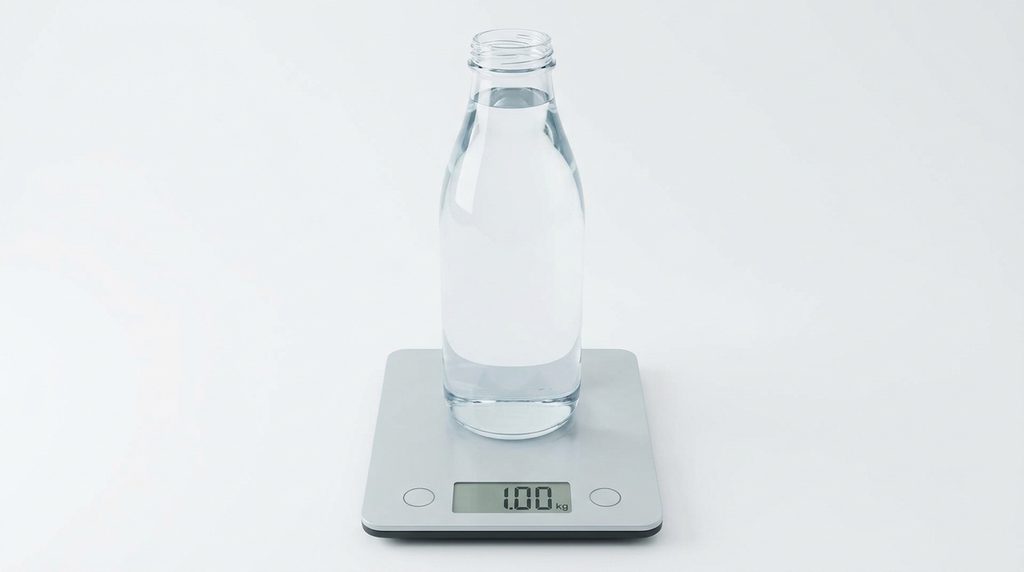
So, how heavy is 1 kilogram in real life?
A kilogram is not extremely heavy, but it is certainly noticeable when you hold it. Think about a full one-liter bottle of water.
That’s one of the simplest common weight references for approximately one kilogram. A medium-sized bag of certain foods may also approach this amount, depending on its contents.
A kilogram contains 1,000 grams. That makes grams useful for lighter things, while kilograms become more convenient as objects get heavier. A few spices might be measured in grams, a bag of rice in kilograms, and a truck in much larger quantities.
If you’re trying to develop a better feeling for weight, don’t just memorize the number. Connect it to objects you actually use. A number like “1 kg” can feel abstract, while holding a one-liter bottle makes the idea suddenly much more real.
Some familiar examples around one kilogram may include:
- A liter of water is approximately 1 kilogram.
- Some medium-sized food packages can weigh around 1 kilogram.
- A collection of several smaller household objects may add up to 1 kilogram.
- A substantial book collection can reach 1 kilogram surprisingly quickly.
- Some kitchen ingredients are sold in convenient 1-kilogram packages.
The exact weight of an object always depends on the object itself, so these are references rather than strict rules. A one liter container filled with something other than water could be much lighter or heavier, which is where volume and weight start becoming interesting.
Weight of One Liter Water: Why It Makes a Great Reference
The weight of one liter water is often used as a simple mental shortcut because water has a density close to one kilogram per liter under standard conditions. This doesn’t mean every liquid follows the same rule, though, and that’s an important little detail.
For example, one liter of oil usually weighs less than one liter of water because oil has a lower density. A liter of another liquid may weigh more. So saying “one liter equals one kilogram” is not universally correct. It is mainly a useful approximation for water.
This is also why kilogram vs liter can sometimes confuse people. A kilogram measures mass, while a liter measures volume. They aren’t interchangeable units. You can have one liter of different materials and get different weights.
Imagine three one-liter containers:
- One contains water.
- One contains cooking oil.
- One contains another liquid with greater density.
All three containers have the same Volume, but their weights can be different. Same space, different mass. That’s a neat little science lesson hiding in your kitchen cabinet.
How Heavy Is a Potato?
Potatoes are another surprisingly useful everyday reference, especially because their sizes vary so much. Asking about potato weight doesn’t have one fixed answer because potatoes can be tiny, medium, large, or those enormous ones that look like they have been training for a bodybuilding competition.
A small potato may weigh only a few dozen grams, while a large potato can weigh several hundred grams. Because of this variation, a potato should be treated as a rough reference rather than a precise unit of measurement.
Still, potatoes can help you understand the difference between grams and kilograms. If you have a bag containing several potatoes, the total can quickly move into kilogram territory.
For example:
- A small potato may be around 50 100 grams.
- A medium potato may be around 150 200 grams.
- A large potato can reach several hundred grams.
- Several potatoes together can easily make 1 kilogram of potatoes.
So when somebody asks about the weight of one kilo potato, they’re really asking about a collection of potatoes whose combined mass reaches one kilogram. The number of potatoes depends on their individual sizes, which is why there isn’t one universal count.
1 Kilogram of Potatoes as a Weight Comparison
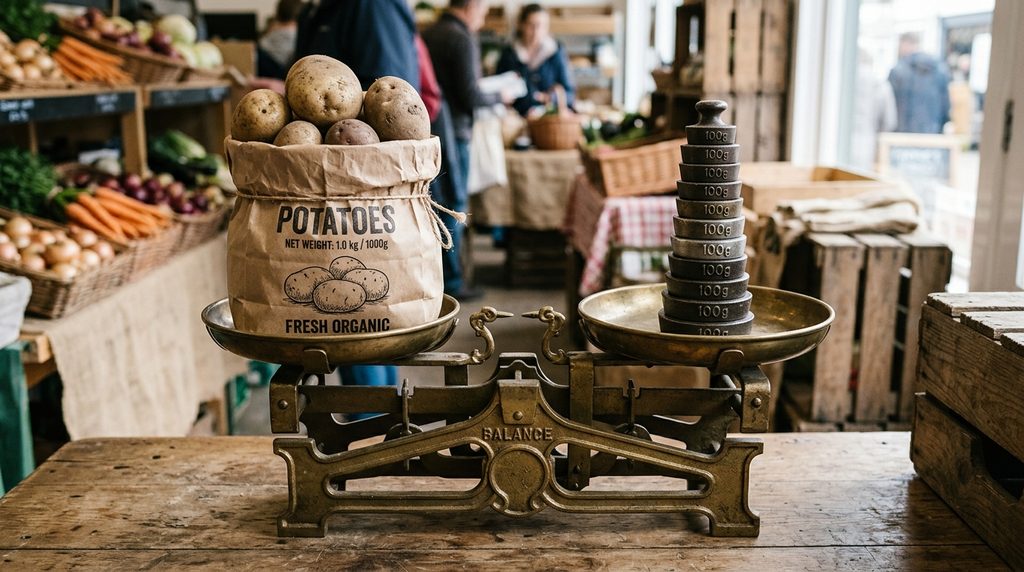
A bag containing 1 kilogram of potatoes is a particularly useful real-life comparison because it gives you something tangible to hold. You can compare it with a liter of water and notice that both are around the same total mass, even though their shapes, textures, and volumes are quite different.
This is a good example of everyday weight comparisons. You don’t need a laboratory scale to understand the basic idea. Your hands can become a rough reference, although they won’t replace an actual measuring device when precision matters.
Imagine carrying a one-kilogram bag of potatoes from the market. Now imagine carrying five such bags. Suddenly you’re carrying around five kilograms. Ten bags would be ten kilograms, and that starts feeling considerably different.
This is how weight comparison becomes easier. Instead of thinking only in numbers, connect the numbers with familiar experiences. A kilogram is not just “1” on a scale; it can be a bottle, a food package, or a small collection of everyday objects.
Weight References You Can Find Around the House
Your home is basically a museum of accidental measuring tools. You just may not have noticed them. Bottles, food packages, books, kitchen ingredients, and household supplies all provide useful Weight references.
A few examples include:
- A small bottle of water can represent a few hundred grams.
- A one-liter water bottle provides an approximate 1 kilogram reference.
- A food packet labeled 500 g represents half a kilogram.
- A 2-liter water container represents roughly 2 kilograms of water.
- A bag of rice labeled 5 kg gives a very obvious 5-kilogram reference.
- Several books together can demonstrate how quickly small weights add up.
- A grocery bag becomes heavier as individual items accumulate.
The important part is not memorizing every object. Instead, build a little collection of references in your mind. Once you have several, understanding weight becomes much easier.
How Heavy Everyday Objects Can Feel Different
Two objects can have the same weight and still feel completely different to carry. This happens because shape, size, balance, and how the object is held all affect our perception.
A compact one-kilogram object may feel more difficult to hold in one hand than a larger object of the same mass with a comfortable handle. A wide object might be awkward, while a small object can be easy to grip. So your sense of how heavy something feels isn’t always identical to its measured weight.
This matters in practical situations. When moving furniture, packing luggage, carrying groceries, or lifting boxes, shape and balance can influence the experience. The scale tells you the measurement, but your hands tell you how that measurement behaves in the real world.
That little difference between measurement and experience is why real-life weight examples are often more memorable than a list of numbers.
Kilograms and Liters: Are They the Same Thing?
No, and this is one of the most common misunderstandings about everyday measurements.
Kilograms and Liters describe different things. A kilogram is generally used to express mass, while a liter measures volume. The reason people sometimes connect them is because one liter of water weighs approximately one kilogram.
But if you fill a one-liter container with another substance, its weight can change.
Think of it this way: a liter tells you how much space something occupies. A kilogram tells you how much mass is present. The relationship between them depends on the substance’s density.
So the phrase liter to kilogram comparison only makes sense when you also know what material is being measured. Water provides a convenient example, but it should not be treated as a universal conversion.
Understanding Mass and Weight in Simple Terms
The words mass and weight often appear together, but they describe different scientific ideas. Mass is related to the amount of matter in an object. Weight depends on gravity.
On Earth, this distinction isn’t something most people need to worry about when buying groceries. A shopkeeper isn’t going to stop halfway through weighing potatoes and announce that gravity has entered the discussion. Still, understanding the difference helps explain why scientists use the terms carefully.
For everyday life, the practical lesson is simple: when you see kilograms on a food package, you are looking at a measure of mass. When you ask “how heavy is it?” you’re usually describing how much force it takes to hold or move that object under Earth’s gravity.
That is enough science for most shopping trips, and honestly, it makes the whole topic less confusing.
Interesting Weight Facts for Everyday Curiosity
Some interesting weight facts become much easier to remember when they’re connected to ordinary things.
- Water provides one of the simplest references because 1 liter is approximately 1 kilogram.
- 1 kilogram equals 1,000 grams.
- The same volume of different substances can have different weights.
- A liter measures volume rather than mass.
- Potatoes can vary widely in individual weight.
- A collection of small objects can quickly become surprisingly heavy.
- Packaging adds a little extra weight beyond the contents.
- The shape of an object can change how heavy it feels without changing its actual mass.
These facts may sound simple, but they form the foundation for measuring weight in daily life. Once you understand them, shopping labels, recipes, shipping information, and household measurements become much easier to interpret.
Why Weight Matters When Welcoming a Baby Girl

Weight has a more emotional meaning when a new baby enters the family. A newborn’s weight may become one of those first numbers everyone remembers, right alongside the baby’s name and birth date.
A grandmother might proudly say, “She was so tiny,” while a parent remembers how carefully the nurse announced the baby’s measurements. The number itself is only one small part of the story, but families often hold onto it because it marks the beginning of a new chapter.
When writing a baby girl congratulations message, you don’t have to focus on measurements.
The more meaningful approach is to celebrate the little person behind the number. A newborn is not a statistic on a chart. She’s a new member of the family, bringing new routines, new hopes, and probably a surprising amount of lost sleep.
You might write:
- “Congratulations on welcoming your beautiful daughter. May her little life be filled with enormous love.”
- “A tiny new arrival has brought a giant amount of happiness into your home. Congratulations!”
- “Wishing your family endless cuddles, peaceful moments, and wonderful memories with your baby girl.”
- “May your daughter’s first days be surrounded by love, laughter, and the gentle care of everyone who adores her.”
- “Congratulations on your precious little girl. Her arrival has made your family’s story even more beautiful.”
- “Sending newborn blessings to your family as you begin this amazing new chapter together.”
- “May your baby girl grow surrounded by kindness, courage, laughter, and people who always believe in her.”
These messages work because they celebrate the family rather than turning the baby’s arrival into a collection of measurements. And really, that’s what matters most.
How to Write a Custom Message About a New Daughter
A personal message doesn’t need to sound poetic. Sometimes the simplest sentence feels the most genuine. Mention the baby’s name if it is appropriate, refer to the parents directly, and add one detail that makes the message yours.
For example, instead of writing only “Congratulations on your baby girl,” you could say something about the family’s new chapter. A cousin might make the message playful, while a grandparent may naturally choose warmer and more sentimental words.
You can also combine a practical observation with emotion. Something like, “She’s tiny, but she has already filled the whole house with happiness,” has a simple charm to it. It doesn’t sound like a greeting-card factory wrote it at 3 a.m., which is probably a good thing.
The best welcoming a daughter messages often sound like something you would actually say aloud. Don’t worry if the sentence isn’t perfectly polished. A little personality is usually better than perfect grammar.
Creative Ways to Deliver Your Wishes
A heartfelt message doesn’t always have to arrive as a plain text. You can write it inside a card, send a short voice message, add it to a family photograph, or include it with a small gift.
For a grandparent, a handwritten card can become a keepsake. For a close friend, a funny message might fit better. In some families, relatives gather for a meal or small celebration, while others simply send blessings and congratulations from wherever they happen to be.
Cultural traditions also vary widely. Some families celebrate with special meals, prayers, naming ceremonies, gifts, or gatherings with relatives.
Others prefer a quiet introduction to the newest member of the family. There isn’t one correct way to celebrate a baby girl’s arrival. The meaningful part is showing love and support in a way that fits the family.
A Quick Weight Reference Guide
When you need a simple weight reference guide, keep these relationships in mind:
| Reference | Approximate Amount |
|---|---|
| 1,000 grams | 1 kilogram |
| 1 kilogram | 1,000 grams |
| 1 liter of water | About 1 kilogram |
| 500 mL of water | About 0.5 kilogram |
| 2 liters of water | About 2 kilograms |
| 5 liters of water | About 5 kilograms |
| 1 kilogram of potatoes | Total weight of the potatoes |
These are useful everyday approximations rather than precision laboratory measurements. Temperature, density, packaging, and the exact substance can all affect the result. Still, they provide a solid starting point for everyday weight measurement.
The Easiest Way to Remember Weight
If numbers don’t stick in your head, attach them to physical objects. Remember one-liter water bottles. Remember a kilogram bag of food. Remember what a half-liter bottle feels like compared with a full one.
Soon, you start developing an internal sense of weight. You pick up a package and think, “That feels like about a kilo,” or you see a large container and immediately understand that it is probably several kilograms when full.
This is much more useful than memorizing dozens of conversions. Comparing weights becomes a practical skill instead of a maths exercise.
And if you get the estimate wrong sometimes, that’s perfectly normal. Human hands are not precision scales. That’s what scales are for, after all.
Frequently Asked Questions
How Heavy Is an Average Object?
The weight of an object depends on its size, material, and shape. Everyday objects can range from a few grams to several kilograms.
How Can I Find Out How Heavy Something Is?
You can use a weighing scale to get an accurate measurement. For rough estimates, compare the object with something of a known weight.
What Is the Difference Between Weight and Mass?
Mass measures how much matter an object contains, while weight refers to the force of gravity acting on that mass.
How Heavy Are Common Household Items?
Common household items vary widely in weight. For example, a book may weigh less than a kilogram, while furniture can weigh much more.
Why Is Knowing How Heavy Something Is Important?
Knowing an object’s weight helps with lifting, shipping, storage, transportation, and choosing the right equipment.
Read This Blog:https://ravonexium.com/how-long-is-13-inches/
Final Thoughts on How Heavy Things Really Are
The question how heavy may look tiny, but it connects everyday life with science in a surprisingly friendly way. Water bottles, potatoes, groceries, books, packages, and household supplies all give us familiar ways to understand weight without making the subject feel complicated.
The most useful reference is perhaps the simplest one: one liter of water is approximately one kilogram. From there, you can build a whole mental library of common weight references, from half-kilogram packages to several-kilogram bags of groceries.
At the same time, remember that kilograms and liters are not interchangeable. One describes mass, while the other describes volume, and different substances behave differently. That small distinction can save you from plenty of confusing weight comparisons.
And then there is the sweeter side of measurement. When a baby girl joins a family, a number on a scale may become a treasured memory, but it will never describe the full size of the happiness she brings.
Her first tiny moments may be measured in grams, liters of milk, hours of sleep, and countless photographs, but love has never needed a unit of measurement.
So whether you’re trying to figure out the weight of one kilo potato, wondering how heavy is 1 liter, comparing everyday objects, or simply searching for a better way to understand measurements, start with what you already know. Hold a bottle of water. Pick up a bag of potatoes. Notice the difference.
Sometimes the easiest way to understand a number is to let your hands meet it.