
A soccer field can look wonderfully simple from the stands: green grass, four corners, two goals, and a bunch of white lines quietly waiting for the match to become dramatic.
Yet when you actually stop and measure it, the soccer field dimensions become a small world of their own. Every line, arc, box, and distance has a reason, and honestly, some of these measurements are easier to forget than your favorite player’s jersey number.
There is also something unexpectedly beautiful about a field prepared for a big occasion. It reminds me of the excitement people feel when a family welcomes a baby girl into the world: everything is measured, prepared, decorated, and waiting for a brand new story to begin.
A football pitch has its own kind of anticipation too. Before the whistle, it is just an empty rectangle. Then suddenly, it becomes a place for memories.
If you’re wondering how big is a soccer field, the answer isn’t one single number. The Laws of the Game, maintained by the International Football Association Board (IFAB), permit a range of dimensions.
For international matches, the permitted range is narrower. FIFA, meanwhile, recommends a 105 × 68 meter field of play for stadium design.
| Feature | Standard Soccer Field Dimensions |
|---|---|
| Length | 90 120 m |
| Width | 45 90 m |
| International Length | 100 110 m |
| International Width | 64 75 m |
| Goal Size | 7.32 × 2.44 m |
| Penalty Area | 16.5 m from goal line |
| Center Circle Radius | 9.15 m |
| Corner Arc Radius | 1 m |
What Are the Official Soccer Field Dimensions?
The basic soccer field dimensions are defined in Law 1 of the Laws of the Game. The playing surface must be rectangular, with the longer boundaries called touchlines and the shorter boundaries called goal lines.
Under the current IFAB rules, a general field of play can measure:
- Field length: 90 120 meters, or 100 130 yards
- Field width: 45 90 meters, or 50 100 yards
For international matches, the permitted dimensions become:
- International pitch length: 100 110 meters, or 110 120 yards
- International pitch width: 64 75 meters, or 70 80 yards
That means the phrase standard soccer field size doesn’t describe one universal rectangle. Competitions can determine the exact dimensions within the permitted ranges.
This is one of those football facts that seems tiny until you actually need to build or mark a field. Suddenly, “just make it regulation” becomes a much bigger sentence than expected.
FIFA Soccer Field Dimensions and the 105 × 68 Meter Standard
When people search for FIFA soccer field dimensions, they are often looking for the familiar 105 × 68 meters measurement.
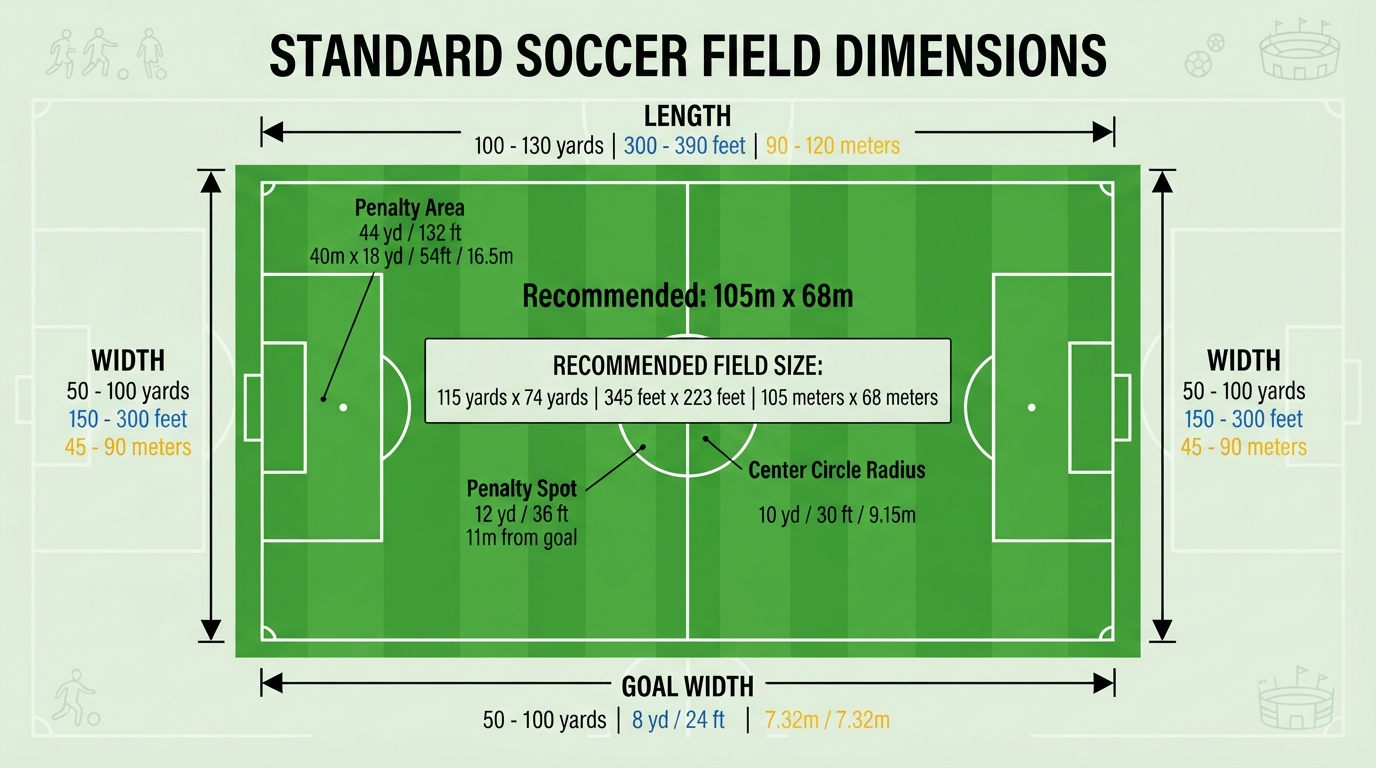
FIFA’s stadium guidance recommends a 105 × 68 meter field of play. That equals approximately 114.8 × 74.4 yards, or about 344.5 × 223.1 feet. It is a widely used reference for professional stadium planning and major competitions.
So, there is an important distinction:
- IFAB establishes the permitted dimensions under the Laws of the Game.
- FIFA provides stadium and competition guidance, including the recommended 105 × 68 meter pitch.
- A specific competition can establish requirements that fit within the applicable rules.
This distinction matters because saying every legal soccer field must be exactly 105 × 68 meters would be misleading.
Soccer Field Size in Feet, Yards, and Meters
People measure football pitches differently depending on where they live, which is why having all three systems nearby is handy.
For the FIFA-recommended 105 × 68 meter field:
| Measurement | Approximate size |
|---|---|
| Length | 105 meters |
| Width | 68 meters |
| Length in yards | 114.8 yards |
| Width in yards | 74.4 yards |
| Length in feet | 344.5 feet |
| Width in feet | 223.1 feet |
| Playing area | 7,140 m² |
| Playing area in square yards | about 8,540 sq yd |
The IFAB international range is broader: 110 120 yards long and 70–80 yards wide. So when someone says an international soccer field is always 110 by 70 yards, that’s a simplification rather than the complete rule.
Soccer Field Layout: Understanding the Lines
The soccer field layout is not random decoration. Those white lines divide the pitch into areas that influence restarts, penalties, positioning, and the referee’s decisions.
A proper soccer pitch layout includes:
- Touchlines
- Goal lines
- Halfway line
- Centre spot
- Centre circle
- Penalty areas
- Goal areas
- Penalty spots
- Penalty arcs
- Corner arcs
- Corner flags
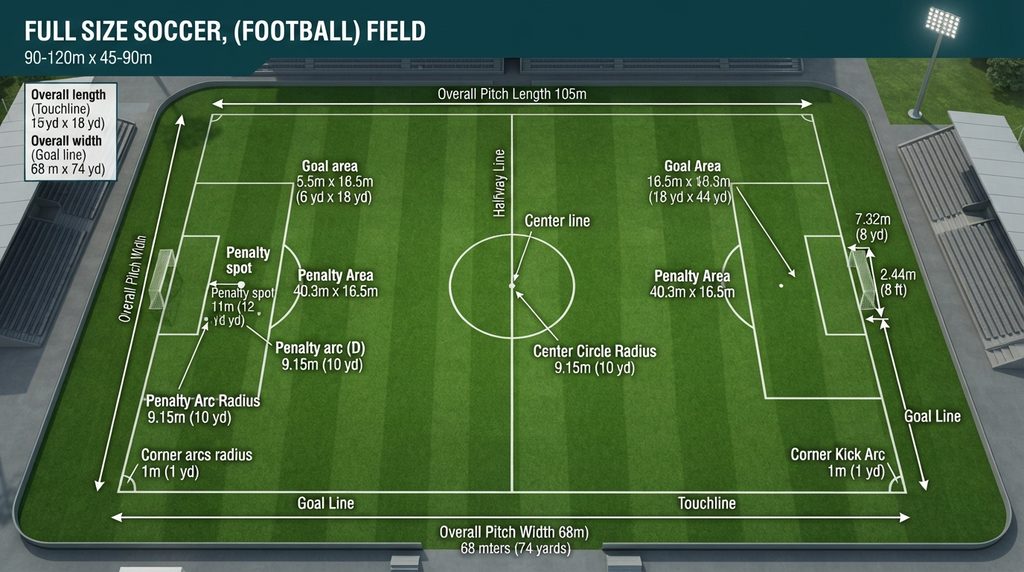
The two longer boundary lines are called touchlines, while the shorter boundaries are the goal lines. A halfway line connects the midpoints of the two touchlines, splitting the field into two equal halves.
The centre mark sits at the midpoint of the halfway line. Around it is the centre circle, which has a radius of 9.15 meters, or 10 yards.
And yes, that circle really is 10 yards. Football loves its yards almost as much as it loves unnecessary last-minute drama.
Soccer Field Markings and Their Measurements
The soccer field markings have specific purposes, and their dimensions are tied directly to the Laws of the Game.
The centre circle has a radius of 9.15 meters. The penalty mark is 11 meters, or 12 yards, from the midpoint between the goalposts. Field lines themselves must not exceed 12 centimeters, or 5 inches, in width.
The major markings include:
- Centre spot: Starting point for kick-offs.
- Centre circle: 9.15 m radius.
- Halfway line: Divides the pitch into two halves.
- Touchlines: Long boundaries running along each side.
- Goal lines: Short boundaries containing the goals.
- Penalty spot: 11 m from the goal line.
- Corner arcs: Define the area used for corner kicks.
- Penalty arcs: Curved markings outside each penalty area.
- Field boundary lines: Define the limits of play.
The lines are measured as part of the areas they enclose, which is a surprisingly important detail when accurate field marking is being done.
Penalty Area and the 18 Yard Box
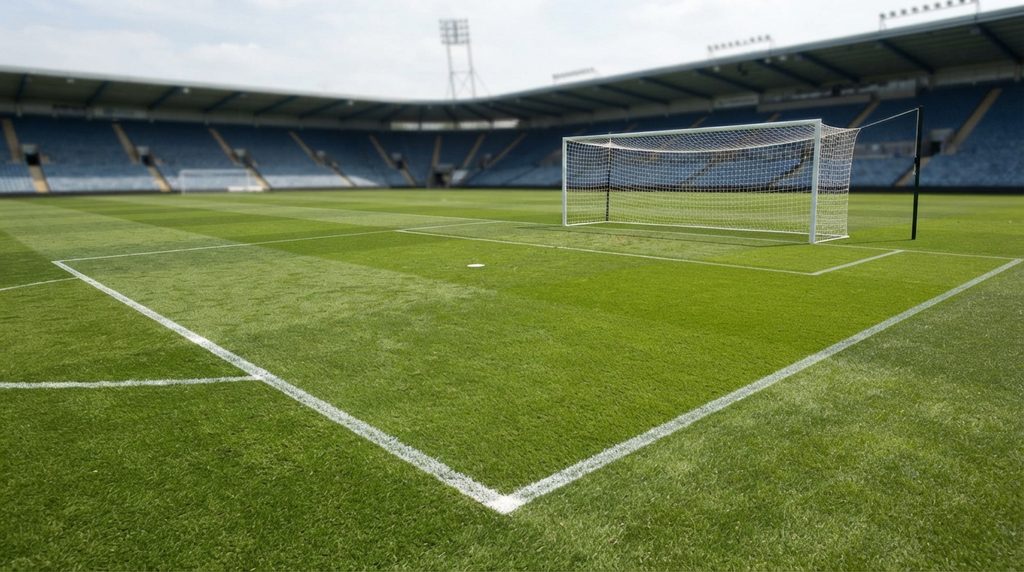
The penalty area, often called the 18-yard box, is one of the most recognizable parts of a football pitch.
Two lines are drawn perpendicular to the goal line, 16.5 meters or 18 yards from the inside of each goalpost. These lines extend 16.5 meters into the field and connect with another line parallel to the goal line.
Inside this area you’ll find the penalty spot, located 11 meters or 12 yards from the midpoint between the goalposts.
The penalty area is important because it is the zone in which the goalkeeper has special handling privileges, and certain fouls by the defending team can result in a penalty kick.
That tiny white spot therefore carries a slightly ridiculous amount of emotional weight. One kick, thousands of eyes, and suddenly everybody becomes very interested in geometry.
Goal Area and the Six-Yard Box
Inside the penalty area is the goal area, commonly called the six-yard box.
The goal area is created using lines positioned 5.5 meters, or 6 yards, from the inside of each goalpost. These lines extend 5.5 meters into the field before being joined by another line parallel to the goal line.
The six-yard box is associated with goal kicks and several situations occurring close to the goal. It is smaller than the 18-yard box, creating a clear visual hierarchy around the goal.
Think of the two boxes like nested rectangles: one large defensive zone and one smaller zone tucked inside it.
FIFA Goal Dimensions: How Big Is a Soccer Goal?
The pitch would be a very lonely rectangle without a goal at each end.
A standard adult soccer goal has internal dimensions of:
- Goal width: 7.32 meters, or 8 yards
- Goal height: 2.44 meters, or 8 feet
That is why you’ll often see the phrases 24-foot goal, 8-foot goal, 7.32-meter goal, and 2.44-meter goal used when discussing a regulation soccer goal.
The goal consists of two upright goalposts connected by a horizontal crossbar, with a net attached behind the frame. IFAB’s Law 1 specifies the goal dimensions and construction requirements.
A youth competition may use smaller goals, though the exact size depends on its competition rules and age group.
A smaller player playing on a smaller pitch with a suitable goal can experience the game differently than a child suddenly dropped onto a full-size professional field. That’s where age-appropriate design becomes useful.
Corner Flags and Corner Areas
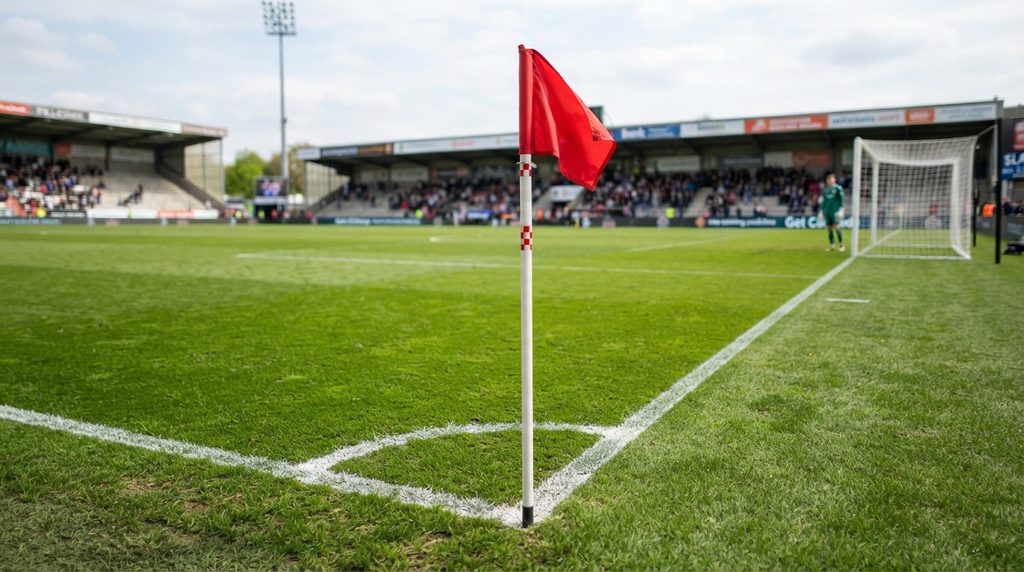
Every official pitch has four corners, and every corner has a corner flag or flagpost.
Under Law 1, flagposts must be at least 1.5 meters, or 5 feet, high and have a non-pointed top. A corner flag is placed at each corner of the field.
The corner arc is marked inside each corner. It has a radius of 1 meter, and the ball must be placed within this area when a corner kick is taken.
So those little flags aren’t just there to make the stadium look properly football-ish. They form part of the formal field setup.
Professional Soccer Field vs Standard Soccer Field
A professional soccer field does not necessarily have to be one exact size everywhere, because the Laws allow dimensional ranges. However, professional stadiums frequently use dimensions around the FIFA-recommended 105 × 68 meter format.
FIFA’s stadium guidance specifically identifies 105 × 68 meters as its recommended field-of-play dimensions.
The term official soccer field therefore needs context. A field can be regulation while still differing in size from another regulation field, provided it meets the requirements applicable to its competition.
That is why two stadiums can both host high-level football while not looking like somebody photocopied the exact same rectangle.
World Cup Soccer Field Dimensions
For a World Cup soccer field, the commonly referenced field-of-play dimension is 105 × 68 meters.
FIFA’s competition documentation has specified a 105-meter length and 68-meter width for fields of play at the relevant final competitions. FIFA stadium guidance also recommends those dimensions.
It is useful to distinguish the playing field from the larger surrounding area. The actual field of play is only part of the stadium pitch environment. Space is also needed around it for player safety, officials, warm-ups, equipment, photographers, and other operational needs.
For example, FIFA guidance recommends clear space beyond the field boundaries, with larger stadium configurations allowing additional distance before perimeter advertising boards.
Bundesliga Soccer Field Dimensions
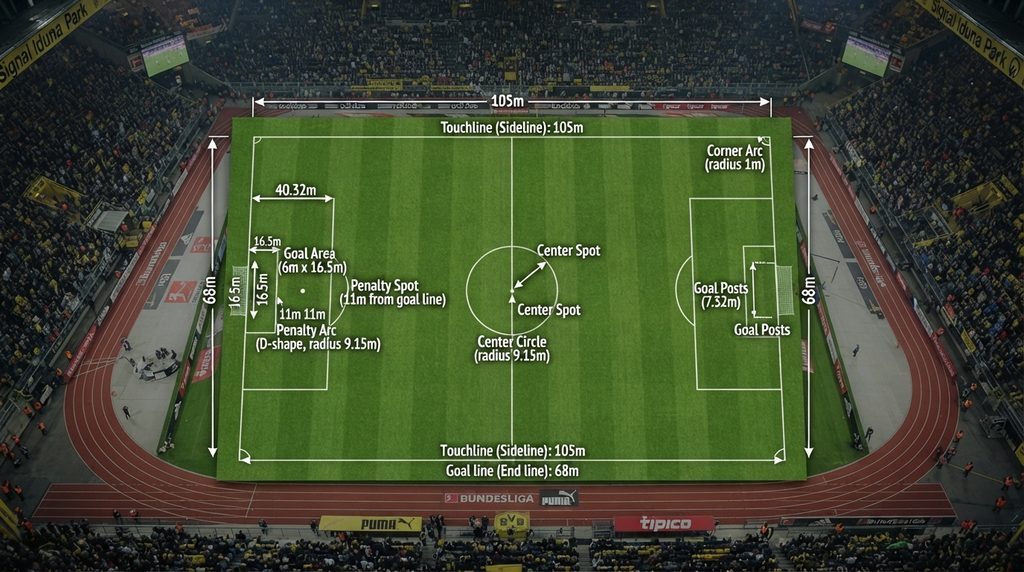
A Bundesliga soccer field is commonly associated with the 105 × 68 meter professional pitch format. This makes sense within the broader European professional-stadium landscape, where the 105 × 68 meter pitch is a familiar reference.
However, it is better to think of 105 × 68 meters as a professional standard used widely rather than claiming that every football pitch in every competition is forced into one identical measurement.
The important point is that the playing field dimensions must satisfy the rules and competition requirements governing the match.
College Soccer Field Dimensions
College soccer field dimensions can differ because competition organizations and facilities may establish their own requirements within the applicable rules.
In the United States, NCAA soccer is played under college competition regulations, while high school soccer is governed through different structures. A college field may therefore not look exactly like a World Cup pitch.
The same general components remain recognizable: touchlines, goal lines, centre circle, penalty areas, goals, and corner arcs. The football language stays familiar even when the rectangle changes slightly.
High School Soccer Field Dimensions
A high school soccer field can vary in size depending on the facility and applicable competition rules.
The NFHS, or National Federation of State High School Associations, governs many high school sports rules in the United States. School facilities also have practical constraints, including available land, shared athletic fields, and stadium design.
That means a school field shouldn’t automatically be assumed to have the same dimensions as a professional stadium pitch.
Youth Soccer Field Dimensions by Age
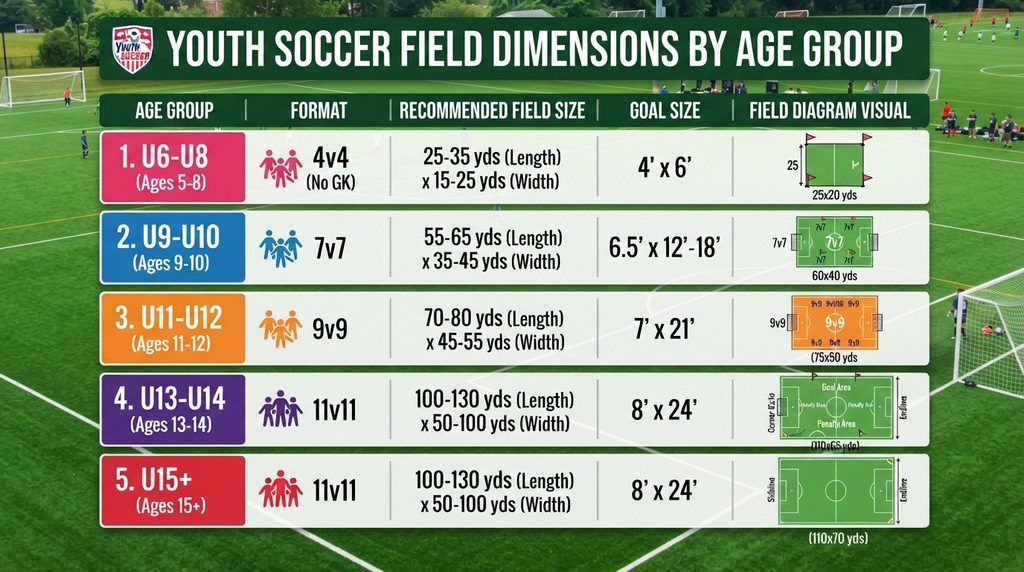
Youth football is where field size can become particularly interesting.
A youth soccer field is often reduced in size so children can spend more time involved in play rather than chasing the ball across an enormous rectangle. Age, competition structure, player ability, and development goals can all influence the setup.
Depending on the program, you may encounter formats such as:
- U6 soccer
- U8 soccer
- U12 soccer
- U13 soccer
- Small-sided children’s soccer
- Junior pitches
- Modified goals and penalty areas
Smaller fields can support development of passing, ball control, decision-making, and game understanding because the players remain closer to the action.
A full size pitch can look glorious under stadium lights, but asking very young children to cover all of it can turn the match into an energetic sightseeing tour.
Natural Grass, Artificial Turf, and Hybrid Surfaces
The dimensions tell only half the story. The playing surface matters too.
A football pitch may use:
- Natural grass
- Artificial turf
- Synthetic turf
- Hybrid grass
IFAB states that the field must be wholly natural or, where competition rules permit, wholly artificial, while hybrid systems combining natural and artificial materials can also be allowed under the applicable rules.
For certain representative and international club competition matches played on artificial surfaces, FIFA Quality Programme requirements apply unless special dispensation is given.
Surface selection can depend on climate, usage, maintenance costs, durability, weather resistance, and the level of competition.
A professional stadium with a heavily used schedule may have completely different maintenance needs from a small community field that hosts weekend matches.
Why Soccer Fields Vary in Size
So, are all soccer fields the same size? No.
The allowed variation exists for several practical reasons:
- Available land
- Stadium architecture
- Competition requirements
- Player age
- Skill level
- Playing style
- Facility budget
- Maintenance requirements
- Competition level
- Local regulations
Field width can influence how much passing space exists, while length affects the amount of vertical territory available.
A wider field can provide more room for players to spread out. A narrower field can make the playing environment feel more compressed. These aren’t just measurements on a builder’s drawing; they can shape how the game feels.
Soccer Field vs American Football Field
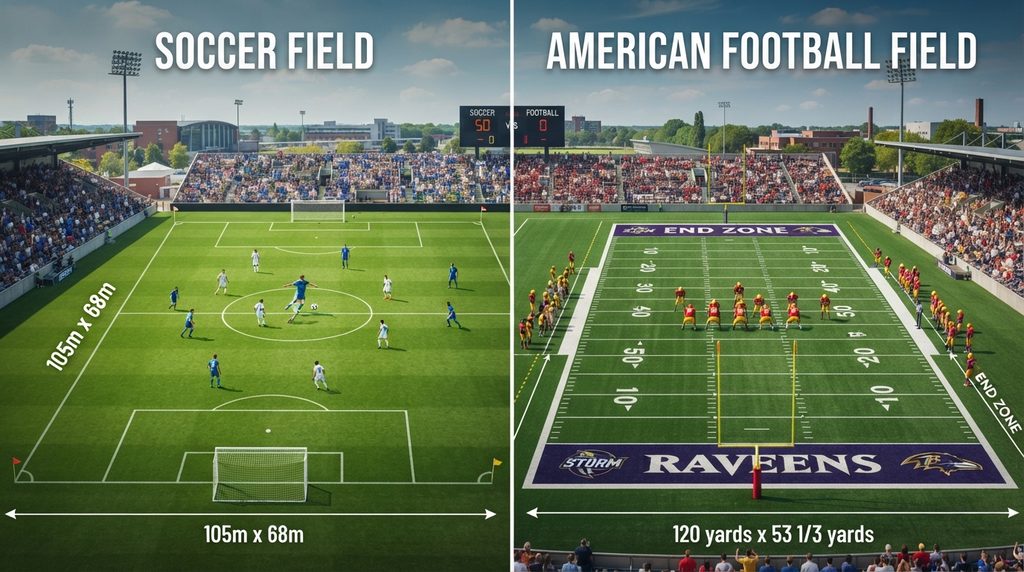
A soccer field is often compared with an American football field, but the layouts and dimensions are different.
An American football field is typically 120 yards long when the two 10-yard end zones are included, while the soccer field follows its own permitted range and rectangular proportions.
The visual difference is easy to notice. American football fields contain yard lines, hash marks, and end zones, while a soccer pitch uses a different marking system centered around the halfway line, penalty areas, centre circle, and goal areas.
So although both sports occupy large rectangular spaces, their field markings tell completely different stories.
Soccer Field vs Basketball Court and Tennis Court
Compared with a basketball court or tennis court, a soccer field is enormous.
A basketball court is compact enough that a player can travel from one end to the other in seconds. A tennis doubles court is smaller still, although those four players somehow manage to make every square meter look occupied.
A full size soccer pitch, by contrast, gives players hundreds of meters of running territory collectively. That large space is central to the sport’s tactics: passing lanes open, close, stretch, and disappear like little temporary roads.
How to Measure a Soccer Field Correctly
If you’re marking a field yourself, accuracy matters. Start by establishing a clean rectangular boundary, then identify the two touchlines and two goal lines.
After that, locate the midpoint of the field for the halfway line and centre spot. The centre circle should have its correct 9.15-meter radius.
Next, mark the penalty areas, goal areas, penalty spots, and corner arcs according to the applicable rules.
IFAB notes that measurements are taken from the outside of the lines because the lines themselves belong to the areas they bound.
This detail sounds fussy until a field is being professionally marked. Then suddenly every centimeter has a job.
A Quick Soccer Field Dimensions Reference Chart
| Feature | Official measurement/reference |
|---|---|
| General field length | 90 120 m |
| General field width | 45 90 m |
| International length | 100 110 m |
| International width | 64 75 m |
| FIFA recommended field | 105 × 68 m |
| Centre circle radius | 9.15 m |
| Penalty spot distance | 11 m |
| Penalty area depth | 16.5 m |
| Goal area depth | 5.5 m |
| Goal width | 7.32 m |
| Goal height | 2.44 m |
| Minimum flagpost height | 1.5 m |
| Maximum line width | 12 cm |
These values come primarily from current IFAB Laws of the Game and FIFA’s stadium guidance.
Frequently Asked Questions
What Are the Standard Soccer Field Dimensions?
A soccer field is generally 90–120 meters long and 45–90 meters wide.
What Are FIFA Soccer Field Dimensions?
For international matches, FIFA recommends a field length of 100–110 meters and a width of 64–75 meters.
How Big Is a Professional Soccer Field?
A common professional field is around 105 meters long and 68 meters wide.
What Is the Size of a Soccer Goal?
A standard soccer goal is 7.32 meters wide and 2.44 meters high.
Does Every Soccer Field Have the Same Dimensions?
No. Field dimensions can vary within permitted limits depending on the competition and available space.
Read This Blog:https://ravonexium.com/average-american-living-room-dimensions/
Final Thoughts on Soccer Field Dimensions
Understanding soccer field dimensions is really understanding how the sport organizes space. The pitch may appear to be nothing more than a giant green rectangle, but inside that rectangle are carefully defined zones, distances, boundaries, and reference points.
The FIFA standard pitch of 105 × 68 meters is an especially useful benchmark, particularly for professional and major-stadium planning. But the Laws of the Game allow a wider range, and international matches have their own narrower dimensional range.
From the centre spot to the penalty spot, from the six-yard box to the 18-yard box, every marking gives players and officials a shared language.
A child kicking a ball around a small youth pitch and a professional walking onto a World Cup field may be experiencing very different versions of the game, yet the underlying geometry connects them.
And maybe that’s the nicest thing about a football pitch. Like welcoming a baby girl into a family, the space is prepared before the story begins. The lines are waiting.
The goals are waiting. The crowd is waiting. Then the whistle blows, and an ordinary rectangle becomes something much bigger than its measurements.