Buying shoes sounds like one of the simplest things in the world, until a pair that looks perfect arrives at your door and somehow doesn’t fit. Maybe the toes feel cramped, the heel slips while walking, or the size you wear in one brand feels completely different in another.
It happens to lots of people, and honestly, choosing the right size shouldn’t feel like solving a mystery.
A reliable US Shoe Size Chart can make the whole process much easier. Whether you’re shopping for sneakers, running shoes, formal footwear, sandals, boots, or shoes for a growing child, understanding American shoe sizes helps you make a more informed choice.
You just need to know how to measure your feet, interpret the numbers, and account for differences between brands.
In this guide, we’ll explore the US shoe size conversion chart, men’s and women’s sizing, children’s footwear, and international size equivalents.
You’ll also learn how to measure foot length in inches and centimeters, understand shoe width, and avoid common mistakes when shopping online. A little preparation can save you from the familiar hassle of returning shoes that looked great but simply didn’t fit.
| US Men’s Size | US Women’s Size | Foot Length (Approx.) |
|---|---|---|
| 6 | 7.5 | 9.25 in |
| 7 | 8.5 | 9.625 in |
| 8 | 9.5 | 9.94 in |
| 9 | 10.5 | 10.25 in |
| 10 | 11.5 | 10.56 in |
| 11 | 12.5 | 10.94 in |
| 12 | 13.5 | 11.25 in |
| 13 | 14.5 | 11.56 in |
What Is a US Shoe Size Chart?
A US shoe size chart is a reference table that connects shoe sizes used in the United States with approximate foot measurements. Depending on the chart, it may also show equivalent sizes in the United Kingdom and Europe, helping shoppers compare different sizing systems.
The American footwear sizing system generally uses separate size scales for men’s, women’s, and children’s shoes. That distinction matters because a men’s US size and a women’s US size with the same number don’t necessarily represent the same fit or dimensions.
Another important detail is that shoe size isn’t determined by foot length alone. Foot width, the shape of the toe box, the shoe’s design, and the manufacturer’s sizing standards can all influence comfort. A chart gives you a helpful starting point, but it doesn’t replace trying on footwear when that’s possible.
Think of the chart as a map rather than an absolute promise. It points you toward a likely size, while the actual shoe determines whether your feet feel comfortable inside it.
Why Understanding US Shoe Sizes Matters
Correct sizing is about much more than finding a number that matches a label. Shoes that fit properly help you walk comfortably, move naturally, and enjoy your everyday activities without unnecessary pressure.
Here are several reasons why a dependable American shoe size chart is useful:
- Better online shopping: You can compare your measurements with a brand’s sizing information before ordering.
- International purchases: A US size reference helps when a website lists UK or European sizes instead.
- Improved comfort: The right length and width provide sufficient room for your toes.
- Fewer returns: Checking measurements beforehand can reduce the likelihood of ordering an unsuitable size.
- More confident choices: You can compare sneakers, dress shoes, boots, and other footwear more intelligently.
- Children’s footwear: Measuring growing feet helps parents reassess sizes as children develop.
A size number is only one piece of the puzzle, though. Two pairs labelled US size 9 may fit differently because manufacturers use different lasts, materials, and design proportions.
US Shoe Size Chart for Men
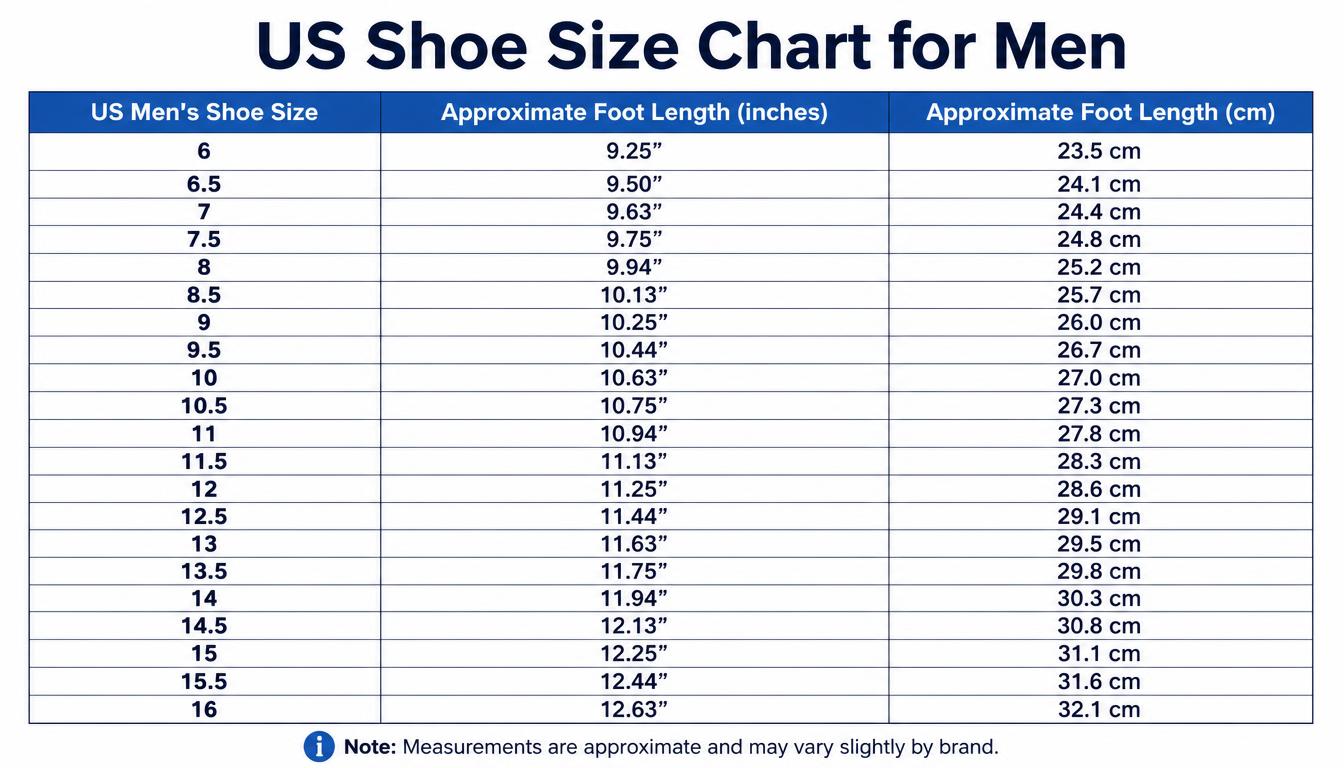
The men’s shoe size chart is useful when shopping for athletic shoes, casual sneakers, work boots, and formal footwear. Men’s US sizes are generally different from women’s sizes, even when both labels use the same number.
The following table provides approximate men’s size equivalents. Foot-length values are indicative references, not universal measurements for every brand.
| US men’s size | Approx. foot length (inches) | Approx. foot length (cm) |
|---|---|---|
| 6 | 9.25 | 23.5 |
| 7 | 9.63 | 24.4 |
| 8 | 9.94 | 25.2 |
| 9 | 10.25 | 26.0 |
| 10 | 10.56 | 26.8 |
| 11 | 10.94 | 27.8 |
| 12 | 11.25 | 28.6 |
| 13 | 11.56 | 29.4 |
| 14 | 11.88 | 30.2 |
These values are rounded approximations compiled for general guidance. Individual manufacturers may associate a particular US size with a slightly different foot-length range.
How to Use the Men’s Shoe Size Chart
Start by measuring your feet in centimeters or inches, then compare the result with the manufacturer’s size chart. If your measurement falls between two sizes, check the brand’s fitting recommendations rather than automatically choosing the larger number.
For example, someone with a foot measuring around 26 cm might begin by checking the US men’s size 9 range. However, the actual recommendation depends on the shoe model, its shape, and the sizing information supplied by the manufacturer.
Width matters too. A person with broad feet may need a wide-fit version instead of simply moving up in length. Choosing a longer shoe to compensate for width can cause the heel to slip, which isn’t exactly the comfortable fit anyone is hoping for.
US Shoe Size Chart for Women
A women’s shoe size chart helps shoppers find suitable sizes for heels, flats, trainers, boots, and everyday footwear. Women’s US sizing uses a different numerical scale from men’s sizing, so it’s important to select the correct chart before comparing measurements.
The table below shows approximate foot-length references for common women’s US sizes.
| US women’s size | Approx. foot length (inches) | Approx. foot length (cm) |
|---|---|---|
| 5 | 8.50 | 21.6 |
| 6 | 8.88 | 22.5 |
| 7 | 9.25 | 23.5 |
| 8 | 9.50 | 24.1 |
| 9 | 9.88 | 25.1 |
| 10 | 10.19 | 25.9 |
| 11 | 10.50 | 26.7 |
| 12 | 10.88 | 27.6 |
These are general estimates, not guaranteed brand-specific conversions. Some shoes may fit longer or shorter than the table suggests, and sizing can vary between styles from the same manufacturer.
Finding Your Women’s US Shoe Size
Measure your feet while standing, preferably later in the day, when your feet may be slightly larger than they were in the morning. Wear the type of socks you normally use with the shoes you’re buying, especially when shopping for trainers or boots.
Compare your longer foot’s measurement with the brand’s US women’s shoe size chart. If you’re purchasing heels or pointed-toe shoes, pay attention to the toe box as well as the length. A shoe can appear to be the right size while placing uncomfortable pressure on the front of the foot.
Remember that the number printed on your old shoes isn’t always the best guide for your next purchase. Your measurements and the manufacturer’s specific chart are usually a better starting point.
US Shoe Size Chart for Children
Children’s feet change as they grow, which makes regular measurement especially important. A pair that fitted comfortably a few months ago may no longer provide enough room, even if the shoes still look perfectly fine from the outside.
A kids’ shoe size chart can help parents compare foot length with children’s US sizes. However, children’s sizes are not simply smaller versions of adult sizes. Infant, toddler, little-kid, and big-kid ranges may follow different conventions, and the transition between them varies by brand.
| Approx. foot length (cm) | General US children’s size reference |
|---|---|
| 10.0 | Around 2C |
| 11.0 | Around 4C |
| 12.0 | Around 5C–6C |
| 13.0 | Around 7C |
| 14.0 | Around 8C–9C |
| 15.0 | Around 9C–10C |
| 16.0 | Around 10C–11C |
| 17.0 | Around 11C–12C |
| 18.0 | Around 12C–13C |
| 19.0 | Around 13C–1Y |
| 20.0 | Around 1Y–2Y |
| 21.0 | Around 2Y–3Y |
C generally indicates a child-size range, while Y indicates a youth-size range. These are approximate examples only; actual conversions depend on the brand and sizing system.
How to Choose Shoes for Growing Feet
It may be tempting to buy shoes several sizes too large so a child can wear them for longer. But overly large footwear can slip, interfere with natural movement, and make running or walking less comfortable.
Instead, measure both feet and look for a shoe that provides appropriate toe room without letting the heel slide excessively. A little extra space is sensible, but the amount should follow the manufacturer’s fitting guidance and the shoe’s design.
For younger children, check the fit regularly rather than relying on age alone. Children of the same age can have very different foot lengths, so age-based estimates are no substitute for actual measurements.
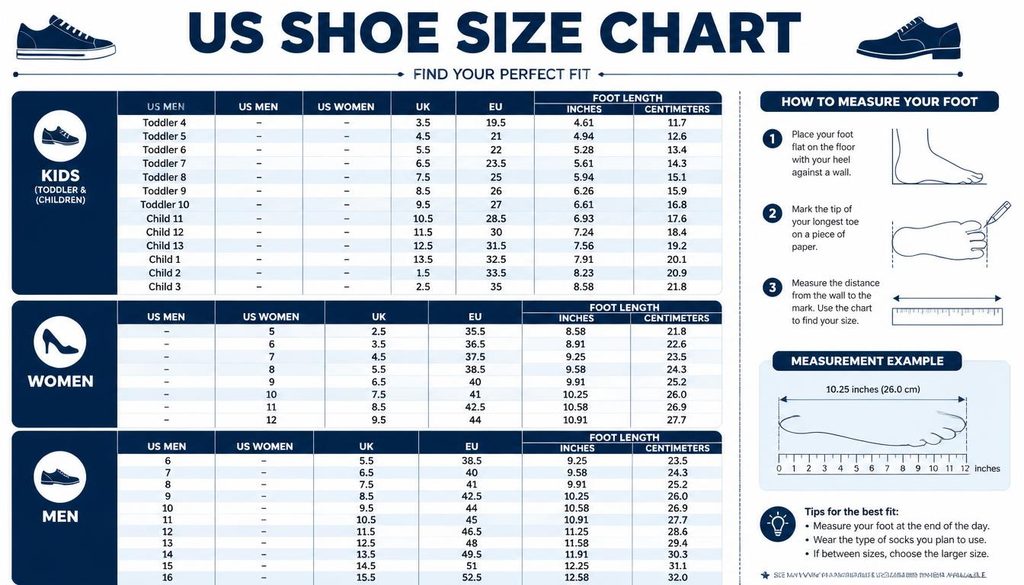
How to Measure Your Foot Size at Home
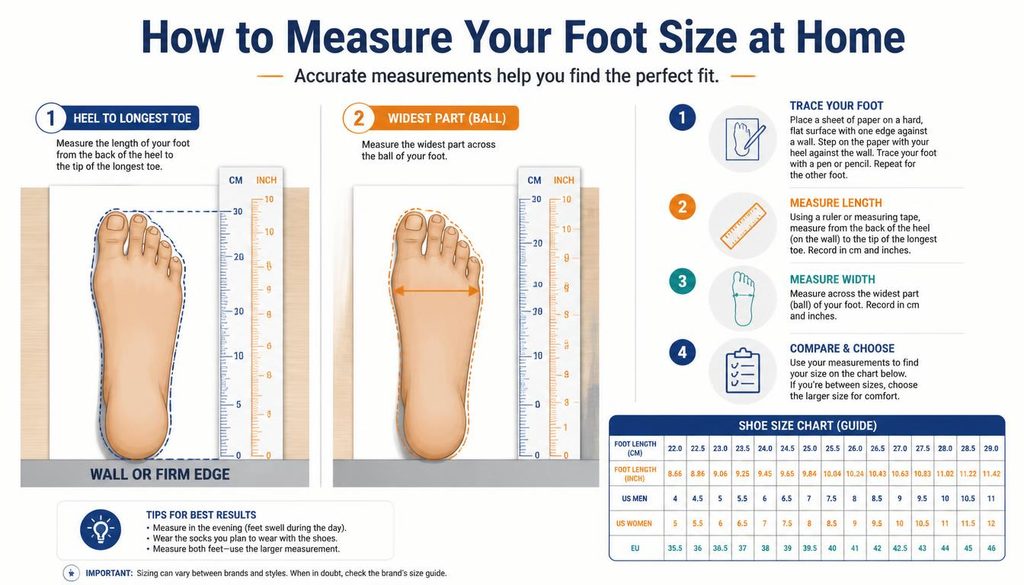
You don’t need an expensive tool to get a useful foot measurement. A sheet of paper, a pencil, a ruler, and a flat surface are usually enough to begin.
Place a sheet of paper against a wall on a hard, level floor. Have a ruler or measuring tape ready, and wear the socks you expect to use with your shoes if appropriate.
Stand naturally with your heel against the wall and your weight distributed normally. Trace around the foot carefully, keeping the pencil upright rather than angled underneath your toes.
Measure the straight-line distance from the back of the heel to the tip of the longest toe. Don’t assume your big toe is always the longest one; for some people, another toe extends further.
Measure across the widest part of the forefoot. This helps you identify whether a regular, wide, or narrow shoe may be more appropriate.
Repeat the process for the other foot and use the longer measurement when consulting the chart. If the feet differ significantly, pay attention to comfort on both sides.
Convert Foot Length Between Inches and Centimeters
The conversion is straightforward:
- 1 inch = 2.54 centimeters
- Inches to centimeters: multiply the inch measurement by 2.54.
- Centimeters to inches: divide the centimeter measurement by 2.54.
For example, a foot length of 10 inches equals 25.4 cm. A foot length of 25 cm is approximately 9.84 inches.
Keep in mind that measuring your foot is not the same as measuring the inside of a shoe. Footwear needs room for natural movement, and manufacturers may use different allowances when designing their size ranges.
US Shoe Size Conversion Chart: US to UK and EU
Shopping from an international retailer can get confusing because the same foot may be described using different sizing systems. The United States, United Kingdom, and Europe do not all use the same numbering conventions.
An international shoe size conversion chart helps you compare approximate equivalents, but it shouldn’t be treated as a universal formula. Men’s and women’s conversions may differ, and individual brands can have their own rules.
US to UK Shoe Size Conversion
US and UK shoe sizes usually differ by approximately one size in many adult ranges, but this is only a rough guide. The difference can vary according to gender, size range, and manufacturer.
| US adult size | Approx. UK equivalent |
|---|---|
| Men’s 7 | UK 6 |
| Men’s 8 | UK 7 |
| Men’s 9 | UK 8 |
| Men’s 10 | UK 9 |
| Men’s 11 | UK 10 |
| Women’s 6 | UK 4 |
| Women’s 7 | UK 5 |
| Women’s 8 | UK 6 |
| Women’s 9 | UK 7 |
| Women’s 10 | UK 8 |
These examples reflect common conversion patterns, not every brand’s official chart. Always confirm the equivalent using the manufacturer’s published sizing information.
US to European Shoe Size Conversion
European footwear sizes typically use a numerical system that differs from both US and UK sizing. EU sizes are often shown as numbers such as 38, 40, 42, and 44.
| US men’s size | Approx. EU size |
|---|---|
| 7 | 40 |
| 8 | 41 |
| 9 | 42–43 |
| 10 | 43–44 |
| 11 | 44–45 |
| 12 | 46 |
| US women’s size | Approx. EU size |
|---|---|
| 5 | 35–36 |
| 6 | 36–37 |
| 7 | 37–38 |
| 8 | 38–39 |
| 9 | 39–40 |
| 10 | 40–41 |
| 11 | 41–42 |
The ranges reflect the fact that brands don’t always agree on exact equivalents. Some European charts also use different conventions for displaying sizes, so a brand’s own conversion chart is the safest reference when ordering.
Are US and Canadian Shoe Sizes the Same?
US and Canadian shoe sizing is generally similar, and many brands use the same numerical sizes for both markets. Still, it is wise to check the label or manufacturer’s chart rather than assume every shoe sold in Canada follows precisely the same convention.
When a retailer lists separate US and Canadian sizes, follow the information provided on its website. The actual fit, width, and design of the footwear matter just as much as the number.
Understanding Shoe Width and Proper Fit
Length gets most of the attention when people shop for shoes, but width is equally important for many feet. A shoe can match your foot length perfectly and still feel uncomfortable if it squeezes the forefoot or allows too much side-to-side movement.
Some manufacturers offer narrow, standard, wide, and extra-wide options. The exact width labels and measurements vary between brands, so it’s best to use the relevant manufacturer’s width chart.
Here are a few signs worth paying attention to when assessing fit:
- Your toes should have enough room to move naturally.
- The widest part of your foot should align comfortably with the widest part of the shoe.
- Your heel should feel secure without painful rubbing.
- The upper shouldn’t squeeze your foot or create persistent pressure.
- You shouldn’t need to curl your toes to keep the shoe in place.
- The shoe should feel reasonably comfortable from the beginning rather than requiring you to tolerate significant pain.
Different shoe styles may fit differently, too. Pointed dress shoes can have less usable toe room than round-toe sneakers, while running shoes may require extra consideration for movement and swelling during activity.
A good fit is not necessarily the tightest fit. Your feet need room to function naturally.
What Is a Brannock Device?
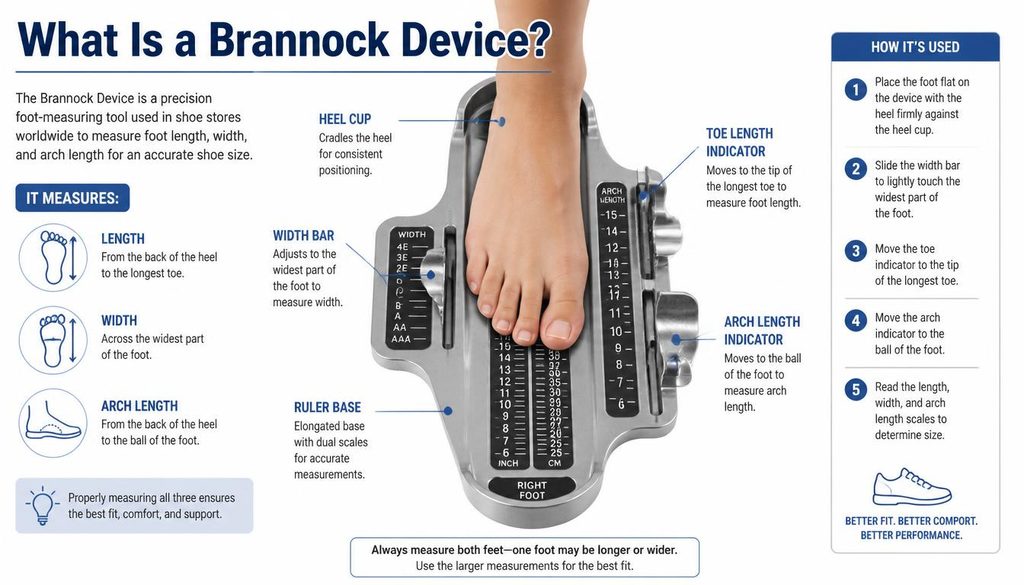
The Brannock Device is a foot-measuring instrument commonly used in shoe stores to help determine shoe size. It was developed by Charles F. Brannock and measures foot length, arch length, and foot width, offering more information than a simple ruler measurement.
Arch length is particularly useful because it considers the distance from the heel to the ball of the foot. A shoe may have sufficient overall length but still feel awkward if its internal shape doesn’t align well with your foot.
You don’t need a Brannock Device to shop successfully, of course. Home measurements can provide a helpful starting point, especially when combined with a manufacturer’s official sizing chart.
But if you struggle to find comfortable shoes, a professional fitting may help identify whether length, width, or shoe shape is the main issue.
How to Choose the Correct Shoe Size Online
Online shoe shopping offers convenience and plenty of choice, but you cannot always try a pair before buying. That’s where a thoughtful shoe fitting guide becomes useful.
Before placing an order, take a moment to check these details:
- Read the brand’s size chart: Don’t assume your usual size will fit every manufacturer.
- Check the product description: Some shoes are described as narrow, roomy, or designed for a particular foot shape.
- Read customer reviews carefully: Look for consistent comments about sizing, width, and heel fit rather than relying on one person’s experience.
- Consider the intended use: Running shoes, hiking boots, dress shoes, and sandals may require different fit considerations.
- Check the return policy: A straightforward exchange policy can make trying a new brand less stressful.
- Measure your feet again when needed: Older measurements may not accurately reflect your current foot size.
- Follow the brand’s advice for between-sizes situations: Some models run large or small, so there isn’t one rule that works for every shoe.
A shoe size calculator can also help you compare measurements with a size table. Just remember that most calculators estimate a likely size; they cannot perfectly predict how a particular shoe will fit your feet.
Common Mistakes to Avoid When Using a US Shoe Size Chart
Even a detailed chart can lead to the wrong choice if it’s used without considering the bigger picture. A few common mistakes are surprisingly easy to avoid.
Choosing Shoes Based Only on Your Old Size
Your old shoes may be from a different brand or use a different sizing convention. Start with current measurements and compare them with the specific product chart.
Measuring While Sitting Down
Your feet can spread differently when you stand and put weight on them. For a more representative measurement, stand naturally with your weight distributed across your feet.
Measuring Only One Foot
One foot is sometimes slightly longer or wider than the other. Measure both and consider the fit of the larger foot when choosing a pair.
Confusing Foot Length With Shoe Length
A foot measuring 25 cm doesn’t mean the inside of the shoe should measure exactly 25 cm. Footwear needs appropriate room for the toes and natural movement, and the required allowance varies with the shoe’s shape and purpose.
Assuming Every Brand Fits the Same
A US size 8 from one manufacturer may feel different from a US size 8 from another. Materials, construction, width, and design all influence how footwear fits.
Buying Shoes That Are Too Large for Growing Room
This is especially common when purchasing children’s footwear. Rather than moving up several sizes, measure regularly and choose a shoe with an appropriate amount of extra room according to the manufacturer’s recommendations.
A Simple Shoe Size Calculator Guide
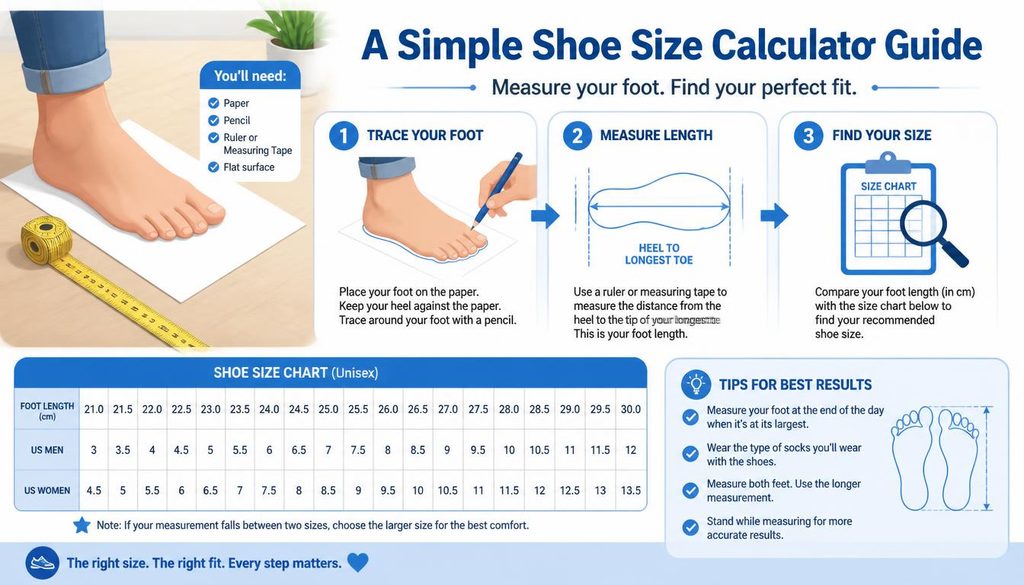
You can use the following interactive reference to convert a foot measurement between inches and centimeters. It does not replace a brand-specific shoe size chart, but it makes the measurement process easier.
Foot Measurement Converter
Enter your measured foot length to convert it into the other unit.Foot lengthMeasurement unitCentimeters (cm)Inches (in)
Converted measurement
25.00 cm
9.84 inches
Use the converted measurement with the official size chart for your chosen brand.
Tips for Buying Different Types of Footwear
Not every shoe should be fitted in exactly the same way. The intended activity, material, and construction can change what a comfortable fit feels like.
Sneakers and Everyday Shoes
For everyday sneakers, check toe room, heel security, and width. If you plan to wear thicker socks, measure or try the shoes with those socks in mind. A shoe that feels comfortable for a quick try-on should also feel stable when you walk normally.
Running Shoes
Running footwear deserves extra attention because feet can swell during longer activity. Look for a secure heel, sufficient toe room, and a fit that feels comfortable while moving. Follow the manufacturer’s fitting recommendations rather than assuming a larger size is always necessary.
Formal Shoes and Heels
Formal shoes often have different shapes from casual sneakers. Pointed toes and narrow designs may reduce the space available for your toes, even when the listed size appears correct. Choose a style that fits comfortably instead of relying on the idea that painful shoes will eventually become wearable.
Boots and Winter Footwear
Boots may be worn with thicker socks, and some designs have a different internal shape from regular shoes. Check both the length and width, along with any guidance about sock thickness or intended use. A secure fit should not mean your toes feel compressed.
Sandals and Open-Toe Shoes
With sandals, your toes and heels should generally remain within the footbed during normal movement. Straps should hold the foot securely without digging into the skin. Since sandals vary considerably in shape, their fit deserves attention even when the size number is familiar.
Frequently Asked Questions
What is a US Shoe Size Chart?
A US Shoe Size Chart helps you find the correct shoe size based on your foot length and US sizing standards.
How do I measure my foot for US shoe sizes?
Place your foot on a flat surface, measure from your heel to your longest toe, and compare the measurement with a shoe size chart.
What is the difference between US men’s and women’s shoe sizes?
US men’s and women’s shoe sizes use different sizing scales, so the same number may represent different foot lengths.
Are US shoe sizes the same for every brand?
No, shoe sizes can vary slightly between brands and styles, so always check the manufacturer’s size chart before buying.
How can I convert US shoe sizes to UK or EU sizes?
Use a US-to-UK or US-to-EU shoe size conversion chart to find the closest equivalent, as sizing systems differ by region.
Read This Blog:https://ravonexium.com/how-long-is-3-inches/
Conclusion: Find Your Best Fit With the Right US Shoe Size Chart
Finding the right shoes doesn’t have to involve guesswork, complicated conversions, or several frustrating returns.
A reliable US Shoe Size Chart gives you a useful starting point, whether you’re buying men’s sneakers, women’s formal footwear, children’s shoes, or a pair from an international retailer.
The most important habit is to measure your feet accurately and compare the results with the manufacturer’s sizing information.
Pay attention to width, toe room, heel security, and the differences between shoe styles. If your measurements fall between sizes, use the brand’s recommendations and consider how the footwear will be worn.
Above all, don’t let a number on a shoe label decide whether a pair is right for you. Comfort, fit, and suitability for your needs matter more than matching the size you wore several years ago.
If you have a useful shoe-fitting tip or a favourite method for converting US, UK, and European sizes, share it in the comments. Your experience might help another shopper find a comfortable pair without all the trial and error.