Have you ever needed to measure something small but couldn’t find a ruler anywhere? Maybe you’re checking the size of a tiny object, working on a school project, comparing the thickness of a notebook, or simply wondering how much space 2 cm actually takes up.
It’s one of those little measurements that seems obvious once you see it, but surprisingly tricky to imagine when you’re just looking at a number.
The good news is that you don’t need a measuring tool to get a reasonable idea. Everyday objects, from coins and pencils to small candies and batteries, can help you understand this short distance. Once you start noticing these familiar items, visualizing centimeters becomes much easier.
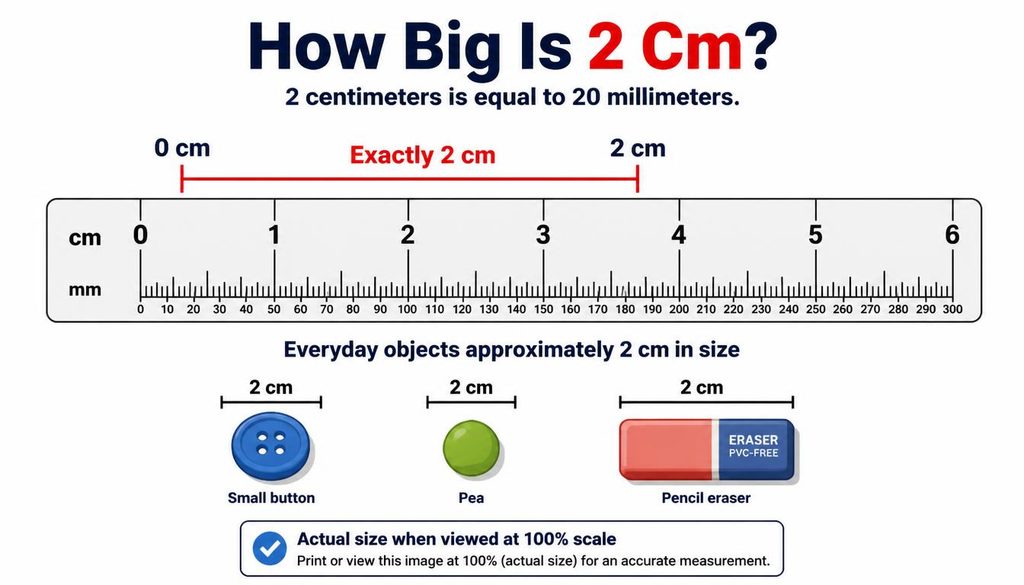
So, how big is 2 cm? Two centimeters is a short length equal to 20 millimeters, approximately 0.79 inches, or 0.02 meters. It’s slightly less than one inch, making it a useful reference when estimating the size of small objects around your home, classroom, or office.
In this guide, we’ll explore what 2 cm looks like, how to convert it into other measurement units, and which everyday objects can help you picture this length.
We’ll also explain how to estimate it without a ruler and how to avoid common measurement mistakes. By the end, that little number should feel much more familiar.
| Measurement | Equivalent |
|---|---|
| Centimeters | 2 cm |
| Millimeters | 20 mm |
| Inches | 0.79 inches |
| Meters | 0.02 meters |
| Approximate size | Slightly less than 1 inch |
| Everyday comparison | About the width of a small button |
How Big Is 2 Cm? Understanding the Basic Measurement
Before comparing this measurement with everyday objects, let’s understand what a centimeter actually represents.
A centimeter is a standard unit of length in the metric system, which is used in countries around the world for measuring everything from furniture and clothing to tiny components in electronic devices.
One centimeter equals 10 millimeters. Therefore, 2 centimeters equal 20 millimeters. If you imagine two sections, each measuring one centimeter, placed end to end, the total length is two centimeters.
Here’s a quick reference to help you understand the measurement:
| Measurement unit | Equivalent of 2 cm |
|---|---|
| Centimeters | 2 cm |
| Millimeters | 20 mm |
| Inches | Approximately 0.79 inches |
| Meters | 0.02 m |
| Feet | Approximately 0.0656 ft |
| Yards | Approximately 0.0219 yd |
These conversions are useful when reading product specifications, following craft instructions, or checking dimensions listed in different units. A product description might use millimeters, while another gives inches, but both can describe exactly the same physical length.
Remember that a length of two centimeters is not the same thing as an area of two square centimeters.
Length measures distance from one point to another, whereas area measures the surface covered by an object. It sounds like a tiny distinction, but it matters when you’re measuring paper, fabric, or small parts.
What Does 2 Cm Look Like in Real Life?
Numbers can be difficult to visualize without a familiar reference. That’s why comparing a measurement with an object you already know is often more helpful than staring at a conversion chart.
Imagine the distance between two centimeter marks on a ruler. That short section is the length we’re discussing. It’s smaller than the full width of many fingers, but it’s enough to notice when you look closely at small household items.
A US quarter has a diameter of approximately 2.426 centimeters, so its width is somewhat greater than two centimeters. This makes it a handy comparison, although the coin is not an exact match.
Another useful reference is a small stack of paper. Depending on the paper weight and binding, a thick notepad can measure around two centimeters from top to bottom.
This comparison is particularly helpful because it shows that a short measurement can also describe an object’s thickness rather than its length.
You can also picture two AAA batteries placed side by side. Each battery has a diameter of approximately 10.5 millimeters, so their combined width is about 21 millimeters when they touch. That’s very close to two centimeters.
The trick is to think about the exact dimension being compared. A battery’s width, a coin’s diameter, and a notebook’s thickness are three different measurements, even if they look similar in size.
Things That Are 2 Cm: Everyday Objects You Can Compare
The easiest way to understand a small measurement is to connect it with things you can actually hold or see.
Some objects are close to two centimeters in one dimension, while others can be combined to create a similar length. Just remember that these are visual estimates, not substitutes for precise measuring tools.
A US Quarter Coin
A United States quarter is a useful reference for understanding a length of two centimeters. Its diameter is approximately 24.26 millimeters, or 2.426 centimeters, making it slightly wider than the measurement we’re exploring.
The coin features George Washington on the front and has a familiar round shape that makes comparison easy. If you picture a line stretching across the coin’s center, you’ll get an idea of how close two centimeters is to its diameter.
It’s not an exact two-centimeter object, but it works well for visual estimation. If you need precision, measure the coin rather than assuming its entire width equals 2 cm.
A Stack of Compact Discs (CDs)
A single compact disc is very thin, typically around 1.2 millimeters thick. That means one CD is nowhere near two centimeters thick on its own.
However, stacking 16 discs, each approximately 1.2 mm thick, produces a combined thickness of about 19.2 mm. That’s just 0.8 mm short of two centimeters, making a stack of 16 discs a surprisingly useful example.
Of course, the actual thickness depends on the disc design and whether any cases are included. For a fair comparison, use the discs themselves, not their plastic packaging.
Thumbtack Pins
Thumbtacks are another familiar object found in classrooms, offices, and home workspaces. Their overall length varies depending on the style, and the plastic or metal head can be wider than the sharp pin itself.
A small push pin may help you visualize two centimeters when you compare its overall dimensions with a ruler. However, not every thumbtack measures exactly 2 cm, so treat it as an approximate reference.
Be careful when handling the pointed end. If you’re using thumbtacks for a measurement activity, it’s better to place them on a flat surface and compare their dimensions without touching the sharp point.
Green Peas
A green pea is much smaller than two centimeters across. A typical pea may measure around 7.5–8.5 millimeters in diameter, although the size varies by variety and maturity.
Two peas placed side by side would usually be close to 15–17 mm wide, while three would create a larger combined width. This makes peas a handy way to understand how several tiny objects can add up to a longer distance.
Peas are especially useful for simple classroom activities because their rounded shape makes it easy to compare diameters. Just don’t expect every pea to have the same dimensions; nature doesn’t manufacture vegetables to ruler specifications!
A Golf Ball
A standard golf ball has a diameter of at least 42.67 millimeters under the USGA Rules of Golf. That’s approximately 4.27 centimeters, which is a little more than twice the length of two centimeters.
Here’s a simple way to picture the relationship: two centimeters is slightly less than half the golf ball’s diameter. Half of 4.27 cm is approximately 2.14 cm, so the comparison is reasonably close.
The golf ball is useful because its standard size makes it a familiar reference for many people. Still, its round shape means you should compare its diameter, not the distance around its surface.
A No. 2 Pencil
A standard No. 2 pencil is much longer than two centimeters, but its width can help you understand small measurements. Many ordinary wooden pencils are around 6–8 mm wide, depending on their design.
If you place three pencil shafts side by side, their combined width may approach two centimeters. The result depends on each pencil’s diameter and how closely you position them.
This is a useful trick when you’re at a desk without a ruler. Rather than using the entire pencil as a reference, look at its width and combine several pencils to create an approximate measurement.
An Aspirin Tablet
Some round aspirin tablets measure around 1.4 cm in diameter, although tablet sizes vary considerably between brands, strengths, and formulations. A tablet of this size is therefore somewhat smaller than two centimeters.
The comparison helps show that a difference of just a few millimeters can be noticeable in small objects. A tablet measuring 14 mm across is 6 mm shorter than a 20 mm target.
Medication should always be identified by its packaging and labeling, not by its physical size. Tablets that look similar may contain different ingredients or doses, so never use size alone to identify medicine.
Two AAA Batteries Placed Side by Side
A standard AAA battery has a diameter of approximately 10.5 mm. When you place two batteries side by side, their combined width is around 21 mm, assuming they touch without overlapping.
That’s only one millimeter more than two centimeters, making this one of the more useful everyday comparisons in our list.
You might find AAA batteries in TV remotes, small toys, wireless accessories, and other household electronics.
Their cylindrical shape also makes them useful for understanding the difference between diameter and length: the diameter is the distance across the round end, while the length runs from one end of the battery to the other.
Keep batteries away from young children and never use loose batteries as toys.
Three Small Staples
Staples are tiny, but their dimensions provide an interesting example of how millimeters work. A common staple type labeled 23/6 has legs approximately 6 mm long.
Three 6 mm lengths add up to 18 mm, which is 1.8 cm. That’s close to two centimeters, although the actual width and shape of the staple can make visual comparisons confusing.
If you’re comparing staples, pay attention to the length of the legs rather than the full width of the metal strip. The direction in which you measure makes all the difference.
A 100-Page Notepad
A notepad can be a surprisingly good reference because its thickness may fall close to two centimeters. A 100-page pad made from relatively thick paper, with a cover or binding, could measure around 1.8–2.3 cm in total thickness.
The exact measurement depends on paper weight, the cover, glue, and how tightly the pages are compressed. A lightweight notepad might be much thinner, while a chunky notebook could be thicker.
If you have one nearby, look at its side edge. It gives you a practical example of how a short length can represent thickness rather than distance along a flat surface.
A Skittles Candy
A single Skittle is approximately 1.27 cm across, depending on the candy and how its width is measured. That’s smaller than two centimeters, but the difference is easy to visualize.
If two candies are placed end to end, their combined length is approximately 2.54 cm, or one inch. One candy and a little more than half of another would add up to roughly two centimeters.
This comparison can make measurement more memorable, especially for younger learners. Just remember that candies aren’t precision measuring tools, and individual sizes can vary.
How Big Is 2 Cm Compared to an Inch?
The relationship between centimeters and inches is one of the most useful things to understand when working with measurements. The metric system uses centimeters and millimeters, while the imperial system commonly uses inches and feet.
One inch equals exactly 2.54 centimeters. Since two centimeters is less than 2.54 cm, 2 cm is smaller than one inch.
The difference is:
- One inch = 2.54 cm
- Two centimeters = approximately 0.79 inches
- Difference = 0.54 cm, or 5.4 mm
In everyday terms, two centimeters is a little over three-quarters of an inch. It’s not quite a full inch, although the difference may be difficult to notice without a ruler.
This is particularly helpful when shopping online. If a product description gives a width of 2 cm, you can think of it as a measurement that’s just over three-quarters of an inch rather than trying to picture the metric number from scratch.
How to Convert 2 Cm to Inches, Millimeters, Meters, and Feet
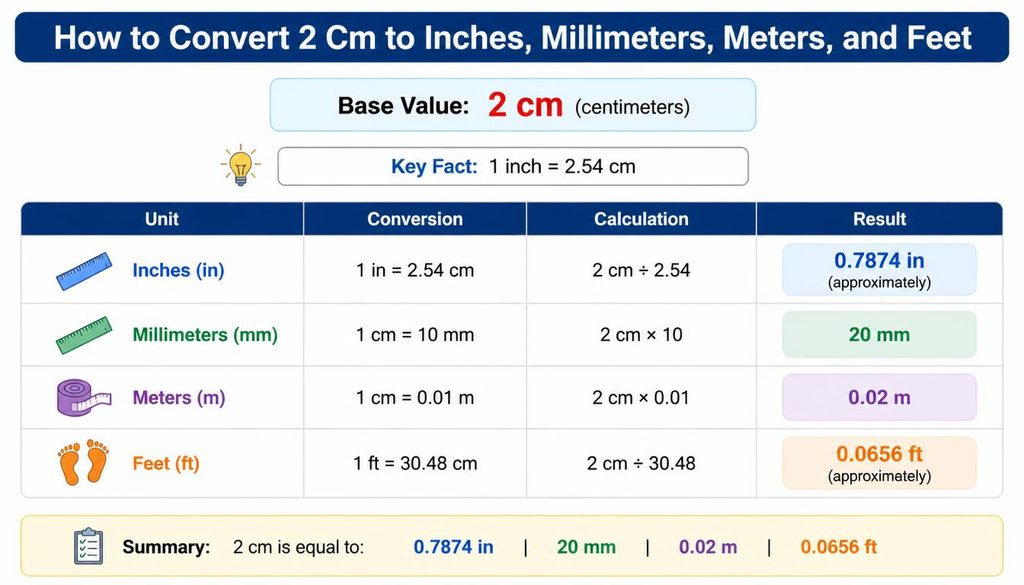
Measurement conversion becomes simple once you know the correct formulas. You don’t need to memorize dozens of numbers; understanding a few basic relationships is enough for most everyday tasks.
2 Cm to Inches
To convert centimeters to inches, divide the centimeter measurement by 2.54.
\[ \text{Inches}=\frac{\text{Centimeters}}{2.54} \]
For two centimeters:
\[ 2\div2.54\approx0.7874 \]
Therefore, 2 cm to inches is approximately 0.79 inches when rounded to two decimal places.
2 Cm to Millimeters
There are 10 millimeters in every centimeter. Multiply the centimeter value by 10 to get millimeters.
\[ 2\times10=20\text{ mm} \]
So, 2 centimeters in millimeters equals 20 mm. This conversion is especially useful for small mechanical parts, craft materials, and product dimensions.
2 Cm to Meters
One meter contains 100 centimeters. Divide the centimeter value by 100 to convert it to meters.
\[ 2\div100=0.02\text{ m} \]
That means 2 centimeters equals 0.02 meters. Although meters are more commonly used for larger distances, this conversion can be useful in scientific calculations.
2 Cm to Feet
One foot contains 30.48 centimeters. Divide the measurement by 30.48 to convert centimeters into feet.
\[ 2\div30.48\approx0.0656\text{ ft} \]
Therefore, two centimeters equals approximately 0.0656 feet, or about 0.07 feet when rounded to two decimal places.
A CM to inches calculator or CM to feet converter can perform these calculations automatically, but understanding the formula helps you check whether the result makes sense.
How to Measure 2 Cm Without a Ruler
Sometimes you need a quick estimate, and the nearest ruler is nowhere to be found. Fortunately, there are several practical ways to visualize two centimeters using familiar objects.
Use a Bank Card as a Reference
A standard bank card is approximately 8.56 cm wide. You can imagine dividing its width into four roughly equal sections. Each section would be around 2.14 cm, which is close to the measurement you need.
This is only an estimate, but it can be useful when checking a small item’s approximate length. Avoid assuming that every card has exactly the same dimensions.
Use Two AAA Batteries
Place two AAA batteries beside each other, with their cylindrical sides touching. Their combined width is about 2.1 cm.
This method works best when you’re estimating the width of a small object rather than trying to measure a straight line on paper. Battery dimensions are standardized within reasonable tolerances, but the comparison is still approximate.
Use a Printed Ruler
If you have access to a printer, a ruler printed at its correct scale can be useful. However, check the print settings before using it.
Select actual size or 100% scaling instead of options such as “Fit to page.” Printing software can enlarge or shrink a ruler, making its markings inaccurate. If possible, verify the printed scale against a known measurement before relying on it.
Use a Phone or Computer Screen Carefully
You may have seen people estimate measurements using a phone display or a computer screen. This can work if you have a properly calibrated on-screen ruler, but the size of the display varies between devices.
A centimeter shown on one phone may not occupy the same number of pixels as a centimeter on another. Screen resolution alone doesn’t guarantee physical size, so don’t treat an uncalibrated screen as an accurate measuring instrument.
For anything that needs precision, use a real ruler or digital caliper.
How Wide Is 2 Centimeters? Understanding Length, Width, and Thickness
Two centimeters can describe different dimensions depending on the object you’re measuring. This is an important point that often gets overlooked when people compare everyday items.
Length is the distance from one end of an object to the other. If a small piece of wood measures 2 cm long, the measurement runs along its longer dimension.
Width measures the distance across an object. A small rectangular item could be 2 cm wide but much longer than that.
Diameter is the distance across a circle through its center. When we say a coin has a diameter of approximately 2.4 cm, we’re measuring across its round face rather than around its edge.
Thickness describes how deep or thick an object is. A stack of CDs or a notepad can be approximately two centimeters thick even if the object’s length and width are much greater.
Understanding these distinctions will help you compare objects more accurately. Two items may both have a measurement of 2 cm, but they might look entirely different because the measurement refers to different dimensions.
Common Mistakes When Estimating Two Centimeters
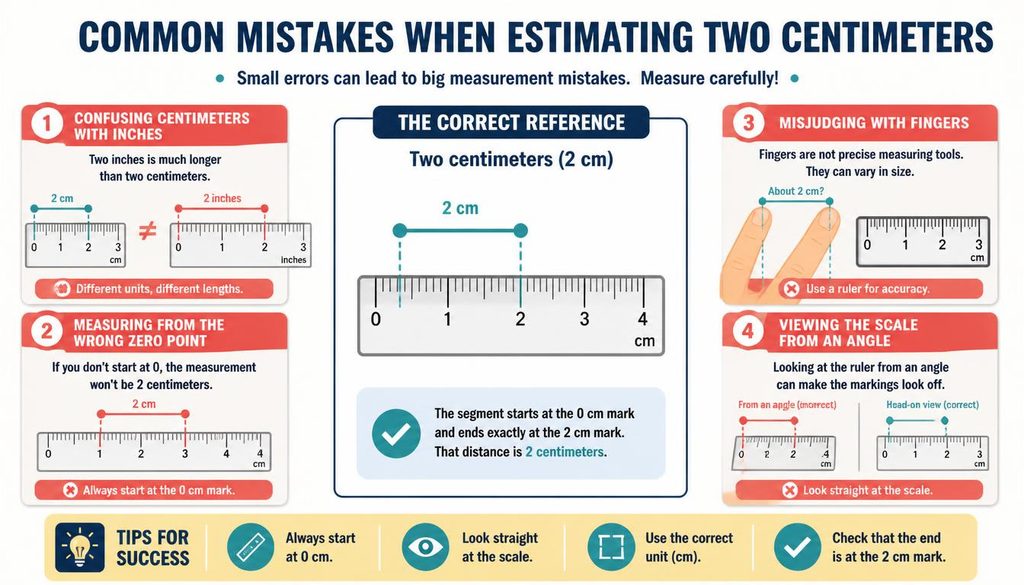
Even simple measurements can become confusing when estimates are treated as exact values. Here are a few mistakes worth avoiding.
- Assuming similar objects have identical dimensions: Peas, candies, pencils, and batteries can vary slightly in size.
- Confusing diameter with circumference: The diameter measures straight across a circular object, while circumference measures around its outer edge.
- Adding measurements in the wrong direction: Two objects placed end to end create a different measurement than two objects placed side by side.
- Rounding too early: The value 0.7874 inches is more precise than 0.79 inches, so use the appropriate level of accuracy for your task.
- Ignoring the unit: Two millimeters and two centimeters are very different lengths. Always check whether a specification uses mm, cm, inches, or another unit.
For casual comparisons, an estimate is usually fine. For woodworking, electronics, science experiments, or fitting a component into a specific space, measure carefully with an appropriate tool.
Practical Uses for Understanding 2 Cm
Learning to visualize a short length isn’t just a fun exercise. It can make everyday activities a little easier.
At school, understanding centimeters can help with geometry, science experiments, art projects, and drawing diagrams. A student who can picture 20 mm will have an easier time checking whether a small object is close to the required size.
At home, this knowledge can help when comparing product dimensions, measuring craft materials, or checking whether a small item might fit into a particular space.
Online shopping descriptions often list measurements in different units, and quick conversion skills make those specifications easier to understand.
In cooking, centimeters can help describe the size of chopped ingredients or small baking decorations. However, food size estimates shouldn’t replace a scale or measuring tool when a recipe requires accuracy.
In DIY projects, even a small difference can matter. A hole that’s two centimeters wide isn’t the same as one that’s two centimeters deep, and confusing those dimensions could affect whether two parts fit together properly.
The more you practice comparing lengths with everyday objects, the more naturally these measurements will come to mind.
Frequently Asked Questions
How big is 2 cm in inches?
2 centimeters is approximately 0.79 inches, which is slightly less than 1 inch.
What does 2 cm look like?
2 cm is about the width of a small button or a little less than the width of a standard inch-long object.
How many millimeters are in 2 cm?
There are 20 millimeters in 2 centimeters because 1 centimeter equals 10 millimeters.
How can I measure 2 cm without a ruler?
You can compare the length with a familiar small object, but using a ruler or measuring tape provides a more accurate measurement.
Is 2 cm bigger or smaller than 1 inch?
2 cm is smaller than 1 inch. One inch equals 2.54 centimeters, so 2 cm is about 0.79 inches.
Read This Blog:https://ravonexium.com/us-shoe-size-chart/
Conclusion: Making Two Centimeters Easier to Visualize
A measurement of two centimeters might seem tiny, but it becomes much easier to understand when you compare it with familiar objects. From a stack of CDs to a pair of AAA batteries, these everyday references help turn an abstract number into something you can picture in your mind.
To recap, 2 cm equals 20 mm, approximately 0.79 inches, and 0.02 meters. It is a little shorter than an inch, and its appearance depends on whether you’re measuring length, width, diameter, or thickness.
The best way to improve your measurement skills is to practise. Pick a few objects around your home, estimate their dimensions, and then check your guesses with a ruler. You might be surprised at how quickly your visual estimation improves.
And remember, familiar objects are great for learning, but accuracy matters whenever a measurement affects safety, fit, or performance. Use comparisons for a quick idea and proper measuring tools when the exact dimension counts.