If you have ever held a Pokémon card in your hand, you probably know that familiar feeling of excitement.
Maybe it was a shiny Charizard you pulled from a booster pack, a Pikachu card you kept from childhood, or a rare-looking card a friend proudly showed you at school.
These little pieces of cardboard can hold surprisingly big memories, and even their size becomes important when you’re collecting, storing, designing, or protecting them.
But have you ever wondered about the exact Pokemon card dimensions? How wide is a standard card, how tall is it, and will it fit inside your favorite card sleeve?
These questions may sound simple, yet getting the measurements right can make a real difference when you’re building a collection or creating custom artwork.
In this guide, we’ll explore the standard Pokemon card size, measurements in inches, centimeters, and millimeters, digital printing dimensions, sleeve compatibility, jumbo card variations, and comparisons with other familiar objects.
We’ll also look at how measurements can help with card protection and authenticity checks. So, grab a card from your collection if you have one nearby, and let’s measure it properly.
| Feature | Measurement |
|---|---|
| Standard Width | 2.5 inches (63.5 mm) |
| Standard Height | 3.5 inches (88.9 mm) |
| Aspect Ratio | 5:7 |
| Shape | Rectangle |
| Thickness | Approximately 0.3 mm |
| Recommended Sleeves | Standard-size trading card sleeves |
What Are the Standard Pokemon Card Dimensions?
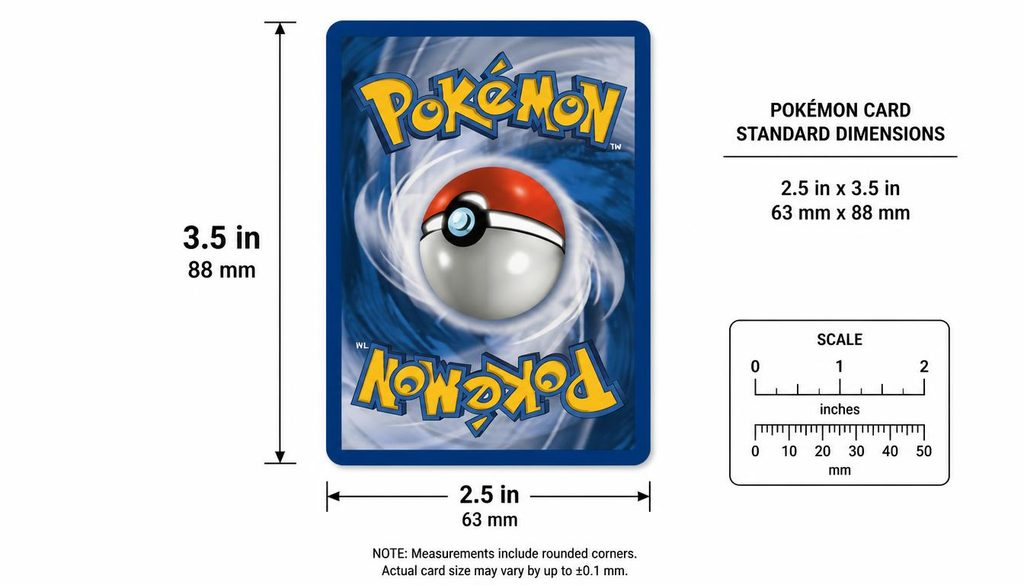
The standard Pokémon Trading Card Game (Pokémon TCG) card follows the familiar trading-card format used by many collectible card games. Most English-language and other international Pokémon cards measure approximately 2.5 inches wide and 3.5 inches tall.
That size makes the cards easy to shuffle, hold, organize, and place inside protective sleeves. They’re small enough to fit into a deck box, but large enough to display artwork, attacks, abilities, and other game information without everything becoming a tiny mess.
Here are the basic Pokemon card measurements at a glance.
| Measurement | Standard size |
|---|---|
| Width | 2.5 inches |
| Height | 3.5 inches |
| Width in centimeters | 6.35 cm |
| Height in centimeters | 8.89 cm |
| Width in millimeters | 63.5 mm |
| Height in millimeters | 88.9 mm |
| Approximate aspect ratio | 5:7 |
| Approximate thickness | Around 0.30–0.32 mm |
| Approximate weight | Around 1.7–1.8 g |
The width and height are the key reference measurements for standard cards. Thickness and weight are approximate rather than universal specifications, because printing materials, finishes, and manufacturing differences can affect them.
If you are buying sleeves, preparing a binder, or making a digital template, start with the standard width and height. These two numbers will solve most everyday sizing questions without making the process more complicated than it needs to be.
Pokemon Card Dimensions in Inches
The easiest way to understand the size is to start with inches, especially if you live somewhere that uses imperial measurements.
A standard Pokémon card measures approximately 2.5 × 3.5 inches. The first number represents its width, while the second represents its height when the card is held vertically.
Imagine placing the card next to a small ruler. Its width reaches 2.5 inches, and its height reaches 3.5 inches. It is a little taller than it is wide, which gives the artwork enough vertical space to show a Pokémon, its name, and its battle information.
These dimensions are also commonly associated with standard poker-size playing cards. That makes them easy to visualize if you already have a deck of ordinary playing cards at home.
A few useful conversions are:
- Width: 2.5 inches.
- Height: 3.5 inches.
- Width in feet: approximately 0.208 feet.
- Height in feet: approximately 0.292 feet.
- Total rectangular face area: 8.75 square inches.
The face area is calculated by multiplying the width by the height. Rounded corners make the actual cardboard area slightly smaller than the full rectangle, but the difference is minor for everyday sizing purposes.
When measuring your own card, place it on a flat surface and line up the ruler with one edge. Avoid estimating from a photograph, because camera angles can make the card look wider or narrower than it really is.
Pokemon Card Dimensions in CM and MM
If centimeters and millimeters are more familiar to you, the standard card size is just as easy to understand.
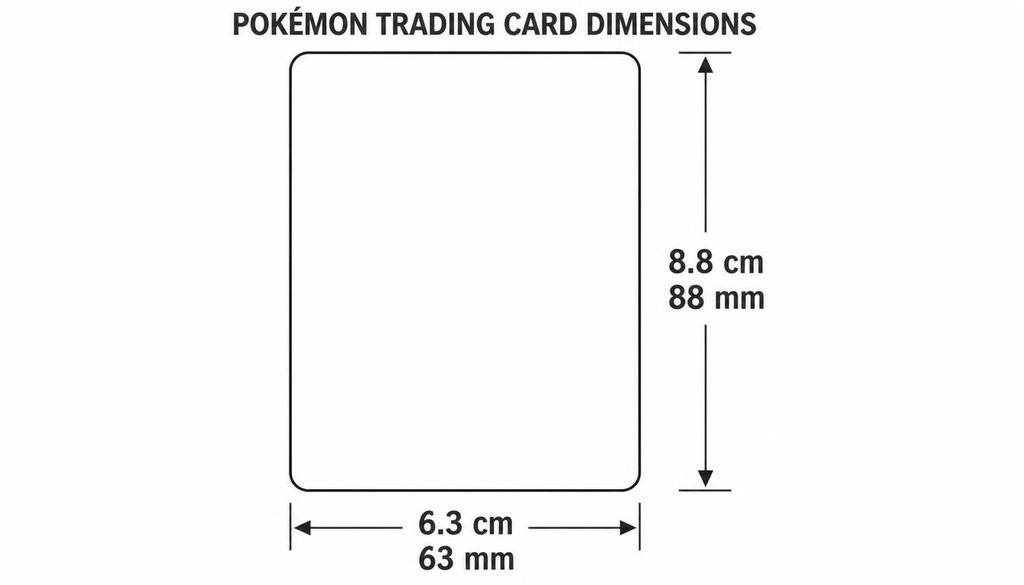
A Pokémon card measures approximately 6.35 cm wide and 8.89 cm tall. In millimeters, that becomes 63.5 mm wide and 88.9 mm tall.
Why use millimeters when the numbers in centimeters already seem clear? Because small differences matter when you’re choosing a snug-fitting sleeve or comparing the edges of two cards. A difference of just a millimeter can change how comfortably a card slides into a protective holder.
Here’s a quick conversion guide.
| Unit | Width | Height |
|---|---|---|
| Inches | 2.5 in | 3.5 in |
| Centimeters | 6.35 cm | 8.89 cm |
| Millimeters | 63.5 mm | 88.9 mm |
| Feet | 0.208 ft | 0.292 ft |
| Meters | 0.0635 m | 0.0889 m |
These are useful card dimensions conversion chart values for collecting, crafting, and printing projects.
One practical tip: if you’re checking a card using a metric ruler, look for the 63.5 mm and 88.9 mm marks rather than rounding everything to 6 cm and 9 cm. Rounding is convenient for a rough mental picture, but it isn’t ideal for a precise fit.
Pokemon Card Thickness and Weight
Width and height tell only part of the story. Thickness and weight can also be useful when comparing cards, particularly when you’re choosing protective accessories or inspecting an unfamiliar card.
A standard Pokémon card is often approximately 0.30–0.32 mm thick, although the exact measurement may vary by printing and finish. Holographic and foil cards can have different surface constructions, so it’s best not to assume every card has exactly the same thickness.
The weight of an individual standard card is often around 1.7–1.8 grams, but this should be treated as a rough estimate rather than an official universal specification.
Here are a few ways these measurements can help:
- Thickness: Useful when comparing a card with other cards or checking whether a holder has enough clearance.
- Weight: Helpful as one additional observation when examining a card.
- Edge construction: Can provide clues about the card’s material layers and printing quality.
- Surface finish: Foil, textured, and other specialty finishes may feel different from ordinary cards.
A digital caliper can measure thickness more precisely than a regular ruler, while a precision scale can record weight. However, neither measurement proves that a card is genuine. Authentic cards can vary slightly, and counterfeit products can sometimes be made to imitate the expected dimensions.
If you’re collecting valuable cards, consider measurements as supporting evidence rather than a final verdict.
Pokemon Card Size Chart: Standard Cards vs. Jumbo Cards
Not every Pokémon card is designed to fit into an ordinary deck. Some promotional products feature oversized cards, often called jumbo Pokémon cards. They are made to display artwork on a larger scale and may come with special collections, promotional products, or other merchandise.
Unlike standard trading cards, jumbo cards do not have one universal size. Their dimensions depend on the product and release period.
| Card type | General size information |
|---|---|
| Standard Pokémon card | Approximately 2.5 × 3.5 inches |
| Jumbo Pokémon card | Larger than standard cards; dimensions vary |
| Older jumbo promotional cards | May use different oversized formats |
| Newer jumbo promotional cards | May follow a different format from older releases |
| Special oversized collectibles | Must be measured individually |
You may encounter terms such as Jumbo L Pokémon cards, Jumbo XL Pokémon cards, box topper cards, and CoroCoro XXL cards in collecting discussions. These labels do not guarantee one consistent set of measurements across all products.
If you own a jumbo card, measure its width and height directly before buying sleeves or storage pages. A standard card sleeve won’t fit, and forcing an oversized card into a small holder can damage its corners.
The same principle applies to unusual collectible products such as Topps Mega Chrome cards and other oversized promotional items: check the dimensions of the specific release rather than relying on the word “jumbo” alone.
Are Japanese and International Pokémon Cards the Same Size?
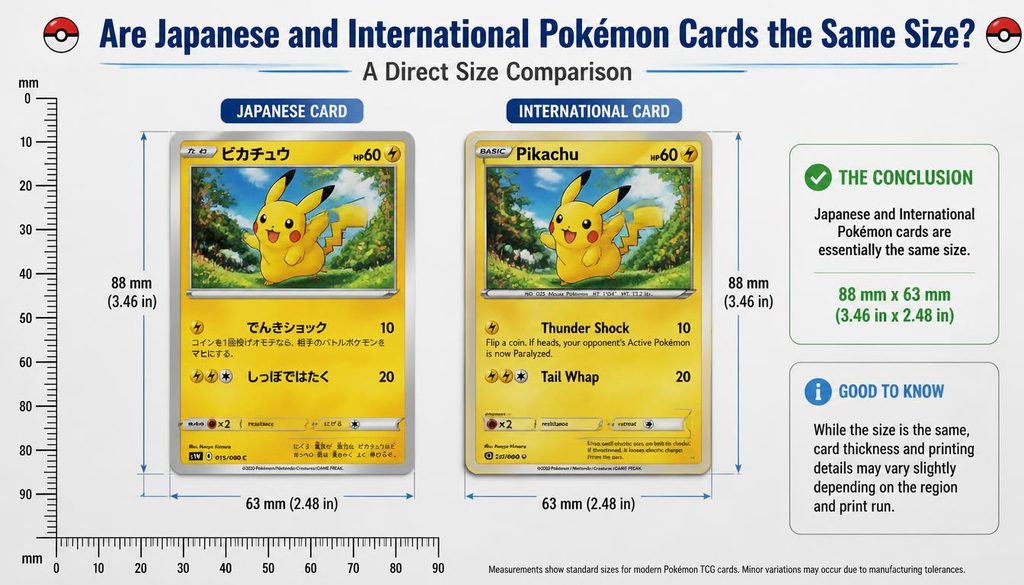
This is a common question among collectors who buy cards from different countries.
In general, standard Japanese Pokémon cards and standard English-language or international Pokémon cards use the same familiar approximate dimensions: 2.5 × 3.5 inches, or 63.5 × 88.9 mm.
That means the cards can generally be stored using accessories designed for standard trading cards. However, the exact fit depends on the accessory itself, not just the language printed on the card.
Japanese Pokémon cards should not automatically be confused with Japanese-size sleeves. The term “Japanese-size sleeve” is commonly used by accessory manufacturers for sleeves designed around smaller trading cards, such as Yu-Gi-Oh! cards. Those sleeves may be too narrow for standard Pokémon cards.
If you’re collecting cards in several languages, compare the actual card measurements and the sleeve’s stated internal dimensions. A small label on a product package can save you from buying an entire pack of unsuitable sleeves.
Pokemon Card Dimensions Compared With Other Objects
Measurements become much easier to remember when you compare them with familiar items. Instead of remembering two numbers, you can picture something you have already held.
Pokémon Cards vs. Standard Playing Cards
Standard poker-size playing cards commonly measure 2.5 × 3.5 inches, making them approximately the same size as standard Pokémon cards.
If you have a deck of playing cards in a drawer, place one beside a Pokémon card. Their overall dimensions should look very similar, although the thickness, coating, texture, and corner shape can vary between manufacturers.
Pokémon Cards vs. Credit Cards
A standard credit card measures approximately 3.37 × 2.125 inches.
That means a credit card is wider than a Pokémon card when both are held horizontally, but a Pokémon card is taller when held vertically. The credit card also has a different overall shape, designed to fit into a wallet and payment terminals.
This is a useful comparison if you don’t have a ruler nearby.
Pokémon Cards vs. Dollar Bills
A US dollar bill measures approximately 6.14 × 2.61 inches.
It’s considerably longer than a Pokémon card and slightly wider than the card’s 2.5-inch width when compared in the same orientation. Laying a card over part of a dollar bill gives you an easy visual reference for how compact the card really is.
Pokémon Cards vs. Yu-Gi-Oh! Cards
Standard Yu-Gi-Oh! cards are commonly listed at approximately 59 × 86 mm, making them smaller than standard Pokémon cards.
The difference is particularly noticeable in the width. A Pokémon card has more horizontal space for its artwork and printed information, while a Yu-Gi-Oh! card uses a narrower format.
Pokémon Cards vs. Magic: The Gathering Cards
Standard Magic: The Gathering cards are approximately 63 × 88 mm. They are very close in size to Pokémon cards, though the precise dimensions may differ slightly.
For collectors who play multiple card games, this is why some accessories can work across several collections. Still, always check the manufacturer’s fit recommendations before buying a sleeve or rigid holder.
What Size Sleeves Fit Pokémon Cards?
A good sleeve protects your cards from fingerprints, surface scratches, dust, and ordinary handling. But a sleeve that’s too tight can be frustrating to use, while an oversized sleeve may allow the card to move around.
For a standard Pokémon card, look for sleeves explicitly advertised for standard-size trading cards or Pokémon TCG cards.
Perfect Fit Inner Sleeves
Perfect fit sleeves are designed to sit closely around a card. They are often used as the first layer in a double-sleeving setup.
A product advertised as approximately 64 × 89 mm may be suitable for standard cards, but the stated measurement could describe the sleeve’s external size rather than its usable internal space. Always check the manufacturer’s specifications.
Penny Sleeves
Penny sleeves are lightweight, flexible protective sleeves. They’re a common option for everyday storage and for keeping cards safe during sorting or trading.
Look for a standard trading-card version with enough internal room for a Pokémon card to slide in without excessive force.
Standard Outer Sleeves
Outer sleeves are available in different materials, thicknesses, and finishes. Some are intended to fit over an inner sleeve for double-sleeving, providing an extra layer of protection.
A sleeve advertised as approximately 66–67 × 91–92 mm may be suitable for standard cards, depending on its actual internal dimensions.
Toploaders
Toploaders are rigid plastic holders that offer more structure than flexible sleeves. They’re commonly used to protect valuable cards, display favorites, or transport collectibles.
You may see 35 PT, 55 PT, and 75 PT holders advertised. The PT measurement refers to thickness capacity, not the card’s width and height.
Standard Pokémon cards usually require a holder intended for ordinary trading cards, but thicker specialty cards or sleeved cards may need different clearance.
Important: Sleeve and holder measurements vary by brand. Before purchasing, check the listed internal dimensions and compatibility recommendations rather than relying on a single number.
How to Store Pokémon Cards Without Damaging Them
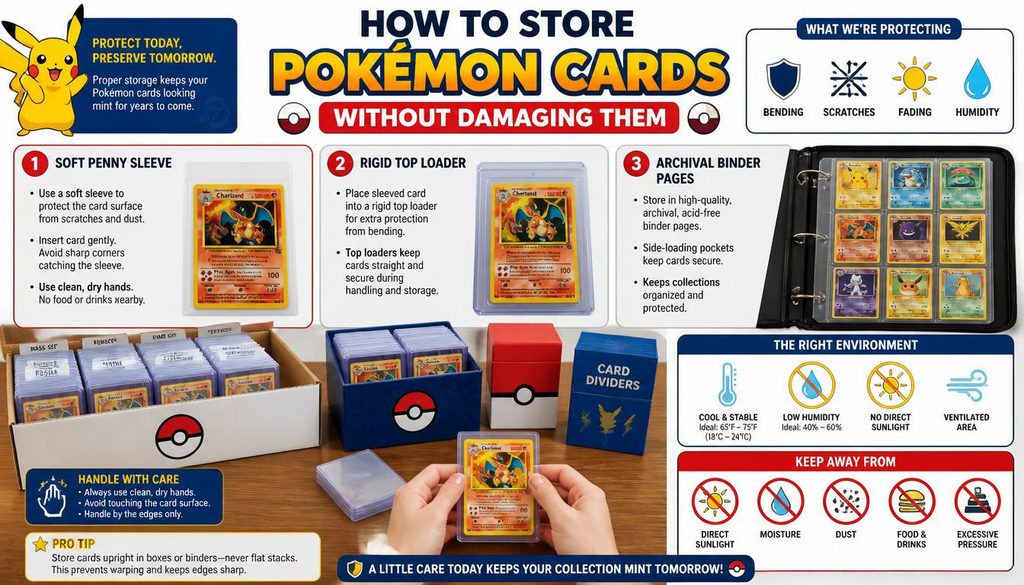
A collection can grow from five cards to fifty before you realize you’ve started organizing an entire little library. And when cards are kept for years, the way they’re stored can make a big difference to their condition.
Here are practical ways to protect them.
- Use clean hands: Dirt and oils can transfer to card surfaces, especially during frequent handling.
- Choose suitable sleeves: The card should slide in smoothly without bending or scraping its edges.
- Use binder pockets carefully: Avoid overfilled pockets that press against neighboring cards.
- Keep cards away from moisture: Humid conditions can contribute to warping and other material changes.
- Avoid direct sunlight: Prolonged exposure can affect colors and printed surfaces.
- Store cards flat and securely: Prevent unnecessary bending and pressure.
- Inspect valuable cards periodically: Look for signs of edge wear, surface scratches, or moisture exposure.
For expensive collectibles, consider archival-quality storage products intended for long-term card preservation.
A protective sleeve alone cannot prevent every kind of damage, but combining appropriate sleeves, a suitable binder, and a stable storage environment can help preserve the collection.
Pokemon Card Dimensions in Pixels for Digital Design
If you’re designing a custom card in Procreate, Photoshop, or another illustration program, physical measurements need to be converted into pixels.
The important thing to understand is that Pokemon card dimensions in pixels depend on the print resolution, usually measured in DPI (dots per inch). A physical card does not have one fixed pixel size for every screen or printing project.
The formula is straightforward:
Pixels = inches × DPI
For a standard 2.5 × 3.5-inch card, the corresponding pixel dimensions are:
| Resolution | Pixel dimensions |
|---|---|
| 72 DPI | 180 × 252 px |
| 150 DPI | 375 × 525 px |
| 300 DPI | 750 × 1050 px |
| 600 DPI | 1500 × 2100 px |
These values are mathematical conversions for the stated physical size. They are useful for planning a digital canvas, but the resolution needed for an actual print depends on the printer, artwork, and production process.
What DPI Is Best for Printing Pokémon Cards?
For most high-quality print artwork, 300 DPI is a practical starting point. At the standard physical card size, that gives you a canvas of 750 × 1050 pixels before adding any bleed.
For finer artwork or certain professional workflows, 600 DPI may be useful. However, increasing the DPI does not automatically improve a low-resolution image; the source artwork needs enough detail to support the output.
If you’re preparing a card for home printing, remember that ordinary printers and commercial card-printing services can have different requirements. Check those requirements before setting up your final file.
How to Set Up Pokémon Card Dimensions in Procreate
When starting a new digital illustration in Procreate, you can use the following general workflow:
- Create a new canvas with the intended physical dimensions.
- Set the resolution to 300 DPI if that suits your printing method.
- Add guides for the trim edge and safe zone.
- Keep important text and artwork away from the cutting boundary.
- Use a suitable color profile based on the output process.
- Export the file in the format requested by your printer.
A 750 × 1050-pixel canvas is the mathematical equivalent of 2.5 × 3.5 inches at 300 DPI. But before printing, verify the exact template and file requirements supplied by the printing service.
Pokémon Card Print Bleed, Safe Zones, and Color Profiles
Designing the front of a card is fun. Preparing the file so it can be printed cleanly is where the tiny details start to matter.
Print bleed is the extra artwork extending beyond the final trim edge. It helps prevent thin white borders from appearing if the cutting position shifts slightly during production.
A commonly used illustrative setup is a canvas measuring 2.75 × 3.75 inches for a 2.5 × 3.5-inch finished card. That adds 0.125 inch of bleed on every side. However, this is only an example; follow the printer’s required bleed dimensions when preparing a real job.
At 300 DPI, a 2.75 × 3.75-inch canvas equals 825 × 1125 pixels.
A few related terms are worth understanding:
- Safe zone: The inner area where important text, logos, and essential artwork should remain.
- Trim line: The boundary where the finished card is intended to be cut.
- Print bleed: The extra artwork beyond the trim line.
- RGB color profile: Commonly used for digital displays and many digital-art workflows.
- CMYK color profile: Often used in print workflows, depending on the printer’s equipment and process.
Color profiles can affect how bright or saturated artwork looks after printing. Don’t convert files blindly, though. Some printers prefer RGB submissions and handle conversion themselves, while others request CMYK.
For a custom card artwork project, always ask the print provider for its template, required file format, bleed, safe zone, and color-profile specifications. This little step can save you from redoing hours of design work.
How to Measure a Pokémon Card at Home
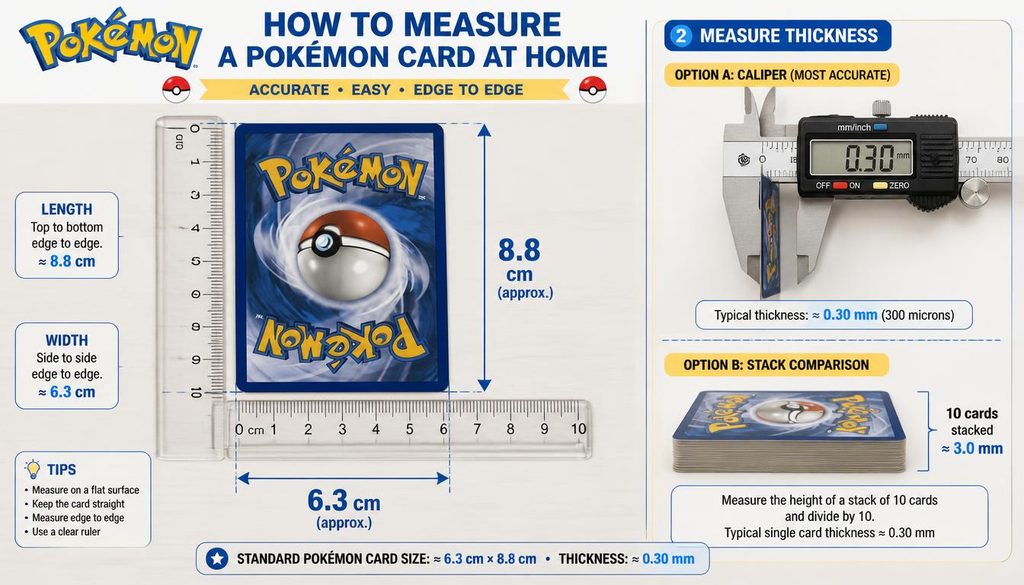
You don’t need a professional workshop to check a card’s dimensions. A simple ruler is enough for most basic comparisons.
Here’s a practical method:
- Place the card on a clean, flat surface.
- Measure across the widest straight edge to determine its width.
- Measure from the bottom edge to the top edge to determine its height.
- Record the results in millimeters for a more detailed comparison.
- If necessary, repeat the measurement to reduce reading errors.
A ruler is usually sufficient for width and height. A digital caliper can provide more precise readings, particularly for thickness, but use it gently. Excessive pressure can damage a card or leave marks on its surface.
Rounded corners can make measurements look confusing if you start measuring along the curved section. Always use the straight edges to determine the overall width and height.
You can also measure a sleeve separately, but remember that its outside dimensions and usable interior dimensions are not necessarily identical.
Can Pokémon Card Dimensions Help Identify Fake Cards?
Card dimensions can be useful when checking an unfamiliar Pokémon card, but they are only one part of a broader authenticity assessment.
A counterfeit card may have incorrect proportions, unusual thickness, inconsistent printing, or poor-quality materials. Yet some fake cards are made close enough to standard measurements that a ruler alone won’t reveal the problem.
If you’re trying to determine whether a card is authentic, consider several factors together:
- Dimensions: Compare the width and height with a known standard card.
- Printing quality: Look for unusual text, blurry details, or inconsistent artwork.
- Card construction: Examine the edges and overall material quality.
- Color and finish: Compare the appearance with a verified card of the same type.
- Set details: Check the card name, numbering, symbols, and other identifying information.
- Professional assessment: Consider a reputable grading and authentication service for valuable cards.
Companies such as PSA and Beckett Grading Services (BGS) offer professional card grading services, with processes that may include authenticity evaluation and condition assessment.
You might also hear about a light test, card opacity, or a graphite core when people discuss counterfeit detection. These methods are not definitive on their own. Lighting, card finishes, and manufacturing differences can influence what you observe, and an unreliable test may damage a collectible.
Similarly, a card’s weight, corner radius, or apparent thickness should not be treated as proof of authenticity. Genuine cards can have minor manufacturing differences, and counterfeit products can imitate some physical characteristics.
If you suspect that a valuable card may be fake, compare it with verified examples and seek professional advice instead of relying on one measurement.
Why Card Grading and Centering Matter
Collectors often pay attention not just to the size of a card, but also to how accurately the printed design sits within its borders.
Centering analysis examines the balance of the borders around the artwork. If one side has a noticeably wider border than the opposite side, the card may be off-center. This can happen during manufacturing and does not automatically mean the card is counterfeit.
A miscut card is a card that was cut incorrectly during production. Depending on the circumstances, it may have unusual borders or portions of neighboring designs. Some collectors find certain manufacturing errors interesting, while others prefer cards with more regular presentation.
Professional grading may consider centering, corners, edges, and surface condition, alongside authenticity checks. The exact evaluation process and grading standards depend on the service.
Understanding standard Pokemon card dimensions gives you a useful baseline, but it doesn’t mean every authentic card will be perfectly identical. Manufacturing involves real materials and processes, so minor variation is possible.
For anyone building a collection, the best approach is to keep measurements in perspective: they are useful evidence, not the whole story.
Frequently Asked Questions
pokemon card dimensions
Standard Pokémon cards measure approximately 2.5 × 3.5 inches (63.5 × 88.9 mm), making them easy to store in standard trading card sleeves.
pokemon card size
A standard Pokémon card is 2.5 inches wide and 3.5 inches tall, similar in size to many other trading cards.
what are the dimensions of a pokemon card
The dimensions of a standard Pokémon card are 63.5 mm × 88.9 mm (2.5 × 3.5 inches).
what size is a pokemon card
A regular Pokémon card is 2.5 inches wide and 3.5 inches long, which is the standard size for most Pokémon trading cards.
dimensions of pokemon card
Pokémon cards typically measure 2.5 × 3.5 inches (63.5 × 88.9 mm), although special products may have different dimensions.
Read This Blog:https://ravonexium.com/common-things-that-are-1-foot-long/
Final Thoughts on Pokemon Card Dimensions
A Pokémon card might be small enough to slip into a pocket, but knowing its exact size can be surprisingly useful.
Whether you’re organizing a growing collection, choosing protective sleeves, comparing Japanese and international releases, or creating a digital illustration, the standard Pokemon card dimensions give you a reliable place to start.
Remember the main numbers: 2.5 × 3.5 inches, 6.35 × 8.89 cm, or 63.5 × 88.9 mm. Keep in mind that thickness, weight, sleeve fit, and oversized card formats can vary, so check the relevant product specifications whenever precision matters.
And if you’re working on custom artwork, don’t forget the difference between the finished card dimensions and the larger canvas used for printing. A little attention to DPI, bleed, and safe zones can make the final result much cleaner.
Most importantly, protect the cards that matter to you. A favorite Pokémon card may not be worth a fortune, but it can still carry memories of trades with friends, exciting booster-pack openings, and afternoons spent building the perfect deck.
Have you ever discovered an unusually large Pokémon card, struggled to find the right sleeve, or designed your own trading-card artwork? Share your experience or favorite card in the comments. Sometimes the smallest collectibles have the biggest stories to tell.