Pokémon cards may look like simple pieces of printed cardstock, but any collector who has handled a rare Charizard, opened a fresh booster pack, or tried to fit a favorite card into a protective sleeve knows that small details matter.
One millimeter can make a difference when you’re choosing a card holder, arranging a binder, or protecting a collectible that means something special to you. And honestly, there’s a certain satisfaction in finding a sleeve that fits just right.
Whether you’re a beginner building your first Pokémon TCG collection or an experienced collector protecting valuable cards, understanding the Pokémon card size helps you make better decisions.
The right measurements can save you from buying incompatible sleeves, choosing an unsuitable toploader, or accidentally damaging a card while storing it.
In this guide, we’ll explore standard Pokémon card dimensions, thickness, sleeve compatibility, storage accessories, and the differences between regular and jumbo cards. We’ll also look at Japanese and English editions, along with practical ways to preserve your collection for years to come.
| Measurement | Size |
|---|---|
| Standard Width | 2.5 inches (63.5 mm) |
| Standard Height | 3.5 inches (88.9 mm) |
| Aspect Ratio | 5:7 |
| Thickness | Approximately 0.3 mm |
| Card Shape | Rectangle |
| Standard Sleeve Size | 2.5 × 3.5 inches |
What Is the Standard Pokémon Card Size?
The standard Pokémon card dimensions are approximately 63 mm wide and 88 mm tall. These measurements are commonly expressed as 2.5 × 3.5 inches, making Pokémon cards similar in size to many other collectible trading cards.
If you’ve held a Pokémon card in your hand, you’ve probably noticed how comfortably it fits between your fingers.
This standard footprint makes it relatively easy to find compatible sleeves, binder pages, and protective cases. Still, the external measurements of a card accessory don’t always tell the entire story, so checking its stated compatibility is a smart move.
Here’s a quick reference for the most important Pokémon card measurements.
| Measurement | Standard size |
|---|---|
| Width | 63 mm (2.48 inches) |
| Height | 88 mm (3.46 inches) |
| Width, rounded | 2.5 inches |
| Height, rounded | 3.5 inches |
| Approximate thickness | 0.3 mm |
| Approximate cardstock reference | 12pt |
| General card category | Standard trading card |
The inch measurements are rounded equivalents, while 63 × 88 mm is a commonly used nominal size for the standard card format. Actual thickness may vary slightly depending on the card’s construction, finish, and printing.
These measurements are useful when purchasing protective supplies, although a close fit should never mean forcing a card into an accessory that’s too tight.
Pokémon Card Size in Inches, Millimeters, and Centimeters
If you shop for card accessories online, you’ll quickly notice that some manufacturers use inches while others list dimensions in millimeters. This can be a little confusing when two products appear similar but have different sizing labels.
The good news is that converting the Pokémon card size in inches into metric measurements is straightforward. A standard card is about 2.48 inches wide and 3.46 inches tall, which is commonly rounded to 2.5 × 3.5 inches.
| Unit | Width | Height |
|---|---|---|
| Millimeters | 63 mm | 88 mm |
| Centimeters | 6.3 cm | 8.8 cm |
| Inches | 2.48 in | 3.46 in |
| Rounded inches | 2.5 in | 3.5 in |
The Pokémon card size in mm is especially useful when comparing sleeve specifications because manufacturers often list precise dimensions in metric units. For example, a sleeve measuring 66 × 91 mm provides more room than a card measuring 63 × 88 mm.
Keep in mind that sleeve dimensions may refer to the sleeve itself rather than the maximum card dimensions it can comfortably hold. Always check the manufacturer’s product description before purchasing.
Understanding Pokémon Card Thickness
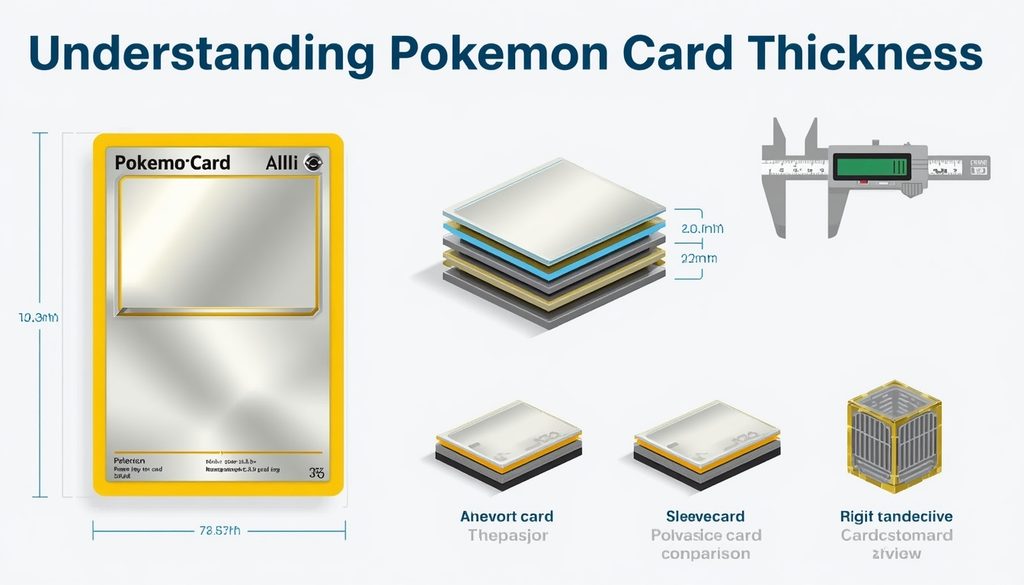
Card thickness is another important detail, particularly if you’re collecting holographic cards, textured cards, or valuable promotional releases. A typical Pokémon trading card is approximately 0.3 mm thick, but this is a general reference rather than a guaranteed measurement for every card.
The material, printing process, surface finish, and construction can all influence the final thickness. Some cards may feel slightly different from others even when their length and width are identical.
What Does 12pt Cardstock Mean?
You may see card holders described using measurements such as 35pt, 55pt, or 75pt. The abbreviation pt refers to points, a unit used to describe thickness in the card-collecting industry.
One point equals 0.001 inch, so a 35pt holder is designed around a nominal thickness of 0.035 inches, or approximately 0.89 mm. This measurement describes the holder’s supported card thickness, not the width or height of the card.
The approximately 12pt cardstock reference is another way to describe a thin paperboard material, but it should not be treated as a precise specification for every Pokémon card.
Do Holographic and Textured Cards Have Different Thicknesses?
Holographic and reverse-holo cards can feel different because of their surface treatments. Special Illustration Rare cards and other textured collectibles may also have a distinctive finish.
That doesn’t automatically mean these cards require a thicker holder. Most standard Pokémon cards still use the same basic dimensions, and a compatible sleeve or holder should generally be selected according to the card’s actual fit rather than its rarity.
If you’re protecting an expensive card, avoid repeatedly bending it or pressing it into a tight sleeve just to test compatibility. A gentle approach is always better than discovering a problem the hard way.
Pokémon Card Sleeve Size: Which Sleeves Fit Best?
Choosing the correct Pokémon card sleeve size is one of the easiest ways to protect a collection. Sleeves provide a barrier against fingerprints, dust, minor scratches, and everyday handling. They’re also useful when you’re shuffling a deck during a Pokémon TCG game.
However, not every sleeve marketed for trading cards offers the same fit. Some are designed to sit close to the card’s edges, while others leave additional room for easier insertion or double-sleeving.
These sleeves fit closely around a standard card. They’re useful as the first layer of protection, particularly when you plan to add a second sleeve over the top
These lightweight sleeves are a popular, economical option for everyday storage, trading, and protecting cards in bulk. Check the listed inner dimensions to ensure they fit standard Pokémon cards.
Approximate reference: 66 × 91 mm
Outer sleeves provide additional protection or serve as the second layer in a double-sleeved setup. Actual compatibility depends on the inner sleeve and the manufacturer’s design.
These dimensions are examples of common sizing references, not universal specifications. Sleeve brands sometimes measure their products differently, so look for an explicit statement that the sleeves fit standard Pokémon cards.
What Size Penny Sleeves Do Pokémon Cards Need?
A penny sleeve intended for standard trading cards is usually a good starting point. The sleeve should allow the card to slide in without catching its corners, but it shouldn’t leave so much excess space that the card moves around unnecessarily.
For a standard card measuring approximately 63 × 88 mm, look for sleeves designed for that card format. A little clearance is normal, and the best fit depends on the sleeve’s material and opening design.
What Size Are Perfect-Fit Pokémon Card Sleeves?
Perfect-fit sleeves are designed to sit close to the card’s edges. A sleeve with approximate dimensions around 64 × 89 mm may be suitable, but the manufacturer’s stated card compatibility matters more than the outer measurements alone.
Don’t force a card into a sleeve if it resists insertion. Even a tiny amount of pressure can put stress on corners and edges, especially when handling a collectible in excellent condition.
Can Pokémon Cards Fit Standard Trading Card Sleeves?
Yes. Standard-size trading card sleeves are generally the correct category for regular Pokémon cards. The familiar 2.5 × 3.5-inch format is shared by several collectible card games.
However, not every product labeled standard size has identical internal dimensions. Checking the measurements and compatibility information is still worthwhile, particularly when ordering sleeves in bulk.
How to Double-Sleeve Pokémon Cards
Double-sleeving means placing a card inside two compatible sleeves. Collectors often use this method when they want an additional barrier against dust, handling, and accidental spills.
The idea is simple, though sleeve compatibility is important. Two layers should fit comfortably without creating excessive pressure around the card’s corners.
A typical double-sleeving process looks like this:
- Choose an inner sleeve designed for standard Pokémon cards.
- Make sure your hands are clean and dry before handling the card.
- Insert the card gently into the inner sleeve without pressing on its corners.
- Select an outer sleeve specifically designed to accommodate the inner-sleeved card.
- Slide the protected card into the outer sleeve carefully.
- Check that the finished card sits flat and isn’t being squeezed by the combined layers.
If the card becomes difficult to insert, bows slightly, or catches against the sleeve opening, stop and check the sizes. A good protective setup should fit securely without requiring force.
Pokémon Card Toploader Size and Thickness Guide
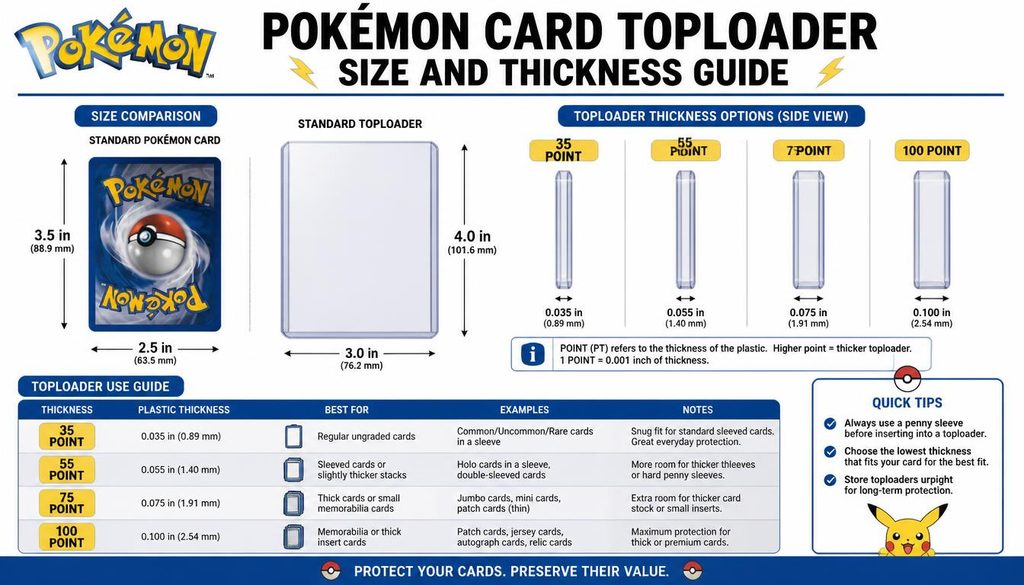
A sleeve protects the surface of a card, but it doesn’t provide much resistance against bending. That’s where rigid holders, commonly called toploaders, become useful.
A Pokémon card toploader size should be selected according to the card’s dimensions, the sleeve you’re using, and the holder’s internal clearance. A holder that is too tight can make insertion difficult, while one that’s too loose may allow unnecessary movement.
Thin standard-card holder
A common choice for ordinary sleeved Pokémon cards when the internal dimensions provide enough room.
Medium nominal thickness
May provide additional clearance, depending on the design. It isn’t automatically better for a standard card if it allows excessive movement.
Usually intended for thicker collectibles. A regular Pokémon card generally doesn’t need this much thickness clearance unless the product has a specific reason for using it.
Thick magnetic holder category
A one-touch magnetic card holder offers a display-friendly option, but the particular model must be compatible with the card and any sleeve you intend to use.
The point rating indicates nominal supported card thickness; it does not describe the holder’s external width and height. Different manufacturers may also offer different internal dimensions and designs.
For most standard cards, a conventional toploader made for sleeved trading cards is a practical choice. If you prefer a magnetic case, verify its intended card format and whether it accommodates a sleeve.
Japanese Pokémon Card Size vs. English Pokémon Card Size
Collectors sometimes wonder whether Japanese Pokémon cards are smaller than English editions. The good news is that modern Japanese and English Pokémon cards generally share the same standard footprint of approximately 63 × 88 mm.
This means a compatible standard-size sleeve will usually work for either language. You don’t need to buy a completely different sleeve system just because you’re collecting Japanese booster packs instead of English ones.
There can still be differences in artwork, printing, text layout, finishes, and particular product formats. Japanese and English cards may also have different set identifiers or rarity terminology, so those details shouldn’t be confused with the physical dimensions.
For example, a Japanese card from the Pokémon 151 Japanese set and an English card from Scarlet & Violet 151 can both fit the same general sleeve category, provided they are standard-format cards.
If you’re comparing cards for authenticity or grading, remember that dimensions alone cannot establish whether a card is genuine. Printing quality, typography, texture, coloring, and other characteristics may also need careful examination.
Jumbo Pokémon Card Dimensions
Jumbo Pokémon cards are designed to stand out. They’re often included in special collection boxes, promotional products, or other releases where the larger format makes the artwork more noticeable.
A common reference for jumbo cards is approximately 5 × 7 inches, or about 127 × 178 mm. However, jumbo cards have appeared in different sizes over the years, so this should be treated as a useful example rather than a universal specification.
| Feature | Standard Pokémon card | Example jumbo card |
|---|---|---|
| Width | 63 mm | 127 mm |
| Height | 88 mm | 178 mm |
| Approximate size in inches | 2.5 × 3.5 in | 5 × 7 in |
| Standard sleeves | Usually suitable | Usually too small |
| Storage | Standard binders and boxes | Jumbo-specific accessories |
Because oversized cards don’t fit standard sleeves, you’ll need jumbo card sleeves, larger rigid protectors, or storage designed specifically for the dimensions of your particular card.
Before purchasing a jumbo protector, measure the card itself. A sleeve advertised for one jumbo format may not fit every oversized promotional release.
Best Ways to Store and Protect Pokémon Cards
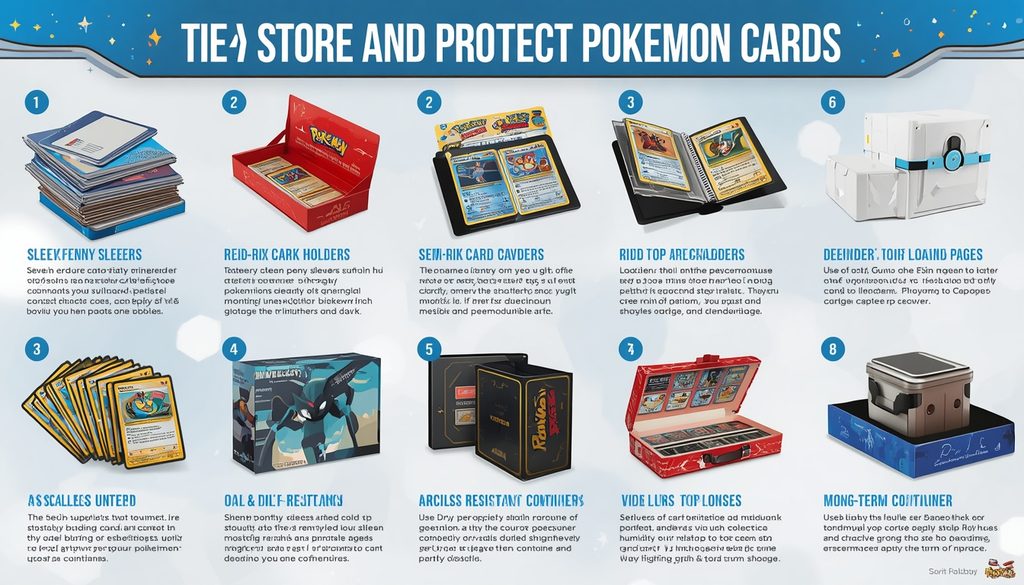
Good Pokémon card storage is about more than finding a box with enough room. The aim is to keep cards clean, dry, organized, and protected from unnecessary friction or pressure.
Different collectors have different needs. Someone building a playable deck may prioritize convenience, while a collector preserving a valuable Special Illustration Rare may prefer a more protective setup.
Binder Pages for Everyday Collections
Binder pages are useful when you want to browse your collection without handling each card individually. Choose pages designed for standard trading cards and use compatible sleeves if you want an additional protective layer.
Avoid overfilling a binder or forcing it closed when the pages are bulky. Excessive pressure can affect cards stored near the spine or outer edges.
Storage Boxes for Larger Collections
Storage boxes work well for bulk cards, organized sets, duplicates, and cards you don’t need to display regularly. Dividers can make it easier to sort by set, Pokémon name, rarity, or collector number.
Keep boxes in a cool, dry location away from direct sunlight. Avoid damp spaces, and don’t place heavy objects on top of boxes containing valuable cards.
Protecting Corners and Edges
Card corners and edges can show wear surprisingly quickly. Sliding a card across a rough surface, pushing it into an undersized sleeve, or stacking unprotected cards can cause unnecessary damage.
Handle cards by their edges when practical, and use a clean, uncluttered surface when organizing your collection. For shipping, combine an appropriately sized sleeve, rigid protection, and secure packaging so the card cannot move excessively during transit.
Keeping Valuable Cards in Good Condition
A card’s condition may influence its collector interest and market value. Scratches, dents, whitening along the edges, creases, and corner wear can all matter when a card is evaluated.
However, expensive cards don’t all require the same storage method. The most sensible setup depends on the card’s condition, value, how frequently you’ll handle it, and whether you want to display it or submit it for grading.
How Pokémon Card Size Affects Grading and Value
Pokémon card grading involves evaluating a card’s condition and, depending on the grading service, other characteristics relevant to its classification. Standard dimensions matter because unusual sizing can be one detail worth investigating, but size alone doesn’t determine a card’s grade.
Before submitting a card, inspect its corners, edges, surface, and centering. Keep it in a clean protective sleeve, follow the grading service’s packaging instructions, and avoid unnecessary handling.
The distinction between raw and graded cards is also useful to understand. A raw Pokémon card is an ungraded card, while a graded card has been evaluated and encapsulated by a grading service.
A grading slab is much larger than the card inside it. As a result, a slabbed card generally won’t fit in a standard card binder pocket or regular toploader. You’ll need accessories made specifically for graded-card slabs.
Market value is another matter. A rare Charizard ex card, such as Charizard ex #199/165 or #201/165, may attract collector interest, but its actual value depends on the exact card, condition, demand, and recent comparable sales.
The same applies to cards from Scarlet & Violet 151 and other sought-after sets. Rarity, artwork, print variation, and condition all contribute to the collecting picture. No single measurement can tell you what a card is worth.
How to Identify a Pokémon Card’s Set and Rarity
If you’re organizing a collection, identifying each card correctly can be just as useful as measuring it. Pokémon cards typically contain identifying information such as a card name, collector number, set symbol, and rarity indicators.
Here are a few practical ways to start:
- Check the collector number: Compare the number printed on the card with a reliable set checklist.
- Identify the set: Look for the set symbol or other identifying information, then confirm it against a reference.
- Inspect the artwork: Special Illustration Rare cards and other premium designs may feature distinctive artwork or finishes.
- Compare the print edition: Japanese and English releases may differ in text, numbering, and other design details.
- Use a card scanner or value checker: These tools can help identify a card, although automated results should be verified.
- Check recent sales: Marketplaces such as eBay can help you compare similar cards, especially when the exact edition and condition match.
A tool such as a Pokémon card scanner can speed up the process, but don’t rely on an image match alone. Similar artwork, alternate versions, and differences in card numbering can lead to incorrect identification.
For valuable collectibles, compare multiple details before making decisions about pricing, trading, or grading.
Common Mistakes When Buying Pokémon Card Protection
Even experienced collectors can purchase the wrong accessories from time to time. Product labels can be confusing, and a holder that looks large enough in a photograph may not have the right internal dimensions.
A few mistakes are especially easy to avoid.
- Buying sleeves based only on external dimensions: Check the actual card size the manufacturer supports.
- Confusing point thickness with card dimensions: A 35pt holder rating describes thickness compatibility, not the sleeve’s width or height.
- Forcing cards into tight sleeves: Choose a better-fitting product rather than risking damage to the corners.
- Using standard accessories for jumbo cards: Oversized cards need appropriately sized protection.
- Assuming every magnetic holder fits sleeved cards: Confirm whether the holder accommodates a sleeve and the card’s format.
- Ignoring storage conditions: Heat, moisture, sunlight, and excessive pressure can all be problematic for a collection.
- Treating size as proof of authenticity: Dimensions are only one aspect of examining a potentially counterfeit card.
The best approach is to check measurements before buying, keep your accessories organized, and choose protection that suits the way you actually use your cards.
Frequently Asked Questions
pokemon card dimensions
Standard Pokémon cards measure 2.5 × 3.5 inches (63.5 × 88.9 mm), making them easy to store in standard trading card sleeves.
what are the dimensions of a pokemon card
A standard Pokémon card is 2.5 inches wide and 3.5 inches tall, or approximately 63.5 × 88.9 mm.
size of pokemon card
The typical Pokémon card size is 2.5 × 3.5 inches, similar to other standard trading cards.
pokemon cards dimensions
Most standard Pokémon cards share the same dimensions: 2.5 inches wide and 3.5 inches tall (63.5 × 88.9 mm).
jumbo pokemon card size
Jumbo Pokémon cards are larger than standard cards, and their dimensions vary by release. Many modern jumbo cards measure approximately 5 × 7 inches.
Read This Blog:https://ravonexium.com/pokemon-card-dimensions/
Conclusion: Choosing the Right Pokémon Card Size and Protection
Understanding the Pokémon card size makes collecting simpler, whether you’re sorting your first deck or preserving a rare card that you’ve searched for months to find.
The standard dimensions of approximately 63 × 88 mm provide a useful starting point for choosing sleeves, binder pages, and rigid holders.
Thickness matters too, but it serves a different purpose. A card’s physical thickness helps determine holder compatibility, while point ratings describe the thickness category supported by a particular accessory.
Jumbo cards and graded slabs require their own storage solutions, so don’t assume that every Pokémon collectible will fit a regular sleeve or binder.
The most practical habit is to check the dimensions, confirm compatibility, and handle your cards with care. With the right sleeves and storage, you can enjoy your collection while helping preserve its condition for the future.
And if you’ve discovered a sleeve brand, binder system, or storage trick that works particularly well for your Pokémon cards, share your experience in the comments. Your advice might help another collector protect a favorite card without spending money on accessories that don’t fit.