Choosing a ring can feel like a tiny decision until the ring arrives and suddenly it is either sliding around like it has somewhere else to be, or sitting on your finger a little too firmly.
A good Ring Size Chart for Men and Women takes away much of that guesswork, but knowing your number is only part of the story.
The shape of your finger, the width of the Ring Band, the design of the ring, and even the temperature of your hands can change how a ring feels.
A ring can carry a surprising amount of meaning too. An Engagement Ring, Wedding Ring, Promise Ring, or even a simple everyday piece of Jewelry may become something you wear for years, so getting the Ring Size reasonably accurate matters.
Nobody wants a beautiful ring sitting in a drawer because the sizing went slightly wrong, honestly.
This Ring Size Guide explains common US sizes, Ring Size in mm, the difference between men’s and women’s sizing, and several ways to measure your Finger Size at home.
It also looks at Comfort Fit, Standard Fit, wider bands, and some of those little details that can make one ring feel different from another even when both have the same printed size.
| US Size | UK Size | EU Size | Finger Circumference |
|---|---|---|---|
| 5 | J | 49 | 49 mm |
| 6 | L | 52 | 52 mm |
| 7 | N | 54 | 54 mm |
| 8 | P | 57 | 57 mm |
| 9 | R | 59 | 59 mm |
| 10 | T | 62 | 62 mm |
| 11 | V | 65 | 65 mm |
| 12 | X | 67 | 67 mm |
| 13 | Z | 70 | 70 mm |
Ring Size Chart for Men and Women
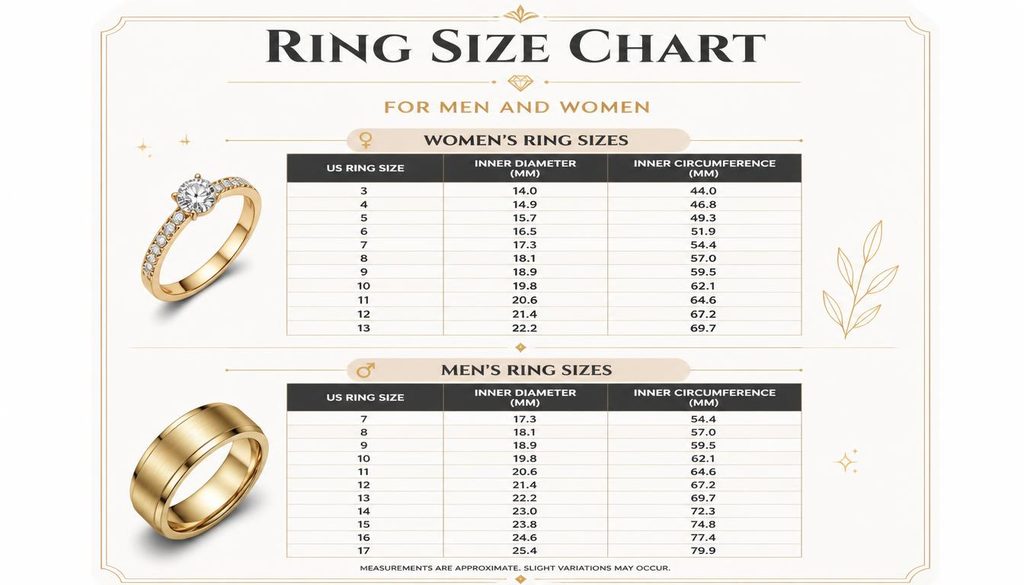
The easiest place to begin is with a standard US Ring Size Chart. US ring sizes use numbers and half sizes, while the inside diameter of the ring is measured in millimeters. The diameter gives you a useful physical reference when comparing an existing ring or checking a sizing chart.
| US Ring Size | Ring Diameter |
|---|---|
| Size 3 | 14.0 mm |
| Size 3½ | 14.4 mm |
| Size 4 | 14.8 mm |
| Size 4½ | 15.2 mm |
| Size 5 | 15.6 mm |
| Size 5½ | 16.0 mm |
| Size 6 | 16.5 mm |
| Size 6½ | 16.9 mm |
| Size 7 | 17.3 mm |
| Size 7½ | 17.7 mm |
| Size 8 | 18.2 mm |
| Size 8½ | 18.6 mm |
| Size 9 | 19.0 mm |
| Size 9½ | 19.4 mm |
| Size 10 | 19.8 mm |
| Size 10½ | 20.2 mm |
| Size 11 | 20.6 mm |
| Size 11½ | 21.0 mm |
| Size 12 | 21.4 mm |
| Size 12½ | 21.8 mm |
| Size 13 | 22.2 mm |
| Size 13½ | 22.6 mm |
This chart covers Ring Sizes 3 13½, which includes many of the sizes commonly encountered when shopping for rings. Still, some manufacturers offer sizes outside this range, and a Brand-Specific Size Chart should always be checked when one is available.
What Is a Size 7 Ring in mm?
A Size 7 Ring has an approximate inside diameter of 17.3 mm in the standard US sizing system. Its corresponding finger circumference is around 54.4 mm, though actual sizing can vary slightly depending on the manufacturer and measuring method.
People often ask whether size 7 is a large or small ring for a woman. There isn’t one universal answer because Finger Size varies naturally between people. Size 7 falls within a commonly encountered range for women’s rings, but it should never be treated as a required or “normal” size.
What Is US Ring Size 10 in mm?
A US Ring Size 10 has an approximate inside diameter of 19.8 mm. It is frequently seen in men’s jewelry, although US sizing itself is not divided into male and female numbering systems, which is an important little detail.
In other words, a size 10 is size 10 whether the ring is marketed toward a man or woman. What changes more often is the style, width, and typical range selected by shoppers.
Women’s Ring Size Chart and Common Sizes
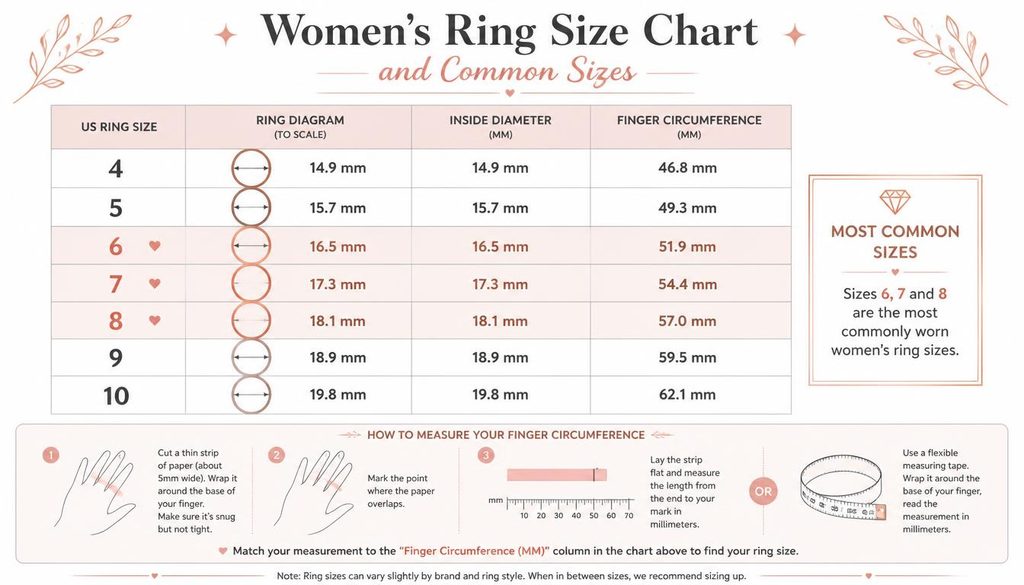
The Women’s Ring Size Chart often includes sizes around 4 through 9, with Women’s Sizes 6–8 appearing frequently in general jewelry discussions. The Average Ring Size for Women is often described as being around size 6 to 8, but averages should only be used as a starting point.
A person may have a smaller or larger Finger Circumference for perfectly ordinary reasons. Genetics, hand structure, age, temperature, and other everyday factors all play a part, so trying to guess someone’s size from appearance isn’t very reliable, nope.
For example, Women’s Ring Size 6 corresponds to an inside diameter of approximately 16.5 mm. Size 7 is about 17.3 mm, while size 8 is about 18.2 mm. That difference may look tiny on paper, but even a fraction of a millimeter can be noticeable when a ring is worn.
Men’s Ring Size Chart and Common Sizes
A Men’s Ring Size Chart commonly covers sizes from around 8 through 15, with Men’s Sizes 9–11 frequently encountered in jewelry shopping. Again, these are common ranges rather than rules carved into stone.
The Average Ring Size for Men is often estimated around sizes 9 to 11, but individual measurements are much more useful than averages. A man with slender fingers may need a smaller size, while someone with larger hands may require a larger one, and thats completely normal.
For reference, a Men’s Ring Size 10 measures approximately 19.8 mm in inside diameter. Size 9 is around 19.0 mm, and size 11 is around 20.6 mm. These small steps between sizes explain why careful measuring can make a big difference.
Men’s Ring Size vs Women’s Ring Size
One common misconception is that men’s and women’s rings use completely different sizing systems. In the US, they generally use the same numerical US Ring Size system. A size 7 remains size 7 regardless of who wears it.
The difference comes mostly from typical purchasing patterns. Men’s rings are often wider and may commonly be purchased in larger sizes, while women’s rings are often narrower and may be purchased in smaller sizes. But there is plenty of overlap, so gender alone doesn’t determine Ring Size.
This is particularly useful when buying Wedding Bands, Engagement Rings, or Promise Rings. Instead of asking whether a ring is a men’s or women’s size, focus on the actual measurement and the way the particular ring is designed.
How to Measure Ring Size at Home
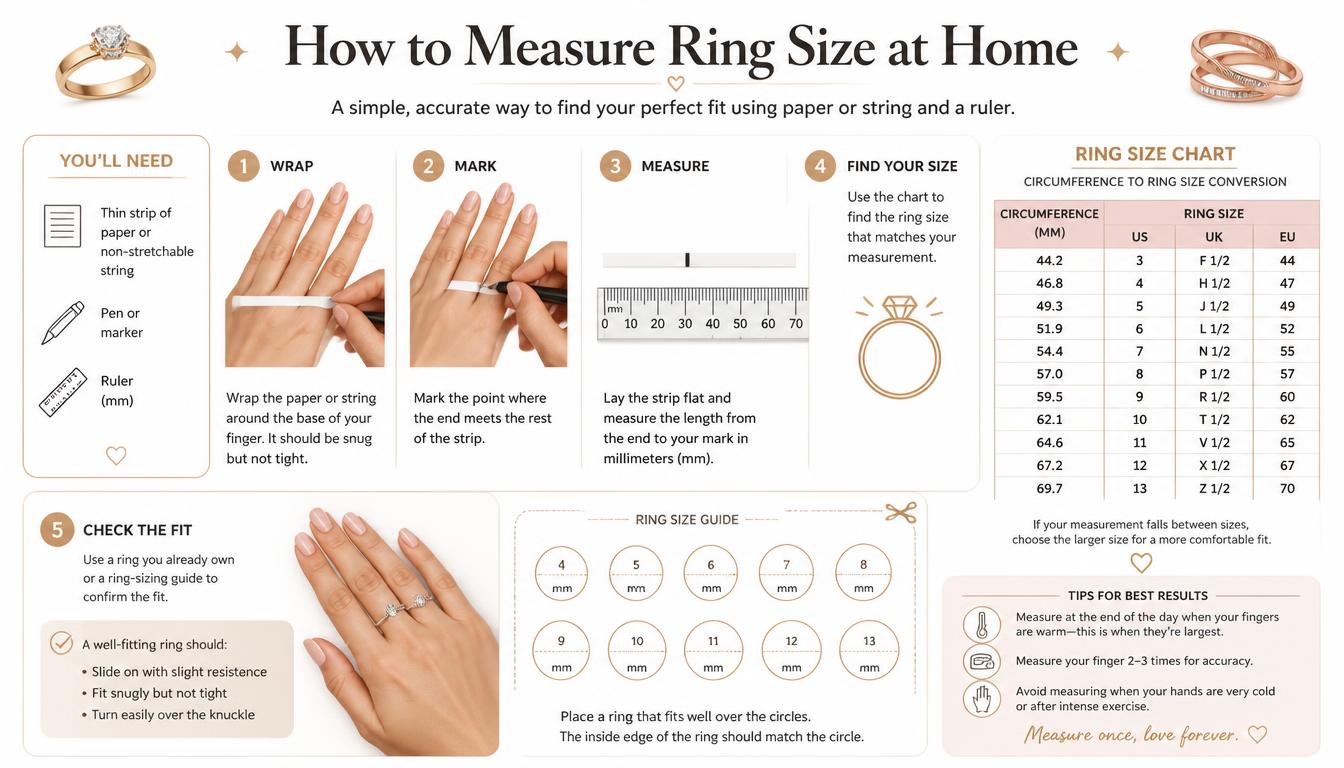
If you are wondering how to measure ring size at home, there are several simple methods. The most reliable option is a proper Ring Sizer Tool, but you can also make a reasonable estimate using everyday materials.
The basic goal is always the same: measure either the circumference of your finger or the inside diameter of a ring that already fits. Once you have that measurement, compare it against a Ring Size Chart.
Measure Your Finger With a Soft Measuring Tape
A Soft Measuring Tape is one of the easiest home methods. Wrap it around the base of the finger where the ring will normally sit, keeping it comfortably snug rather than squeezing the skin.
Record the circumference in millimeters and compare it with a reputable Ring Size Chart. Don’t pull the tape extremely tight because that can make your measured Finger Circumference smaller than it really is, which is a sneaky little mistake.
Measure Ring Size With String, Thread, or Floss
If you don’t have measuring tape, you can measure ring size with string, thread, or floss. Wrap the material around the finger and mark where the end meets the loop.
Then lay it flat against a Ruler and measure the length in millimeters. This method is convenient, but string can stretch or twist, so don’t treat the result as perfectly precise. A ring sizer is still better for an important purchase.
Use Paper and a Pen
A narrow strip of Paper can work in much the same way. Wrap it around your finger, mark the overlap with a Pen, then measure the strip against a ruler.
The strip should sit where the ring will actually rest. If you measure too close to the knuckle or too loosely around the finger, the resulting Ring Measurement may not represent the fit you need.
How to Measure Ring Size With an Existing Ring
Already have a ring that fits the intended finger? Great, that can be one of the simplest ways to estimate the size.
Place the Existing Ring on a ruler and measure the inside diameter from one inner edge to the opposite inner edge. Do not measure across the outside of the ring because the metal thickness would make the result larger than the true ring diameter.
You can also use the Ring Tracing Method by placing the ring over paper and tracing around the inside edge.
Compare the tracing against a Printable Ring Size Chart, but make sure the chart is printed at 100% Print Scale. A printer that automatically shrinks or enlarges the page can quietly ruin the whole measurement.
Why Ring Fit Matters as Much as Ring Size
Getting the correct number is important, but Ring Fit deserves equal attention. A ring should normally slide over the knuckle with some gentle resistance and sit securely without causing uncomfortable pressure.
Your finger isn’t a perfectly straight cylinder, which is something basic charts don’t always communicate very well.
The knuckle may be wider than the base of the finger, or the finger may swell during the day. So the best Ring Size Measurement considers how the ring actually behaves on your hand.
A ring that constantly spins may be too loose, while a ring that leaves strong pressure marks or becomes difficult to remove may be too tight. Everyday Ring Comfort is the real goal.
Comfort Fit vs Standard Fit Rings
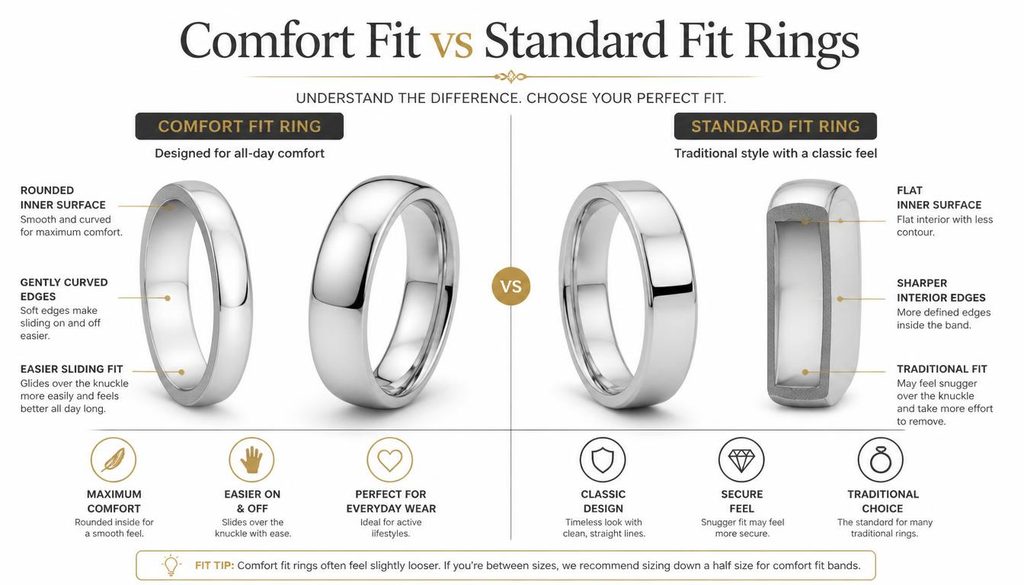
A Comfort Fit Ring usually has a rounded or Convex Interior, allowing the ring to glide over the finger more easily. This can make a ring feel different from another ring with exactly the same nominal size.
A Standard Fit Ring generally has a flatter or straighter inside surface. Traditional Wedding Bands often use this type of construction, although designs vary widely between manufacturers.
Some rings may have a Concave Fit, a Gallery Fit, or other specialized interior shapes. A gallery-style interior can include hollow indentations that reduce material and weight, while other profiles may use a Curved Interior to change how the ring sits against the finger.
Because of this, you shouldn’t assume that every size 8 ring will feel identical. Ring design is part of sizing, weirdly enough.
Wide Bands and Narrow Bands
The width of a Ring Band can change the way a ring feels. A Narrower Band usually occupies less of the finger, while a Wider Band covers more surface area and can feel tighter even when the numerical size is identical.
If you’re buying a particularly wide wedding band, it may be worth discussing the fit with a professional Jeweler rather than relying only on a basic chart. The same idea applies to chunky statement rings and multi-band designs.
A lightweight ring may feel less noticeable, while a thick ring can feel more substantial around the finger. Neither is automatically better; it depends on the design and how you plan to wear it.
When Should You Measure Your Finger?
Finger size can change throughout the day. Temperature is one reason. Cold hands may temporarily become smaller, while warmth can increase swelling. Physical activity and other normal daily conditions can also influence the measurement.
For a more dependable result, measure your finger when your hands are at a comfortable room temperature. Take the measurement more than once, preferably at different times of the day, and compare the results.
If the measurements are slightly different, don’t panic. That’s normal. Your goal is to identify a comfortable range rather than pretend your finger is a machine part with one permanent measurement.
Ring Size Conversion and International Sizes
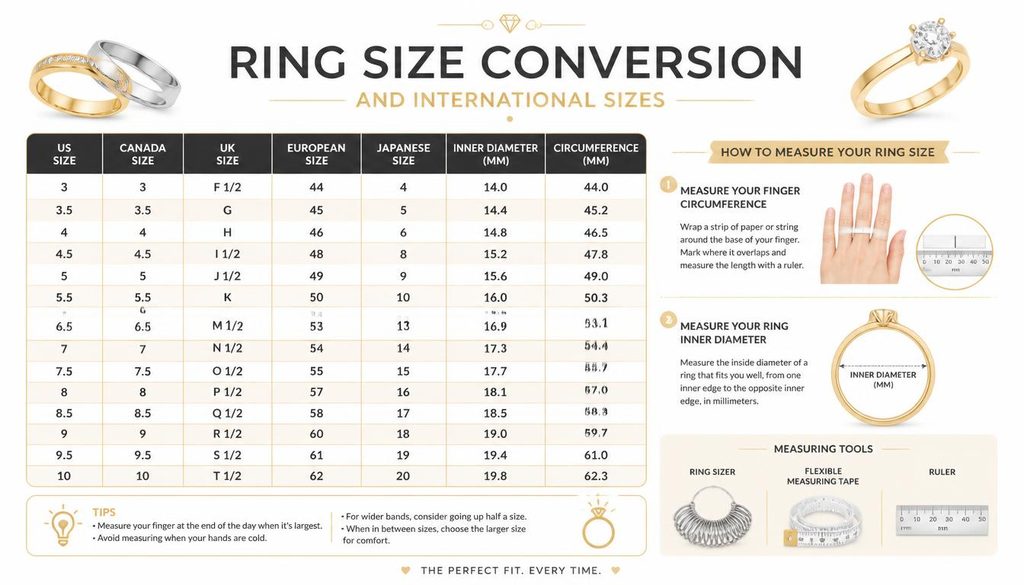
If you’re shopping internationally, Ring Size Conversion becomes especially useful. Different countries can use numerical, alphabetical, or measurement-based systems, and the labels don’t always line up directly.
A US Ring Size Chart may therefore look very different from a UK, European, or other Country-Specific Ring Size chart. Instead of guessing based on a number alone, look for the actual Diameter in mm or circumference and compare it with the seller’s official chart.
A Ring Size Conversion Chart is helpful, but it should be treated as a conversion aid rather than absolute proof. Small differences between manufacturers can still exist, so checking the specific retailer’s Ring Size Standards is smart.
Ring Size for Engagement Rings and Wedding Bands
Finding an Engagement Ring Size can be more complicated because the buyer may not want to ask directly. A surprise proposal adds a whole secret mission to an already emotional moment, which is where people sometimes get creative.
If you’re trying to find your partner’s ring size, you might look at an existing ring they already wear on the same finger. However, be careful: a ring worn on a different finger may have a completely different size.
Another option is to ask a trusted family member or friend if they genuinely know the size. If you can borrow an existing ring without causing suspicion, a reputable Jewelry Store or Ring Designer may also be able to estimate its dimensions.
And if the surprise doesn’t produce a perfect fit, don’t assume the proposal has somehow failed. Many rings can be professionally resized or adjusted, depending on the metal, stone setting, and design.
How to Get a More Accurate Ring Measurement
For an important purchase, professional Jewelry Sizing is worth considering. A jeweler can use physical sizing rings or measuring tools and check how the finger and ring interact.
This can be especially useful for expensive Wedding Rings, detailed Eternity Rings, or rings with unusual construction. Some styles have limitations on resizing, so getting the measurement right before ordering is preferable to discovering the issue afterward.
If you’re doing Online Ring Shopping, look for a reputable retailer that provides a detailed Brand-Specific Size Chart, sizing instructions, and information about resizing. Those little details can save plenty of frustration later.
Common Ring Sizing Mistakes to Avoid
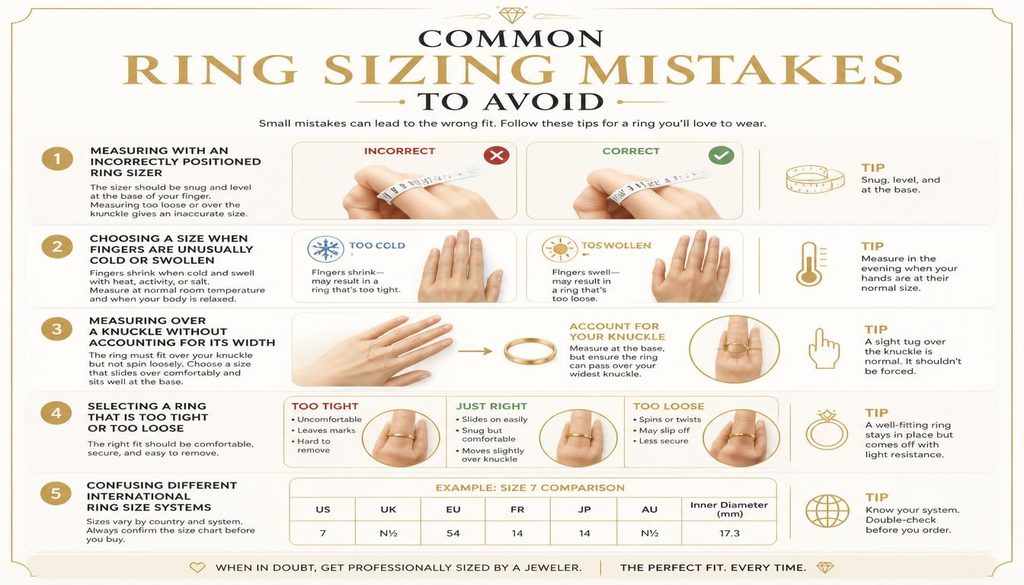
One of the biggest mistakes is measuring only once. A single measurement may catch your finger on an unusually cold or warm day and give you a misleading result.
Another mistake is measuring a finger without considering the knuckle. The ring must pass over the widest part of the finger, so a size that feels perfect at the base may become difficult to remove if the knuckle is considerably wider.
Avoid relying entirely on appearance too. Someone’s Hand Size does not reliably tell you their ring size, and two people with similarly shaped hands can have different measurements.
Also, don’t automatically choose a larger size because you’re afraid of tightness. A ring that is excessively loose can spin, catch on objects, or even slip off. The goal is a secure and comfortable Proper Ring Fit, not simply the biggest possible opening.
Should You Size Up or Down?
If your measurement falls between sizes, the answer depends on the ring design and your finger. A narrow band may behave differently from a wide band, and a Comfort Fit Ring can feel different from a flat interior.
For a valuable ring, ask the jeweler whether a quarter size or half size is available. Some manufacturers offer quarter sizes, while others don’t.
The best choice is the one that allows the ring to pass comfortably over the knuckle while staying securely on the finger. That’s much more useful than following a rigid “always size up” or “always size down” rule.
A Simple Ring Size Checklist
Before purchasing a ring, quickly check these points:
- Measure the actual finger that will wear the ring.
- Measure more than once when possible.
- Use millimeters for greater precision.
- Consider finger swelling and room temperature.
- Check the ring’s band width.
- Identify whether it has a Comfort Fit or Standard Fit interior.
- Compare an existing ring if one is available.
- Check the retailer’s Brand-Specific Size Chart.
- Use a Ring Sizer for important purchases.
- Confirm the seller’s resizing policy before ordering.
It sounds like a lot, but once you have your measurement written down, future Ring Shopping becomes much easier.
Frequently Asked Questions
How Do I Measure My Ring Size at Home?
Wrap a strip of paper or string around your finger, mark the length, and compare it with a ring size chart.
Are Men’s and Women’s Ring Sizes Different?
The same ring-size system can be used for both men and women, but typical size ranges often differ.
What Is the Most Common Ring Size for Women?
Common women’s ring sizes often fall around US 6 8, though finger size varies from person to person.
What Is the Most Common Ring Size for Men?
Common men’s ring sizes often fall around US 9 11, but accurate measurement is the best way to choose a size.
Can I Convert Ring Sizes Between Countries?
Yes. Ring sizes can be converted between US, UK, EU, and other sizing systems using a ring size conversion chart.
Read This Blog:https://ravonexium.com/unisex-t-shirt-size-guide/
Final Thoughts on Choosing the Correct Ring Size
A good Ring Size Chart for Men and Women is more than a table of numbers. It is a starting point for understanding how diameter, circumference, finger shape, band width, and ring construction all work together.
Whether you’re choosing an Engagement Ring, Wedding Band, Promise Ring, or a simple everyday piece, taking a few minutes to measure properly can make the final result much more comfortable.
A size 7 means approximately 17.3 mm in inside diameter, while a size 10 is approximately 19.8 mm, but those numbers become truly useful only when they are matched to the actual finger and ring design.
If you are measuring at home, use a soft measuring tape, paper, thread, floss, ruler, or an existing ring as a starting point. For an expensive or emotionally important ring, professional sizing is still the safer route.
And perhaps thats the nicest thing about ring sizing: behind all the millimeters and numbers is something much more human. A ring is usually being chosen for a reason.
It might mark a promise, celebrate a marriage, remember a milestone, or simply be a little piece of Jewelry that someone loves wearing every day. Getting the size right means that the ring doesn’t just look beautiful in the box, it feels like it belongs there on the hand too.