Choosing a T shirt sounds like one of those tiny everyday decisions that should take two minutes, but somehow it can turn into a whole little adventure. You find a color you love, the fabric feels perfect, and then comes the question: what size should I actually order?
This becomes even more confusing when the shirt says “unisex,” because unisex sizing does not always feel exactly like traditional men’s or women’s sizing. And honestly, nobody wants a beautiful tee arriving at the door only to discover the sleeves have their own plans.
A good T-shirt size guide makes that decision much easier. Whether you are buying a shirt for yourself, choosing matching team T shirts, ordering event -shirts, or picking brand merchandise, the right size starts with understanding measurements rather than guessing from the letter on the tag.
A Small from one clothing brand can feel surprisingly different from a Small somewhere else, which is why checking the actual T-shirt measurements is always a smart move.
There is also something lovely about choosing clothing that does not put people into strict little boxes. A unisex tee can be styled in many ways, worn loose or fitted, and adapted to different personal preferences.
It can be part of a gender-neutral wardrobe, a casual family outfit, or simply that favorite everyday shirt you reach for without thinking twice.
So, let’s make the whole thing less confusing. This unisex T-shirt size guide explains common sizes, chest measurements, fit styles, conversion ideas, and practical ways to find a comfortable fit without relying on guesswork.
| Size | Chest | Fit |
|---|---|---|
| XS | 32 34 in | Slim |
| S | 35 37 in | Regular |
| M | 38 40 in | Regular |
| L | 41 43 in | Relaxed |
| XL | 44 46 in | Loose |
| XXL | 47 49 in | Oversized |
What Is a Unisex T Shirt?
A Unisex T shirt is designed to be worn by people of different genders rather than being specifically cut around traditional men’s or women’s clothing patterns. In many cases, unisex shirts use a fairly straight body shape, slightly broader shoulders, and a more relaxed construction.
But there is no single worldwide rule saying every unisex tee must look exactly the same, so brands can vary quite a bit.
Many unisex shirts are based loosely on traditional Men’s sizing, especially in the way the chest, shoulders, sleeves, and overall length are proportioned.
This does not mean that every woman should automatically choose a smaller size, though. Personal preference matters a lot here, and a relaxed shirt can look intentionally relaxed rather than simply “too big.”
The idea fits naturally into modern gender neutral clothing and inclusive fashion, where the emphasis is more on comfort, personal style, and useful sizing options.
A person might choose XS for a closer shape, M for an everyday fit, or XL because they like a roomy silhouette. None of those choices are wrong, it just depends on the look you want.
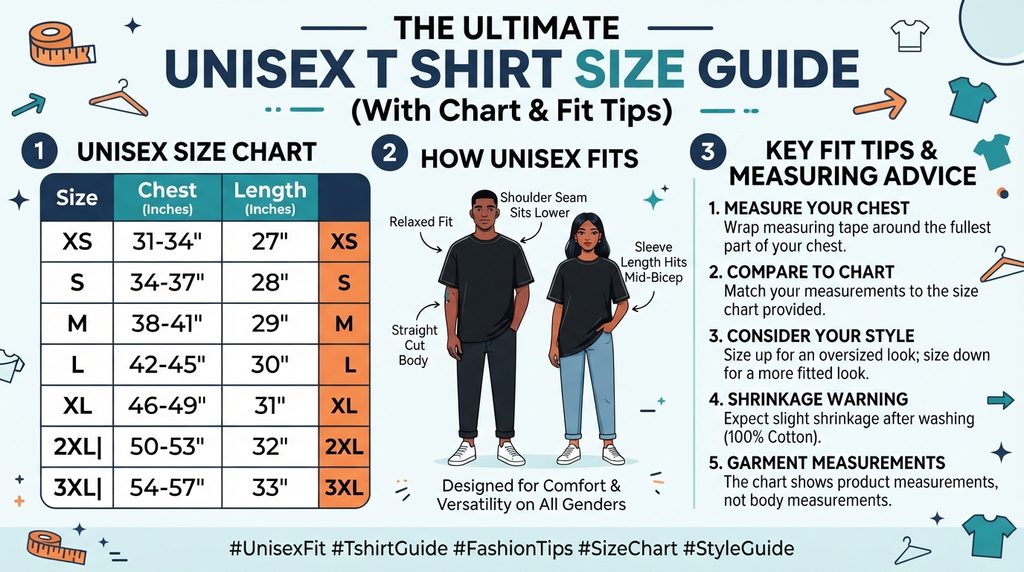
Unisex T-Shirt Size Chart
The table below gives a general starting point for standard unisex sizes. These measurements are approximate because clothing size variation by brand is very common. Always compare the chart with the specific brand before ordering.
| Unisex Size | Approx. Chest | Chest in cm | General Fit |
|---|---|---|---|
| XXS | 30 32 in | 76 81 cm | Very slim |
| XS | 32 34 in | 81 86 cm | Slim |
| Small (S) | 34 36 in | 86 91 cm | Standard |
| Medium (M) | 36 38 in | 91 97 cm | Comfortable |
| Large (L) | 38 40 in | 97 102 cm | Relaxed |
| XL | 40 42 in | 102 107 cm | Roomy |
| 2XL | 42 44 in | 107 112 cm | Loose |
| 3XL | 44 46 in | 112 117 cm | Extra roomy |
| 4XL | 46 48 in | 117 122 cm | Very roomy |
These figures are not universal laws carved into a clothing ruler. They are simply a useful reference point when starting your unisex clothing size chart search.
Some brands may use different chest ranges, while certain streetwear companies deliberately make their shirts much wider or longer.
How Should a Unisex T Shirt Fit?
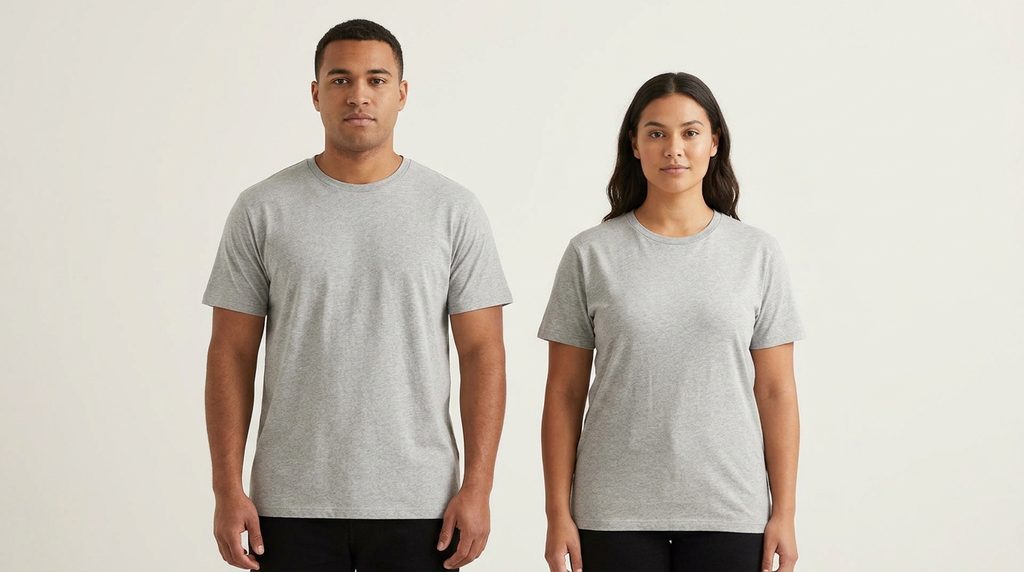
There is no single answer to how should a unisex T shirt fit, because fit is partly a matter of personal style. A classic everyday tee generally sits comfortably across the chest, gives the shoulders enough room to move, and does not pull tightly around the waist.
For a comfortable fit, the shoulder seam should usually sit around the natural shoulder area rather than hanging dramatically down the arm.
The chest should have enough space for normal movement without creating excessive tension across the fabric. A little extra room is common in unisex designs, and that is part of their appeal.
A relaxed fit can have wider sleeves and a little more room through the torso. An oversized tee takes this idea further, creating a noticeably loose silhouette.
Meanwhile, a person wanting a fitted look may select a smaller unisex size, but this should be based on actual measurements rather than simply choosing a smaller letter.
The important thing is comfort. If you can move your arms, sit, walk, and go through your normal day without constantly adjusting the shirt, you are probably somewhere near your preferred T-shirt fit.
Understanding Unisex T-Shirt Measurements
Letters such as S, M, and L are useful, but measurements tell a much more complete story. A proper size guide may include chest width, shoulder width, sleeve length, and T-shirt length.
The chest measurement is often the first number shoppers look for. Depending on the brand, the chart may show body circumference or the shirt’s flat measurement. Those two numbers should not be treated as identical.
For example, if a shirt measures 20 inches across the chest when laid flat, its approximate chest circumference is around 40 inches. That little distinction catches people out more often than you might expect.
Other measurements matter too. Shoulder width can affect how natural the shirt feels, especially if you have narrow or broad shoulders.
Sleeve length influences the overall appearance, while shirt length becomes especially important if you prefer either a tucked-in style or a longer casual silhouette.
How to Measure for a T-Shirt
You do not need a complicated fashion laboratory to measure yourself. A flexible measuring tape, a mirror, and a few quiet minutes are usually enough.
For your chest, wrap the tape around the fullest part of your upper torso. Keep it comfortably level and avoid pulling the tape extremely tight. This gives you your chest circumference, which can then be compared with the brand’s size chart.
To measure your waist, place the tape around your natural waist area without squeezing. If you have a tapered waist, remember that a straight-cut unisex shirt may naturally hang differently from a fitted women’s style.
For shoulder width, measure across the back from one shoulder point to the other. If the brand provides garment measurements, compare this with the shirt you already own and love. That trick can be surprisingly helpful.
Finally, measure the shirt length from the highest shoulder point down toward the bottom hem. This is useful when deciding between a standard fit T shirt, a longer shirt, or an oversized design.
Unisex T Shirt Size for Women
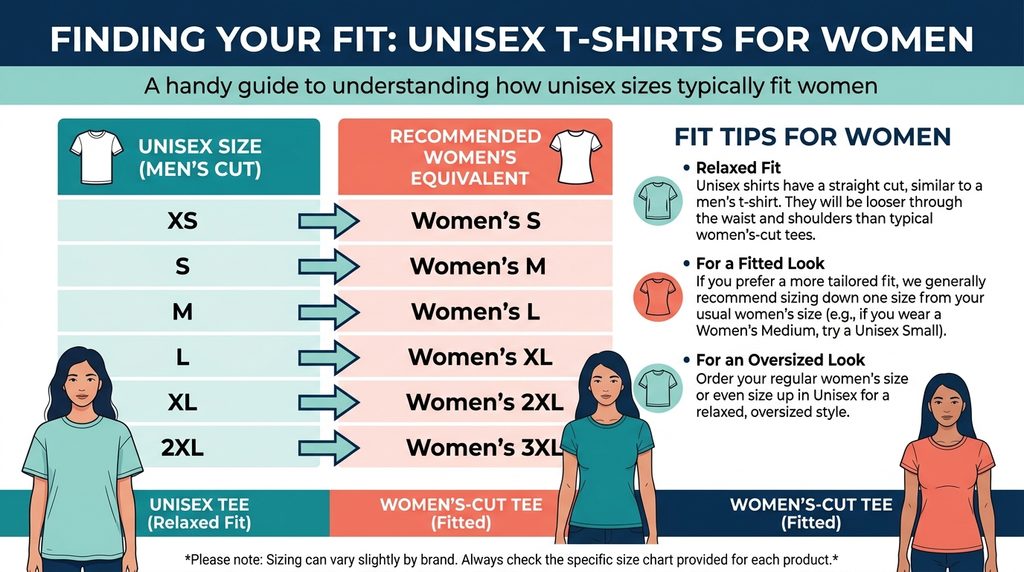
When considering a unisex T-shirt size for women, there is no universal rule that says everyone must size down. Some women prefer the relaxed proportions of a unisex shirt exactly as they are, while others choose one size smaller for a closer silhouette.
For example, someone who normally wears a Women’s large might feel comfortable in a unisex Large if they want a relaxed shirt. They might choose a unisex Medium if they prefer a more fitted appearance. Another person may intentionally select XL for a loose streetwear style.
This is why statements such as “women should always size down” are too simplistic. Women’s sizing and unisex sizing use different proportions, but personal styling can override the traditional conversion.
If you like a women’s relaxed T-shirt fit, staying close to your normal chest measurement is often a useful starting point. If you want a fitted unisex T-shirt, compare the garment measurements carefully before choosing.
Unisex T Shirt Size for Men
A unisex T-shirt size for men is often relatively straightforward when the brand’s chart resembles traditional men’s sizing. Someone who usually wears a Men’s medium may find that a unisex Medium gives a familiar fit.
But again, the word “unisex” does not guarantee identical measurements between brands. One Medium might be a classic straight cut, while another Medium could have a more boxy fit with wider sleeves and a shorter body.
Men with broader chests should pay particular attention to the chest size, while those with longer torsos may want to check T-shirt length before ordering. A shirt can fit nicely around the chest but still feel short through the body, which is a sneaky little problem.
Unisex Sizing vs. Women’s and Men’s Sizing
The difference between unisex and traditional sizing is mostly about garment construction and proportions rather than a simple mathematical formula.
A women’s shirt often has shaping around the bust and waist, while many unisex shirts use a straighter cut. A traditional men’s shirt may also use a straight shape, but its proportions can differ in shoulder width, length, and sleeve construction.
This means the unisex fit vs women’s fit can feel noticeably different even when the printed size looks similar. Likewise, the unisex fit vs men’s fit may be almost identical in one brand and quite different in another.
Here is a simple comparison:
| Feature | Unisex T-Shirt | Traditional Women’s Tee | Traditional Men’s Tee |
|---|---|---|---|
| Body shape | Usually straight | Often shaped | Usually straight |
| Shoulder area | Moderate to broad | More shaped | Often broader |
| Waist | Less tapered | Often tapered | Usually straight |
| Sleeves | Relaxed to standard | Often shorter/fitted | Standard to longer |
| Overall feel | Versatile | More contoured | Traditional straight fit |
The chart is only a broad guide. Actual apparel sizing depends heavily on the manufacturer and design.
What Does a Unisex Medium Mean?
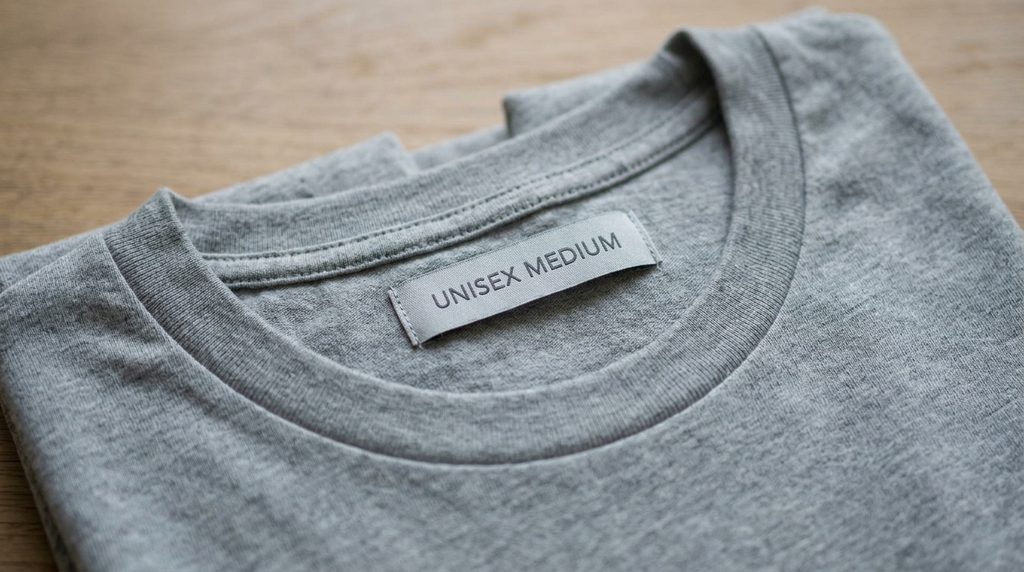
A unisex medium equivalent usually refers to a Medium designed with the proportions of that brand’s unisex range. In many brands, it may correspond roughly to a 36 38 inch chest, but that is not guaranteed.
If you are wondering what does unisex medium mean, the safest answer is: check the garment’s measurement chart. The letter M alone does not tell you everything.
This is particularly important for customized apparel, promotional shirts, and T-shirt merchandise, where manufacturers may use different blank shirt suppliers.
Two event shirts printed by different companies can both say Medium and still fit differently. Clothing sizing likes to keep us humble, apparently.
Choosing Between XXS, XS, Small, Medium, and Large
Smaller sizes such as XXS, XS, and Small (S) are often chosen by people who want less fabric around the body. However, the desired silhouette matters just as much as body measurements.
A Medium (M) often works as an everyday starting point for people whose chest measurement falls within that brand’s middle range. A Large (L) can provide more room through the chest and torso, while XL and larger sizes create progressively more space.
Do not automatically think that a larger size means a better or worse fit. Size is simply a measurement label. The goal is to find the garment dimensions that work comfortably for your body and your personal style.
XL, 2XL, 3XL, and 4XL Unisex Sizing
Larger inclusive sizing can be especially useful for people who want comfortable everyday clothing without compromising movement. XL, 2XL, 3XL, and 4XL may differ not only in chest width but also in garment length and sleeve dimensions.
Someone choosing Women’s XL, Women’s 2X, or Women’s 3X should not assume the equivalent unisex size can be identified from the label alone. The best approach is to compare actual measurements.
A broader size range is one of the practical benefits of thoughtful inclusive clothing design. Good sizing gives people more ways to find the fit they want, whether that means a standard silhouette, a loose fit, or an oversized look.
T Shirt Fit by Body Type
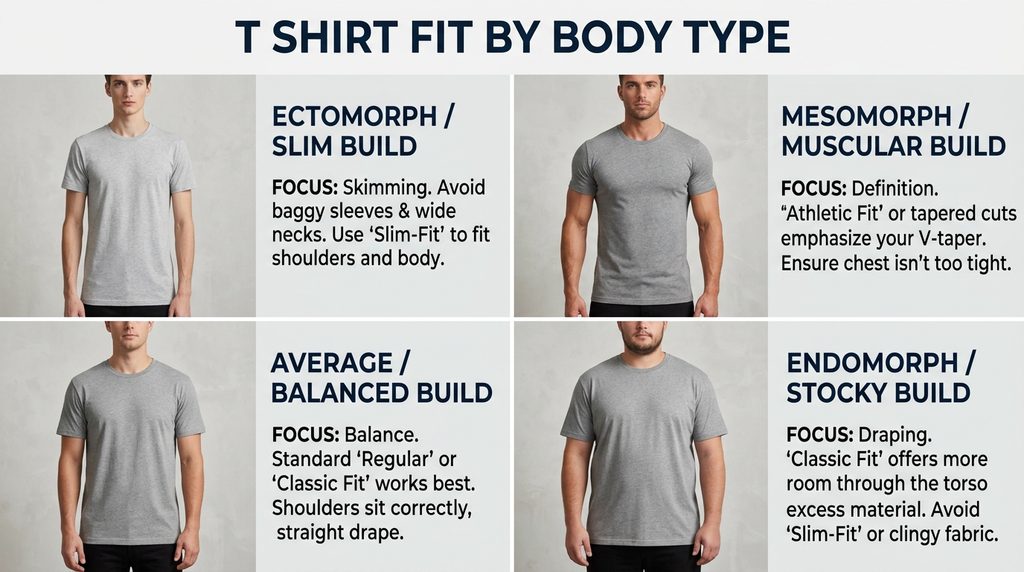
People often search for T-shirt fit by body type, but it is better to think in terms of proportions and preferences rather than strict body categories.
If you have narrow shoulders, a shirt with slightly structured seams may provide a balanced appearance. If you prefer extra space around the torso, a roomy fit can be more comfortable. Someone who likes a cleaner silhouette may prefer a straight cut with moderate fabric around the body.
For curves, the most comfortable choice may simply be a shirt with enough chest and hip room rather than a smaller size chosen to create a particular appearance. Clothing should accommodate the person wearing it, not force the person to accommodate the clothing.
Relaxed, Boxy, Fitted, and Oversized Styles
The same size can look completely different depending on the cut. A classic boxy tee is usually wider through the body and may be shorter than a traditional shirt.
A loose-fitting T-shirt gives more room around the chest and waist, while a tailored style may sit closer to the body. A tailored fit is not necessarily formal; it simply means the garment has a more shaped appearance.
An oversized unisex T shirt intentionally adds extra volume. It can be part of a modern casual wardrobe and works nicely with different styling choices. The trick is understanding that oversized is a design choice, not simply buying a shirt that is several sizes too large.
International T-Shirt Size Conversion
Shopping internationally introduces another little puzzle because US size, UK size, EU size, Japan size, Korea size, and Australia size systems can differ.
There is no completely universal international T-shirt sizing standard. A US Medium may not correspond perfectly to a Japanese Medium, for example. Even within the same country, individual clothing brands can interpret sizes differently.
A general size conversion chart can help as a starting point, but actual garment measurements are more reliable than a country-to-country letter conversion.
| General Label | US | UK | EU Approx. | Best Check |
|---|---|---|---|---|
| XS | XS | XS | 42 44 | Chest |
| S | S | S | 44 46 | Chest |
| M | M | M | 46 48 | Chest |
| L | L | L | 50 52 | Chest |
| XL | XL | XL | 54 56 | Chest |
| 2XL | 2XL | 2XL | 58 60 | Chest |
These EU figures are approximate and should not replace a brand-specific chart. International clothing sizes are not standardized enough for a single table to guarantee the perfect match.
Inches to Centimeters for Clothing Measurements
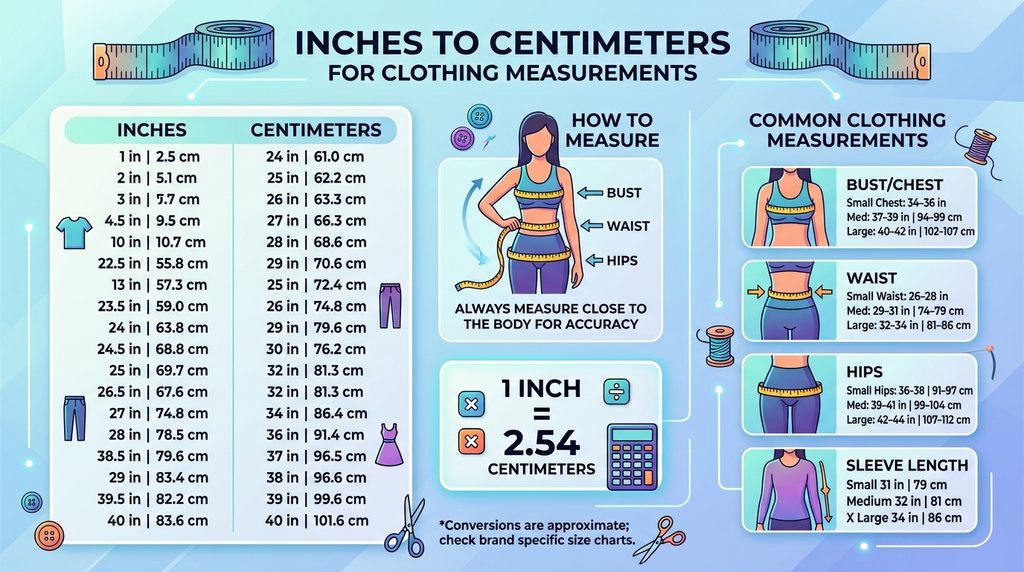
Many shoppers move between inches and centimeters, especially when buying from international clothing brands.
The basic conversion is:
1 inch = 2.54 centimeters
So:
- 32 inches = 81.28 cm
- 34 inches = 86.36 cm
- 36 inches = 91.44 cm
- 38 inches = 96.52 cm
- 40 inches = 101.60 cm
- 42 inches = 106.68 cm
- 44 inches = 111.76 cm
- 46 inches = 116.84 cm
- 48 inches = 121.92 cm
You may also see measurements such as 86 cm, 90 94 cm, 94 96 cm, 98 102 cm, 102 106 cm, 106 110 cm, or 110 114 cm on international size charts. Always check whether the number represents body circumference or the flat garment measurement, because those are not the same thing.
Why Brand Specific Size Charts Matter
One of the biggest mistakes shoppers make is assuming every clothing brand follows identical clothing size standards. They do not. A fashion label, sportswear company, promotional printer, and streetwear brand may all use different patterns.
Even within one company, a relaxed sweatshirt, fitted tee, and oversized shirt can have completely different measurements. That is why a brand specific size chart should usually beat a generic internet conversion chart.
If you already own a shirt that fits beautifully, measure it flat and compare those numbers with the new garment. This creates a much more useful reference than saying, “I always wear Medium.”
Unisex T Shirts for Merchandise and Events
Unisex shirts are popular for brand merchandise, concerts, school activities, sports teams, charity events, and community gatherings because one general style can work for a large group of people.
You might see the same approach used for pop singer merchandise, band merchandise, event apparel, or team apparel. A straight cut tee makes distribution easier because participants do not necessarily need completely separate men’s and women’s garments.
For large orders, however, it is still important to provide a detailed size chart. If people can submit their chest measurement and preferred fit before the order is placed, there are usually fewer unpleasant surprises later.
Why Choose Unisex Sizing?
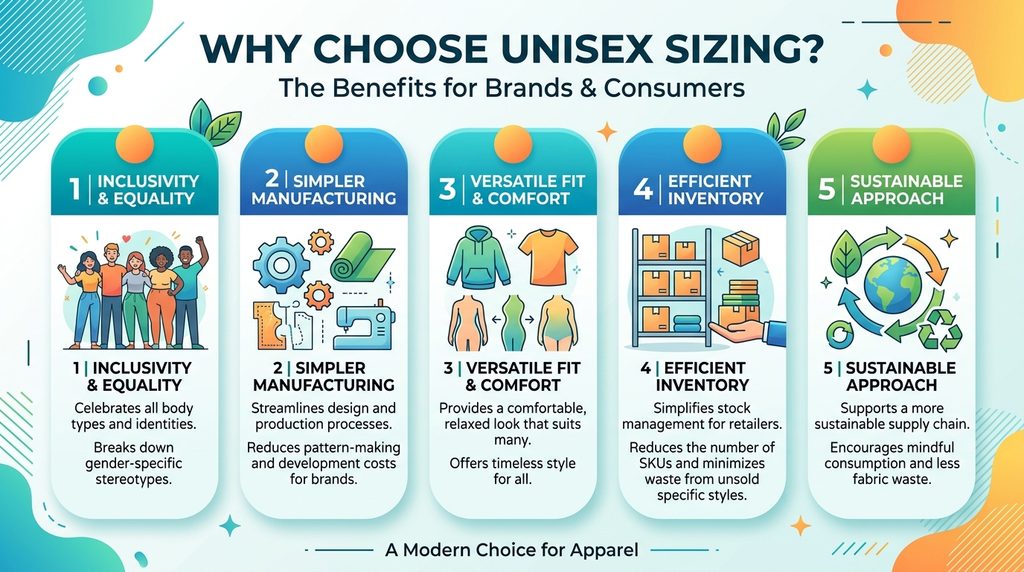
There are several practical benefits of unisex T-shirts. They can be versatile, easy to style, and useful for group orders. They also support the broader idea of gender-neutral fashion, where clothing choices are not limited by traditional categories.
A unisex tee can become part of an everyday wardrobe, a casual outfit, a customized design, or even a simple layering piece. Neutral colors can make styling easier, while brighter shades and graphics can bring a completely different personality.
Unlike highly structured haute couture, a T-shirt is usually about accessibility and daily comfort. And that simplicity is exactly why getting the fit right matters so much.
Common Unisex T-Shirt Sizing Mistakes
One common mistake is choosing a size based only on the label. Another is ignoring shirt length because the chest measurement looks correct.
People also sometimes confuse flat garment width with body circumference. A shirt measuring 20 inches across the chest does not mean the wearer has a 20 inch chest. The garment measurement is generally doubled to estimate its circumference.
Another mistake is assuming that an oversized shirt should simply be several sizes larger. Purpose-made oversized designs are often proportioned differently, with wider bodies, altered sleeve lengths, and sometimes shorter hems.
And finally, don’t forget personal preference. A person may intentionally choose a larger size because they like a relaxed style. Someone else may want a closer fit. Neither approach needs defending, really.
Quick Tips for Finding the Perfect T Shirt Fit
Before ordering, take your body measurements and write them somewhere handy. Then compare them with the actual chart provided by the clothing brand.
Check these measurements:
- Chest circumference
- Shoulder width
- Waist measurement
- Sleeve length
- T-shirt length
Think about how you want the shirt to feel. If you want a comfortable T shirt fit, allow enough room for movement. For a fitted appearance, compare your measurements carefully rather than automatically going down a size.
If you are between sizes, look at the garment’s cut. A boxy fit may already provide extra room, while a slim or tailored design could feel more restrictive at the same labeled size.
How to Pick a Unisex T Shirt as a Gift

Buying a T-shirt as a gift can be tricky because asking someone for their measurements may spoil the surprise. One clever option is to check a shirt they already wear often.
Look for a tee with a similar style and measure its chest width, length, and shoulder width. Then compare those measurements with the new shirt’s chart.
This method is especially helpful for customized T-shirts, family shirts, birthday merchandise, team apparel, and other personalized clothing. You are basically using their favorite shirt as a quiet little sizing translator.
A Final Guide to Choosing Your Size
If you only remember a few things from this T shirt size guide, remember these:
- Do not rely on the letter alone.
- Measure your chest carefully.
- Check whether the chart lists body or garment measurements.
- Compare shoulder width and shirt length when possible.
- Think about whether you want fitted, standard, relaxed, or oversized.
- Check the specific clothing brand’s chart.
- Use international conversion charts only as a starting point.
- When between sizes, consider both measurements and personal style.
The perfect shirt is not necessarily the one with the “correct” size label. It is the one that lets you move comfortably, feels right when you put it on, and looks the way you intended.
Frequently Asked Questions
How Do I Choose the Right Unisex T-Shirt Size?
Check your chest, shoulder, and shirt length measurements against the size chart to find the closest fit.
Are Unisex T-Shirt Sizes the Same as Men’s Sizes?
Unisex sizes often have a relaxed, standard cut and may differ slightly from traditional men’s or women’s sizing.
How Should a Unisex T Shirt Fit?
A unisex T-shirt should feel comfortable around the chest and shoulders without being too tight or excessively loose.
How Do I Measure for a Unisex T Shirt?
Measure your chest, shoulder width, and preferred shirt length, then compare these measurements with the brand’s size chart.
Should I Size Up or Down in a Unisex T Shirt?
Choose your usual size for a regular relaxed fit. Consider sizing up for a looser look or down for a closer fit.
Read This Blog:https://ravonexium.com/15-cm-to-inches-easy-conversion-guide-and-formula-explained/
Conclusion: Finding a T-Shirt That Feels Like Yours
Clothing has a funny way of becoming part of ordinary memories.
A favorite T shirt might remind you of a concert, a family trip, a school event, a special celebration, or just those lazy weekends when nobody wanted to dress too seriously. That is why choosing the right size can matter more than it first appears.
A good unisex T-shirt size chart gives you a starting point, but your own measurements and preferences tell the fuller story.
Whether you are looking for a unisex T shirt for men and women, building a gender-neutral wardrobe, ordering team shirts, or simply searching for a reliable everyday tee, understanding chest size, shoulder width, length, and fit makes shopping much easier.
And if you are welcoming a new baby girl into the family, even the smallest clothing choices can become sweet keepsakes. A tiny customized tee, a family event shirt, or a matching outfit can become one of those ordinary objects that quietly carries a memory for years.
A grandparent may remember the first time they saw that little shirt, while parents remember the happy chaos surrounding those early days. The garment is simple, but the moment around it is anything but.
So measure twice, check the brand chart, and choose the fit that feels natural to you. Unisex fashion is at its best when it gives people room to express themselves rather than making everyone fit one rigid template. And sometimes, finding the right T-shirt really is that simple.