
There is something oddly satisfying about holding a cold Coke can in your hand. It is just a simple little cylinder, yet its size feels almost perfectly familiar, like the object has quietly learned the shape of our hands, refrigerators, cup holders, and lunch bags.
You might not think about its measurements while taking a sip, but the moment you need to design a holder, plan retail packaging, arrange a vending machine, or compare cans, those tiny dimensions suddenly become important.
A Coca Cola can is not available in one universal size either. The familiar U.S. can is usually the 12 oz / 355 mL format, while smaller and taller versions appear in different markets and product lines.
Even cans with the same capacity can have different proportions, which is where things get a little interesting.
This Coke can dimensions guide explains the common formats, including standard, mini, tallboy, and slim cans.
It also covers height, diameter, radius, circumference, lid size, capacity, and practical uses so you can understand the can rather than merely memorize a number.
Measurements below should be treated as approximate format references, because exact dimensions can vary between packaging specifications and markets. Technical vending documentation, for example, lists a U.S. 16 oz Coca-Cola can at 6.21 inches high and 2.60 inches in diameter.
| Coke Can Size | Volume | Height | Diameter |
|---|---|---|---|
| Mini Can | 7.5 oz / 222 mL | 4.2 in | 2.1 in |
| Standard Can | 12 oz / 355 mL | 4.83 in | 2.6 in |
| Tallboy Can | 16 oz / 473 mL | 6.2 in | 2.6 in |
| Slim Can | 12 oz / 355 mL | 6.125 in | 2.13 in |
Coke Can Dimensions at a Glance
The easiest way to begin is with a quick Coke can size chart. The standard 12 oz can is the familiar reference point for many people in the United States, while other sizes change either the height, diameter, or both.
| Coke Can Size | Capacity | Approx. Height | Approx. Diameter |
|---|---|---|---|
| Mini Coke can | 7.5 oz / 222 mL | About 4.1 in / 10.4 cm | About 2.25 2.3 in / 5.7 5.8 cm |
| Standard Coke can | 12 oz / 355 mL | About 4.8 4.83 in / 12.2–12.3 cm | About 2.6 in / 6.6 cm |
| Slim Coke can | 12 oz / 355 mL | About 6.1 6.2 in / 15.5–15.7 cm | About 2.25 2.3 in / 5.7 5.8 cm |
| Tallboy Coke can | 16 oz / 473 mL | About 6.2 in / 15.7 cm | About 2.6 in / 6.6 cm |
| European style can | 330 mL | About 4.5 in / 11.5 cm | Varies by format |
| Australian style can | 375 mL | About 5 in / 12.7 cm | Varies by format |
| Small Asian format | 250 mL | Varies | Varies |
The numbers can differ between individual products, so this table is best used as a planning reference rather than a manufacturing blueprint.
For comparison, one current technical reference gives a 355 mL standard can at about 122.22 mm high and 66.1 mm wide, while a 355 mL sleek can is much taller and narrower.
Standard Coke Can Dimensions: 12 oz / 355 mL
The standard Coke can is probably the measurement most people are looking for when they search for Coke can measurements.
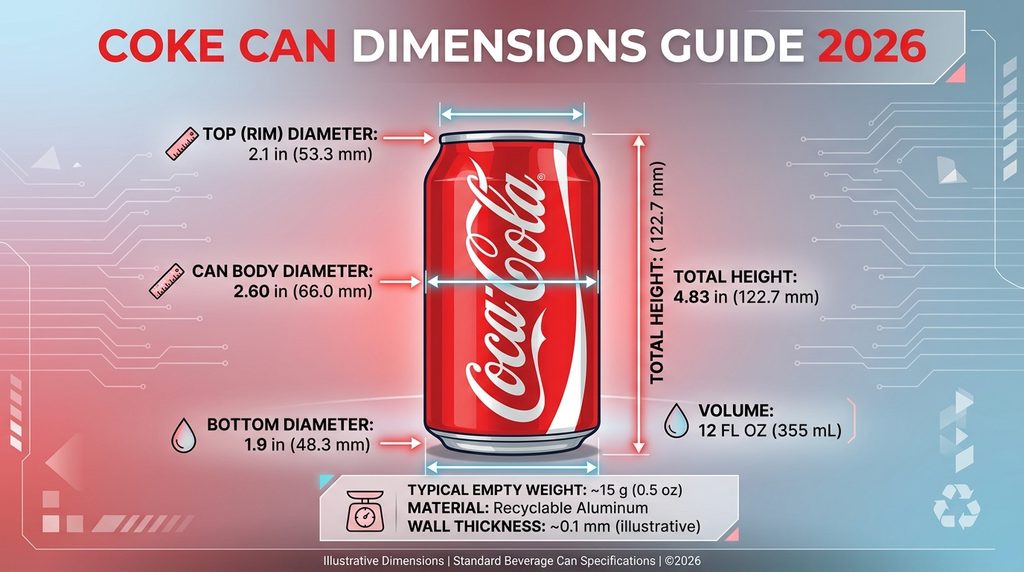
A typical U.S. 12 oz Coke can contains 355 mL of beverage. Its approximate dimensions are:
- Height: 4.83 inches / 12.3 cm
- Body diameter: 2.6 inches / 6.6 cm
- Radius: about 1.3 inches / 3.3 cm
- Lid diameter: about 2.13 inches / 5.41 cm
- Circumference: about 8.17 inches / 20.75 cm
The body diameter is the number that matters most when you are checking whether a can will physically fit inside a holder. The lid is narrower than the main body, giving the can its familiar stepped appearance around the top.
A technical packaging reference for a 16 oz Coca Cola can also records a 2.60 inch diameter, showing how the same broad can diameter can be retained while increasing capacity mainly through extra height.
12 oz Coke Can Dimensions in Inches and Centimeters
For people working on craft projects, packaging, CAD drawings, product displays, or storage, having both measurement systems is handy.
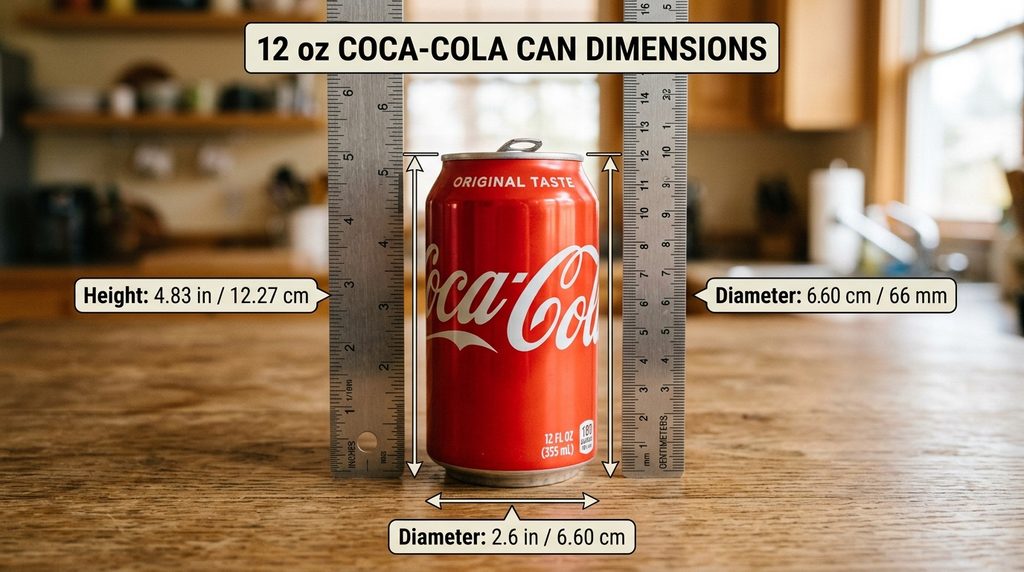
The common 12 oz Coke can dimensions are approximately:
- 4.83 inches tall
- 12.3 centimeters tall
- 2.60 inches wide
- 6.6 centimeters wide
- 1.30 inch radius
- 3.3 centimeter radius
The circumference is roughly 8.2 inches, or around 20.8 cm. This is simply the distance around the cylindrical body and can be estimated using the formula circumference = π × diameter.
Tiny differences matter more than people expect. A holder designed at exactly the same diameter as a can may be too tight, because manufacturing tolerances and the shape of the holder itself can change the fit.
So, if you’re building something physical, don’t treat an internet measurement as an absolute law of the universe.
Mini Coke Can Dimensions: 7.5 oz / 222 mL
The mini Coke can is made for a smaller serving, but “mini” does not always mean one exact physical shape.
A commonly referenced 7.5 oz / 222 mL mini format is roughly 4.1 inches tall and around 2.25 to 2.3 inches in diameter.
Packaging specifications for 222 mL sleek-style cans can differ, which is why the actual can should be measured when a close-fitting product is being designed.
The 7.5 oz Coke format is popular for portion control and smaller serving occasions. It is noticeably less bulky than the standard 355 mL can, although its exact height depends on the packaging format.
Approximate mini-can figures include:
- Capacity: 7.5 oz / 222 mL
- Height: around 4.1 inches / 10.4 cm
- Diameter: around 2.25 2.3 inches / 5.7 5.8 cm
- Radius: roughly 1.1 1.15 inches
If you’re comparing the mini can with the standard can, the biggest difference is not simply “smaller everywhere.” Manufacturers can change the proportions, making the little can feel quite different in your hand.
16 oz Coke Can Dimensions: Tallboy Format
The 16 oz Coke can, sometimes called a tallboy Coke can, increases capacity without dramatically increasing the body width.
A documented U.S. 16 oz Coca-Cola can is listed at:
- Capacity: 16 oz / 473 mL
- Height: 6.21 inches / 15.76 cm
- Diameter: 2.60 inches / 6.59 cm
That technical packaging record identifies it specifically as a Coca-Cola aluminum can made for vending applications.
This is a useful example of why Coke can size comparison should include both capacity and shape. A 16 oz can can have almost the same diameter as the familiar 12 oz can while being considerably taller.
That extra height becomes important when checking a refrigerator shelf, cooler compartment, vending machine column, or car storage space.
Slim Coke Can Dimensions
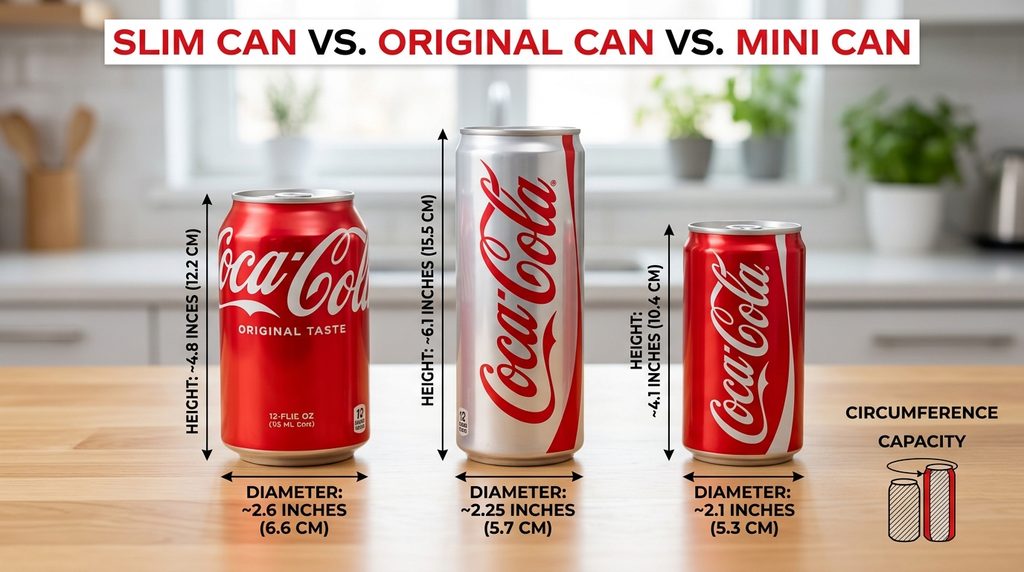
The slim Coke can is a different creature altogether. It usually has a smaller diameter and considerably more height, giving it a sleek vertical appearance.
A 355 mL sleek can format, for example, can be approximately 156.6 mm tall and 58 mm in diameter. That works out to roughly 6.16 inches tall and 2.28 inches wide.
So a slim or sleek 12 oz can can hold essentially the same beverage volume as a standard 355 mL can while looking dramatically taller.
This distinction matters for:
- Car cup holders
- Refrigerator door shelves
- Coolers
- Lunch boxes
- Vending machine slots
- Custom can holders
- Product photography
- Beverage packaging designs
If a project requires a snug fit, never assume that “355 mL” automatically tells you the physical dimensions.
Coke Can Dimensions Chart for International Sizes
Coca Cola products are sold across North America, Europe, Australia, Asia, and many other markets. The capacity printed on the label can therefore look quite different from the familiar U.S. 12 oz number.
Common reference formats include:
| Market / Format | Capacity | Approximate Equivalent |
|---|---|---|
| U.S. standard | 355 mL | 12 oz |
| Europe | 330 mL | About 11.2 oz |
| Australia | 375 mL | About 12.7 oz |
| Smaller international format | 250 mL | About 8.5 oz |
| U.S. mini | 222 mL | 7.5 oz |
| U.S. tall format | 473 mL | 16 oz |
A 330 mL can should not automatically be assumed to have exactly the same height as a 355 mL can. Packaging manufacturers offer multiple geometries, including standard and sleek designs.
That is one reason international Coke can sizes can feel confusing at first glance.
Coke Can Measurements: Height, Diameter, Radius and Circumference
When someone says “Coke can dimensions,” they might mean several different things.
Can height is the vertical distance from the bottom of the can to the top edge.
Can diameter is the distance across the cylindrical body. For a standard can, it is roughly 2.6 inches.
Can radius is half the diameter, so a 2.6-inch body diameter produces a radius of approximately 1.3 inches.
Can circumference is the distance around the body. For a 2.6-inch diameter, the circumference is approximately 8.17 inches.
There is also the can opening, which is smaller than the full body diameter. The familiar top opening sits inside the can lid, and the lid itself is shaped differently from the cylindrical body.
This may sound like mathematical housekeeping, but it becomes very useful when you’re designing a printed sleeve, storage rack, custom holder, or display.
Coke Can Lid and Opening Dimensions
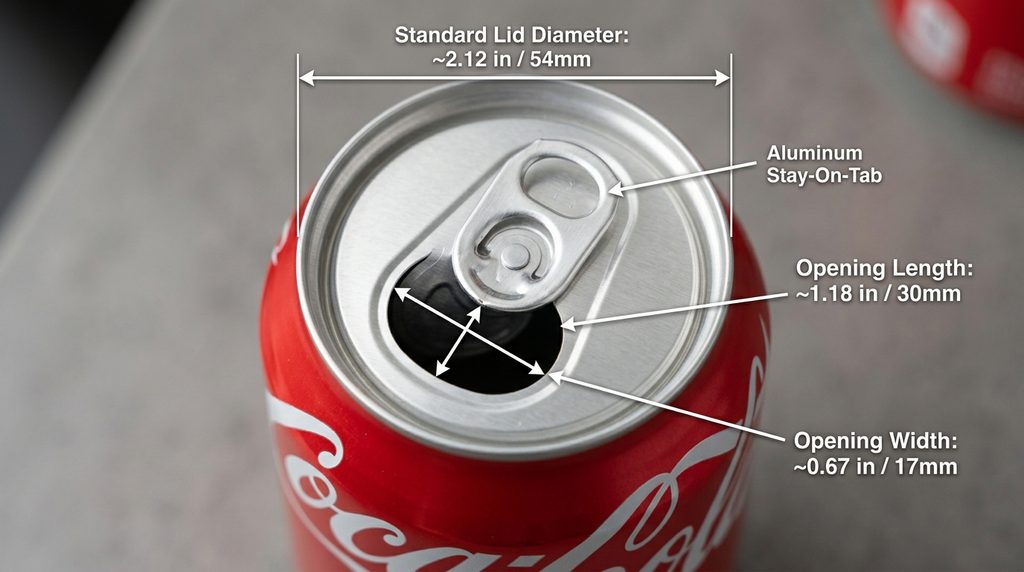
The top of a can has more going on than it looks like. The can lid contains the opening, pull tab, rim, and recessed areas that help the container maintain its structure.
A commonly cited standard lid diameter is around 2.13 inches / 5.41 cm, compared with a body diameter of about 2.6 inches / 6.6 cm.
The term tapered lid can sometimes cause confusion because the top is not simply a smaller cylinder stuck onto the body. The transition between the body and lid is part of the can’s overall engineered shape.
For a visual or craft project, measuring the top separately can prevent an annoying little mismatch later.
Coke Can Capacity vs Physical Volume
A can’s can capacity is the amount of beverage it is intended to contain, while the external dimensions describe the physical container.
For example, a 355 mL Coke can contains 355 mL of beverage, but that does not mean the outside of the aluminum cylinder has a geometric volume of exactly 355 mL.
There is material thickness, a shaped bottom, a shaped top, headspace, and structural features. The inside is not a perfect mathematical cylinder.
This distinction is especially useful for anyone doing packaging calculations. If you’re estimating can volume from height and diameter alone, your result will be an approximation rather than the labeled liquid capacity.
Coke Can Packaging and Retail Display
The shape of a can affects far more than how it feels in your hand. It affects retail packaging, soda packaging, shelf arrangements, transport cartons, and the amount of shelf space required.
Standard cans can be stacked or grouped efficiently because their cylindrical bodies create predictable footprints. A retailer may arrange them in rows, while a vending machine needs a can format that fits its internal mechanism.
The same logic appears in refrigerators and coolers. A taller can can fit vertically on one shelf but become awkward on another. A slim can may use less horizontal space but require more vertical clearance.
Packaging design is therefore a quiet game of millimeters. Nobody notices it when everything works, which is sort of the point.
Coke Can Size for Car Cup Holders, Coolers and Mini Fridges
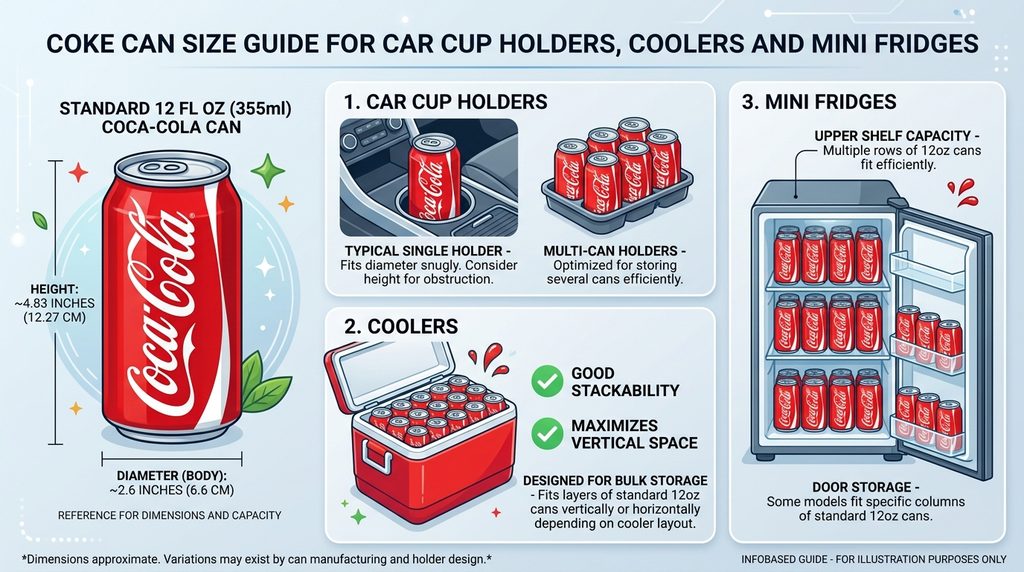
A standard 12 oz can has a diameter of around 2.6 inches, which makes it compatible with many common beverage holders.
Still, “fits a cup holder” is not a guarantee for every vehicle. Cup holders differ in depth, diameter, taper, and surrounding space.
The same applies to a mini-fridge, cooler, refrigerator shelf, or lunch box.
Before designing a tight-fit insert, measure:
- Available width
- Available height
- Holder depth
- Opening diameter
- Clearance above the can
- Space around neighboring cans
A Coke can for cup holders may work beautifully in one holder and wobble in another. Real-world furniture, appliances and vehicles are wonderfully inconsistent like that.
Coke Can vs Pepsi Can Dimensions
People often search for Coke can vs Pepsi can dimensions because both brands use familiar aluminum beverage-can formats.
In practice, the important comparison is usually not the logo. It is the actual packaging format: capacity, diameter, height, and can design.
A standard Pepsi can and standard Coca Cola can may be very similar in external dimensions because the beverage industry uses standardized can formats. But exact measurements can vary by market, supplier, and product.
The same principle applies when comparing Sprite, Dr Pepper, Diet Coke, or other soft drinks. The branding may change while the underlying aluminum can format remains similar.
Coke Can Comparison With Energy Drink Cans
Energy drinks make an interesting comparison because brands often use taller, slimmer packaging.
For example, a Red Bull can is commonly available in an 8.4 oz format, while Celsius and Monster products are available in various larger or taller formats.
A commonly cited Red Bull can height is around 5.3 inches for the 8.4 oz format, while a Celsius can can be around 6.25 inches depending on the particular product. These figures demonstrate why you shouldn’t identify a can by appearance alone.
A can’s shape can communicate portion size, brand identity, portability, and even the intended drinking occasion before anybody reads the label.
Coke Can Size and Nutrition Information
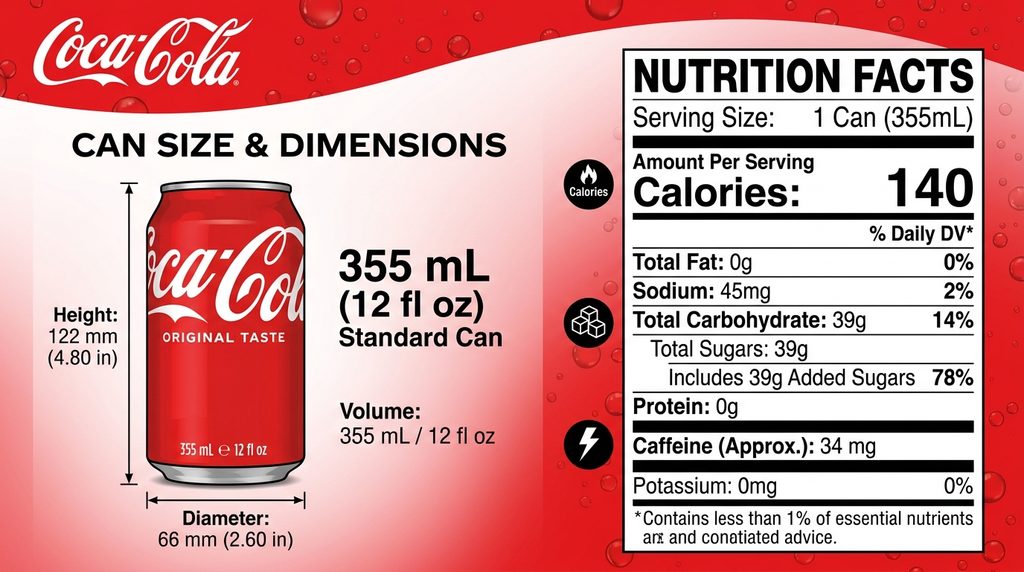
Physical size also connects with the amount of beverage being consumed. A larger can capacity generally contains more liquid, although the nutritional information depends on the specific product.
For regular Coca-Cola, commonly cited U.S. nutrition information for a 12 oz serving includes around 39 grams of sugar and 34 mg of caffeine, although formulations and serving labels can change by market and product.
That means the words “12 oz Coke” describe both a physical container size and a serving quantity. But the container dimensions themselves do not tell you the nutritional content.
For Diet Coke, Coca-Cola Zero Sugar, and specialty flavors, the nutritional profile can be quite different even when the can dimensions are identical.
Why Coke Can Dimensions Matter in Real Life
You might wonder why anyone needs such precise information for a soda can. Then you start making something for one, and suddenly 2.6 inches becomes the most important number on your desk.
Accurate Coke can measurements are useful for:
- Product packaging
- Storage planning
- Refrigerator organization
- Cooler design
- Vending machines
- Retail displays
- Cup holders
- 3D modeling
- Graphic design
- Product photography
- Custom can holders
- Shipping calculations
A designer creating a sleeve might care about circumference. A vending-machine technician may care about height and diameter. Someone organizing a mini-fridge may care mostly about vertical clearance.
Same can, completely different question.
How to Measure a Coke Can Yourself
If you have the exact can you are designing around, measuring it yourself is often better than relying on a generic online chart.
Use a ruler or digital caliper and measure the widest part of the body for the can diameter. Then measure vertically from the lowest point of the base to the highest point of the rim for the overall height.
For the lid, measure across the top separately.
If accuracy really matters, take each measurement two or three times. Write down the results in both inches and centimeters so you don’t later wonder whether 6.6 means centimeters or inches. That particular mistake has caused more than one bad drawing, probably.
Also measure the actual product rather than assuming that every Coke can with the same volume has the same shape.
Choosing the Right Coke Can Size
Choosing a can size depends on what you’re actually trying to do.
For a traditional U.S. soft drink reference, the 12 oz / 355 mL standard Coke can is the most useful starting point.
For smaller servings, the 7.5 oz / 222 mL mini Coke can offers a reduced capacity.
For more beverage without greatly increasing diameter, the 16 oz / 473 mL tallboy adds height.
For a narrow, modern appearance, a slim Coke can can provide a taller profile with a smaller diameter.
And if you’re working internationally, always check whether the product is a 330 mL can, 375 mL can, 250 mL can, or another regional format before designing around it.
Frequently Asked Questions
What Is the Height of a Standard Coke Can?
A standard 12 oz Coke can is 4.83 inches (12.3 cm) tall.
What Is the Diameter of a Coke Can?
A standard Coke can has a diameter of about 2.6 inches (6.6 cm).
How Big Is a 7.5 Oz Mini Coke Can?
A 7.5 oz mini Coke can is 4.2 inches tall and 2.1 inches in diameter.
What Size Is a 16 Oz Coke Can?
A 16 oz tallboy Coke can is 6.2 inches tall and 2.6 inches in diameter.
How Tall Is a Slim Coke Can?
A slim Coke can is approximately 6.125 inches tall with a 2.13-inch diameter.
Read This Blog:https://ravonexium.com/how-long-is-8-inches/
Final Thoughts on Coke Can Dimensions
The humble Coke can is a surprisingly clever piece of packaging. Its height, diameter, radius, circumference, lid, opening, and capacity all work together to make a container that can travel through vending machines, refrigerators, coolers, retail displays, and our hands without demanding much attention.
For most U.S. projects, remember the familiar reference point: approximately 4.83 inches tall and 2.6 inches in diameter for a 12 oz / 355 mL standard can.
For a 16 oz Coca-Cola can, technical vending documentation gives approximately 6.21 inches in height and 2.60 inches in diameter.
But the most important lesson in this entire Coke can dimensions guide 2026 is that capacity alone does not define shape. A 355 mL standard can and a 355 mL sleek can can hold the same amount while having very different proportions.
So, if you’re creating packaging, storage, a cup holder, a vending-machine layout, or simply trying to figure out why one can fits somewhere and another doesn’t, measure the actual format.
A few millimeters can turn a perfect fit into a frustrating one, and cans, for all their simplicity, are not as identical as they look.