Have you ever tried to picture a length without having a ruler nearby? Maybe you’re shopping for a tablet, measuring a small shelf, preparing a school project, or wondering whether an object will fit inside a particular space.
Eight inches might sound like a simple measurement, but imagining its actual size isn’t always easy. We often understand measurements much better when we compare them with things we already know.
The first time you compare eight inches with an everyday object, the number starts to feel less abstract. A banana, a notebook, a few soda cans, or a familiar sheet of paper can help you build a mental picture. Suddenly, 8 inches becomes something you can visualize instead of just a number on a measuring tape.
So, what does 8 inches look like compared to common things? Eight inches equals 20.32 centimeters, which is about two-thirds of a foot. It’s a useful length for understanding small household items, electronic devices, stationery, and many other objects we encounter throughout the day.
In this guide, we’ll explore several familiar comparisons, explain how to estimate eight inches without a ruler, and look at simple measurement conversions.
Some objects will be close to eight inches, while others will help you understand the length through a combination of smaller dimensions. Let’s make this measurement easier to picture, one everyday example at a time.
| Common Item | Approximate Length |
|---|---|
| Standard pencil | 7–8 inches |
| Dinner fork | 7–8 inches |
| Small tablet | 8 inches |
| Butter knife | 7–8 inches |
| Large smartphone | 6–8 inches |
| Adult hand (wrist to fingertip) | 7–8 inches |
| Paperback book width/height (varies) | Around 8 inches |
| Small kitchen spatula | 8 inches |
How Big Is 8 Inches? Understanding the Basic Measurement
Before comparing everyday objects, it helps to understand what the measurement actually means. An inch is a standard unit in the imperial measurement system, commonly used in the United States for everyday measurements, product dimensions, and construction projects.
Eight inches is not particularly long, but it is large enough to notice when holding an object in your hand. Think of the length of a small notebook, the longer dimension of certain compact electronic devices, or the distance between two points on a desk.
Here are the essential conversions.
| Measurement unit | Equivalent of 8 inches |
|---|---|
| Inches | 8 in |
| Centimeters | 20.32 cm |
| Millimeters | 203.2 mm |
| Feet | 0.6667 ft |
| Meters | 0.2032 m |
| Yards | 0.2222 yd |
The conversion is straightforward. Since one inch equals 2.54 centimeters, multiplying 8 by 2.54 gives 20.32 centimeters.
Similarly, twelve inches make one foot, so eight inches equals two-thirds of a foot. It’s shorter than a standard foot-long ruler, but the difference is easy to overlook until you compare them side by side.
Remember that 8 inches in cm is 20.32 cm, a useful figure if you’re reading product descriptions from countries that use the metric system.
What Does 8 Inches Look Like Compared To Common Things? 7 Everyday Examples
The easiest way to understand a measurement is to connect it with familiar objects. The examples below offer practical reference points for estimating eight inches in real life. Their dimensions can vary, so treat them as comparisons rather than exact measuring tools.
A Medium-Sized Banana
A medium or large banana can be a useful starting point when trying to imagine eight inches. Some bananas measure around seven to eight inches from end to end, although smaller fruit may be noticeably shorter.
Picture placing a banana horizontally on a kitchen counter. Its curved shape gives you a rough sense of the length, but remember that measuring along the curve produces a different result from measuring its straight-line distance between the tips.
This comparison is especially convenient because bananas are common in many kitchens. If you’re trying to visualize common things that are 8 inches long, a banana might give you a surprisingly helpful estimate without any special equipment.
A Small Notebook
Some compact notebooks measure close to eight inches along their longer edge. Others are shorter, particularly pocket-sized notebooks designed to fit inside a small bag.
Take a look at the notebook you use for school or personal notes. Its height might be near the length you’re imagining, even if the width is much smaller.
A notebook is a particularly useful everyday reference object because its edges are straight. Unlike a banana or another curved item, you can easily see the distance from one end to the other. Just check its dimensions before treating it as a reliable measuring reference.
An iPad Mini’s Screen
An iPad mini provides an interesting comparison, but there’s an important detail to understand. Its display is approximately 8.3 inches diagonally, which is slightly longer than eight inches.
A screen’s advertised size is measured from one corner of the display to the opposite corner, not straight across its width or along its height. This means an 8.3-inch screen doesn’t have an eight-inch-wide body.
Imagine drawing a line between opposite corners of the screen. That diagonal line gives you a close reference for eight inches, while the actual device dimensions are different.
This is a helpful example of why object dimensions need context. When comparing electronic devices, always check whether a measurement refers to the screen diagonal, device height, device width, or overall thickness.
A5 Paper
A5 paper measures approximately 5.8 × 8.3 inches, making its longer edge a close match for eight inches.
If you’ve ever used a small notebook, journal, or notepad, you may already be familiar with this paper size. The longer side extends about 0.3 inches beyond eight inches, so it’s a convenient visual comparison.
A5 paper is also useful because its dimensions follow an international standard. Unlike a banana or a hand, the paper size is consistent when the sheet conforms to the standard.
If you have an A5 notebook at home, look at its longer edge. You’ll get a good impression of what eight inches looks like without needing to search for a special measuring tool.
Three Soda Cans Placed Side by Side
A typical standard soda can has a diameter of roughly 2.6 inches, although can sizes vary by brand and design.
Place three cans next to one another in a straight row, measuring across their widths rather than around their curved surfaces. Their combined width would be approximately 7.8 inches if each can measures 2.6 inches across.
That’s remarkably close to eight inches.
This comparison works best when the cans are touching and arranged in a straight line. If you leave gaps between them or use unusually slim cans, the total measurement will change.
It also provides a useful lesson in measurement comparison: several small objects can help you estimate a longer distance when you know their approximate dimensions.
A Wooden Pencil
Many ordinary wooden pencils measure around seven to eight inches before sharpening, though their exact lengths depend on the manufacturer and style.
A standard unsharpened pencil is therefore a convenient object to consider when estimating eight inches. Place it horizontally on a desk and imagine extending its length by a small amount.
However, don’t assume every pencil is exactly eight inches long. Some pencils are shorter, and mechanical pencils, carpenter pencils, and mini pencils have different dimensions.
The main advantage of this comparison is availability. A pencil is often sitting in a school bag, desk drawer, or stationery holder when you need a quick visual guide.
A Human Hand
Your hand can help you estimate a length, but it’s not a universal ruler. Hand length varies from person to person, and the measurement depends on where you start and finish.
For example, the distance from the base of your palm to the tip of your middle finger is one possible reference. Some adults may have a hand length approaching eight inches, while others will have shorter hands.
A hand span, measured between the tips of the thumb and little finger when spread apart, is a different measurement entirely. It’s important not to confuse the two.
For measuring by hand, use your own hand as a rough reference only after checking its actual dimensions against a ruler. Once you know your hand length, it can become a convenient personal measuring guide.
How Long Is 8 Inches Compared to Office and School Supplies?
School and office supplies make excellent reference points because they have relatively regular shapes. You probably won’t find every object measuring exactly eight inches, but several can help you visualize the distance.
A4 Paper’s Shorter Edge
A standard A4 sheet measures approximately 8.27 × 11.69 inches. Its shorter edge is therefore very close to eight inches, measuring about 8.27 inches.
This is a particularly useful comparison for people who print documents, complete homework, or use office stationery. A4 paper is widely used internationally, so the reference is easy to recognize.
Lay a sheet flat on a desk and look at its shorter edge. It’s just a little longer than eight inches, providing a practical visual guide.
Keep in mind that paper dimensions refer to the sheet itself, not the printable area inside the margins.
A Row of Eight Paperclips
Small paperclips can provide another way to understand length. If each paperclip measures approximately one inch from end to end, eight clips arranged in a straight row would span about eight inches.
In reality, standard paperclips come in several sizes, and their longest dimensions are not always exactly one inch. Some may be shorter or longer, so check the particular clips you’re using.
Arrange them carefully, end to end, with as little space between them as possible. This creates a simple demonstration of how repeated reference points can help estimate a larger measurement.
It’s also a fun classroom activity for teaching children about inches, estimation, and the difference between an approximate result and an accurate measurement.
A Wooden Ruler
A standard 12-inch ruler is one of the simplest tools for visualizing eight inches accurately. The eight-inch mark appears two-thirds of the way along the ruler, leaving four inches beyond it.
If you don’t have an eight-inch object available, a regular ruler can show you the exact distance directly.
Look at the marks between zero and twelve. Count to the eight-inch line, or use the centimeter markings if your ruler includes both measurement systems.
Once you’ve seen eight inches on a ruler, it becomes easier to recognize similar lengths elsewhere. That’s the basic idea behind visualizing measurements: a familiar reference gradually helps you make better estimates.
A Standard Business Card
A typical US business card measures 3.5 inches long and 2 inches wide. Two cards placed end to end along their longer edges measure seven inches, which is one inch shorter than eight.
Add a third card and the combined length becomes 10.5 inches, assuming all cards have standard dimensions and are aligned correctly.
This makes business cards a helpful comparison, though they’re better for understanding a nearby length than measuring exactly eight inches.
You can also compare four card widths of two inches each to reach eight inches. That arrangement demonstrates how the orientation of an object affects the total distance you measure.
Household Objects That Help You Picture Eight Inches
Sometimes the most convenient measuring references aren’t in a pencil case or office drawer. They’re already sitting in the kitchen, living room, or bathroom.
A Small Serving Plate
Some small serving plates have a diameter of around eight inches, although plate sizes range considerably. Dessert plates, side plates, and bread plates can all have different measurements depending on their intended use.
A plate’s diameter is the straight-line distance across its circular surface through the center. It isn’t the distance around the outside edge, which would be its circumference.
If your plate is labeled eight inches, you have a direct reference. Otherwise, use it as an approximate comparison until you can check the actual diameter.
This distinction matters because circular objects can make measurements confusing if you accidentally compare their width with their perimeter.
A Small Kitchen Spatula
Some compact spatulas have a handle or overall length close to eight inches. Others are much longer, especially utensils designed for deep mixing bowls or large pans.
For a fair comparison, measure the entire utensil from one end to the other. Measuring only the silicone head or the handle will give you a different result.
A spatula can be a handy reference if you’re planning a kitchen drawer, arranging utensils in a storage container, or deciding whether a particular compartment is large enough.
It’s a reminder that familiar household items can help with quick length estimation, even when their dimensions are not standardized.
A Small Picture Frame
Compact photo frames are available in many sizes, including frames with an outer edge close to eight inches long. However, the dimensions of the photograph inside the frame may differ from the overall frame size.
For example, a frame holding a smaller photograph may have a larger outer border. When measuring, decide whether you’re interested in the glass opening, the picture itself, or the complete frame.
This is especially useful when arranging photographs on a shelf or planning a gallery wall. An eight-inch measurement can help you estimate how much space a frame occupies without having to guess based on its appearance alone.
A Small Serving Bowl
Some serving bowls measure close to eight inches across their top opening. Yet the base is usually narrower, and the bowl’s depth is a separate dimension.
If you’re comparing a bowl with an eight-inch space, measure the widest point across the opening. Don’t rely on its height or the distance around its rim.
This example is useful because it shows that object dimensions often involve several measurements. Length, width, height, depth, and diameter describe different aspects of an object, even when they belong to the same item.
What Does 8 Inches Look Like in Everyday Situations?
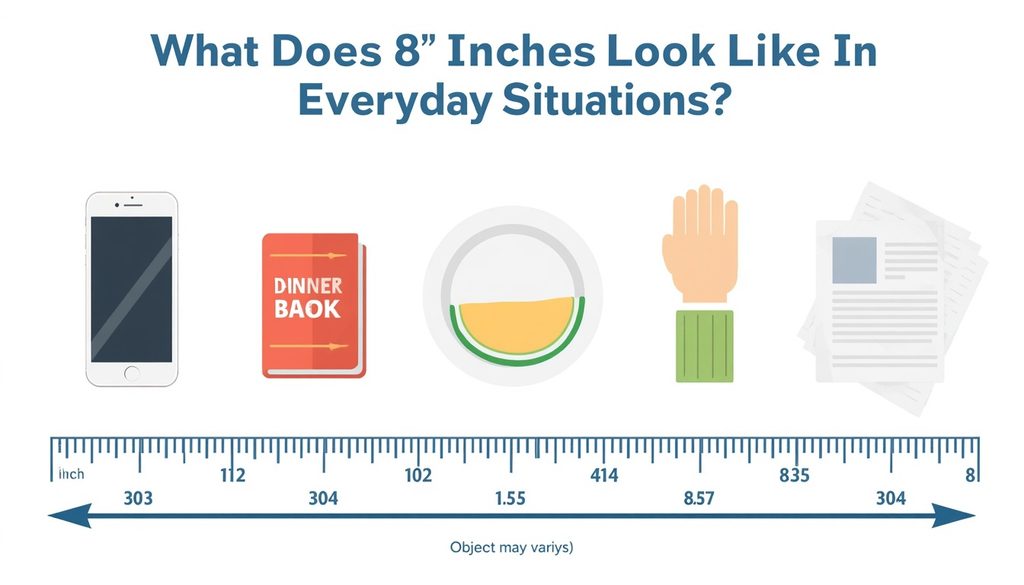
Understanding a measurement becomes more useful when you know how to apply it. Eight inches might appear in shopping decisions, home organization, crafts, or school assignments.
When Shopping for Electronic Devices
Product descriptions frequently include screen size, body dimensions, and accessory measurements. An eight-inch screen may sound like a width of eight inches, but the number usually describes its diagonal when the manufacturer lists the display size that way.
Before buying a tablet or portable screen, check the full specifications. The outer body can be larger than the display, and a protective case adds even more size.
This is a good example of why knowing how big is 8 inches isn’t enough on its own. You must also know which part of the product the measurement describes.
When Organizing Drawers and Shelves
Imagine a shelf with eight inches of available space. Would a small notebook, a utensil, or an electronic device fit?
The answer depends on the direction in which you place the object. A device measuring eight inches in length might fit across the shelf but not necessarily fit inside a compartment with less than eight inches of usable space.
Allow a little extra room when planning storage. Measurements can be affected by handles, rounded edges, protective cases, and the thickness of surrounding objects.
When Doing Crafts or School Projects
Eight inches is a useful length for paper crafts, handmade cards, small decorations, and classroom activities. You might need to draw a line, cut a strip of paper, or leave a particular distance between two design elements.
If accuracy matters, mark the measurement with a ruler before cutting. Estimation is helpful for planning, but a measured line is more reliable when pieces must fit together.
For younger students, comparing eight inches with a pencil, a sheet of paper, or a row of paperclips can make measurement concepts easier to understand.
How to Measure 8 Inches Without a Ruler
You don’t always need a dedicated measuring tool to get a rough idea of eight inches. Several alternative measuring methods can help, particularly when you only need an estimate.
Use a Familiar Object
Find an object whose dimensions you already know. A standard US business card is 3.5 inches long, so two arranged end to end measure seven inches. That gets you close to eight inches, although it leaves a one-inch difference.
Alternatively, a sheet of A5 paper has a longer edge of about 8.3 inches. If you know the paper size, you can use it as a convenient reference.
The important part is knowing the object’s actual dimensions rather than assuming all similar objects are identical.
Calibrate Your Hand
Your hand can become a personal measuring reference once you’ve checked its dimensions with a ruler.
For example, if the distance from your palm’s base to your middle fingertip measures 7.5 inches, you know that it’s half an inch shorter than eight inches. That gives you a practical starting point when estimating lengths.
However, hand measurements differ between individuals, so another person’s hand may not give you the same result. Treat this as a personalized guide rather than a universal rule.
Use a Phone Carefully
Some phones offer measurement apps that use the camera to estimate distances. Their accuracy depends on the device, software, camera position, lighting, and the surface being measured.
If you use one, follow the app’s instructions and compare its results with a physical ruler whenever precision is important.
Don’t assume your smartphone itself measures eight inches. Most phones are shorter than that, and dimensions vary widely across models.
Estimate With Repeated Units
If you know the length of a small object, you can estimate eight inches by repeating it along a straight line.
For example, four objects measuring approximately two inches each would span eight inches when arranged end to end. The total will be less reliable if the objects overlap or leave gaps.
This technique is useful for quick estimates, but small errors can accumulate when several objects are combined.
Eight Inches Compared With Other Measurements
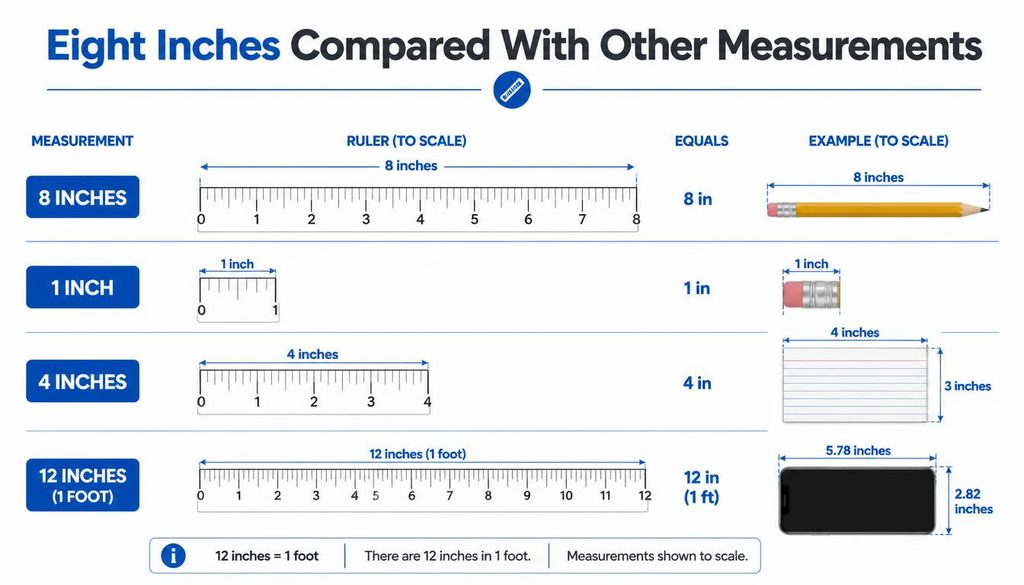
It’s easy to mix up inches and centimeters, especially when shopping online or reading specifications from different countries. Here are some comparisons that help clarify the difference.
| Measurement | Approximate equivalent |
|---|---|
| 1 inch | 2.54 cm |
| 2 inches | 5.08 cm |
| 4 inches | 10.16 cm |
| 6 inches | 15.24 cm |
| 8 inches | 20.32 cm |
| 10 inches | 25.4 cm |
| 12 inches | 30.48 cm |
Eight inches is considerably longer than eight centimeters. In fact, eight inches equals 20.32 centimeters, while eight centimeters is only about 3.15 inches.
This is why checking the unit matters. A product described as eight inches long is not the same size as one described as eight centimeters long.
If you’re comparing product specifications, furniture dimensions, or craft materials, make sure you’re looking at the same measurement system before deciding whether an object will fit.
Common Mistakes When Estimating Eight Inches
Even a familiar measurement can be misunderstood when you rely only on visual estimates. Here are a few mistakes worth avoiding.
- Assuming every similar object has the same size: Bananas, pencils, plates, and notebooks come in different dimensions.
- Confusing a screen’s diagonal with its width: An eight-inch display measurement usually refers to the diagonal, not the horizontal edge.
- Measuring around a curved surface: The distance along a banana or bowl’s curved edge differs from its straight-line dimensions.
- Ignoring gaps between objects: Several small items arranged in a row may not add up to the expected length if they’re spaced apart.
- Confusing inches with centimeters: Eight inches is 20.32 centimeters, not eight centimeters.
- Using an estimate when precision matters: A visual comparison is convenient, but a ruler or tape measure is more reliable for cutting, fitting, or construction.
The best approach is to use familiar objects to develop a rough sense of scale, then measure directly whenever an accurate result is necessary.
Frequently Asked Questions
What does 8 inches look like compared to common things?
Eight inches is about the length of a standard dinner fork, a small tablet, or a large pencil.
How long is 8 inches in centimeters?
Eight inches equals 20.32 centimeters, making it easy to visualize using a standard ruler.
What household items are about 8 inches long?
Common items around 8 inches long include dinner forks, butter knives, small kitchen tools, and some pencils.
Is 8 inches considered a long measurement?
Eight inches is a moderate length for everyday objects, roughly two-thirds the length of a standard 12-inch ruler.
How can I measure 8 inches without a ruler?
You can compare the length with a familiar object, such as a dinner fork, or use a measuring app on your smartphone for an estimate.
Read This Blog:https://ravonexium.com/how-long-is-100-ft-compare-to-things-that-are-100ft-long/
Final Thoughts: Making Eight Inches Easier to Visualize
Understanding eight inches doesn’t require memorizing a number and hoping it makes sense later. The measurement becomes much more familiar when you compare it with objects you see every day, from a notebook or banana to A5 paper and a row of soda cans.
The key is to remember that these examples are approximate reference points, not identical measurements. Some objects will be shorter than eight inches, others will be slightly longer, and certain dimensions refer to a diagonal or diameter rather than a straight edge.
If you need a quick estimate, use a familiar object. If you need a precise measurement for a project, purchase, or storage space, reach for a ruler or tape measure whenever possible.
Over time, you’ll develop a better sense of length and become more comfortable estimating everyday dimensions.
And if you have a favorite object that helps you visualize eight inches, share it in the comments. Your everyday reference might be exactly what someone else needs to make sense of this surprisingly useful measurement.