Buying shoes from Japan can feel a little like solving a puzzle when the size numbers don’t match the ones you’re used to. You might wear a US size 8, a UK size 6, or a European size 39, but a Japanese shoe label could simply say 25 cm.
Suddenly, choosing the right pair becomes less straightforward than it should be. The good news is that the Japanese sizing system is relatively easy to understand once you know what those centimeters mean.
This Japanese Shoe Size Chart And Conversion Guide will help you compare Japanese shoe sizes with US, UK, and European measurements, understand men’s and women’s footwear charts, and find the right fit for children.
We’ll also explore how to measure your feet at home, what to check before buying Japanese sneakers online, and why different brands sometimes fit differently.
Whether you’re shopping for stylish Japanese sneakers, ordering traditional footwear as a souvenir, or helping a child find comfortable school shoes, a little preparation can save you the trouble of dealing with an unsuitable pair.
After all, shoes should make walking easier, not turn every step into a tiny argument with your toes.
| Japan (cm) | US Men | US Women | UK |
|---|---|---|---|
| 22.0 | 4 | 5.5 | 3 |
| 23.0 | 5 | 6.5 | 4 |
| 24.0 | 6 | 7.5 | 5 |
| 25.0 | 7 | 8.5 | 6 |
| 26.0 | 8 | 9.5 | 7 |
| 27.0 | 9 | 10.5 | 8 |
| 28.0 | 10 | 11.5 | 9 |
| 29.0 | 11 | 12.5 | 10 |
| 30.0 | 12 | 13.5 | 11 |
Understanding the Japanese Shoe Sizing System
The Japanese shoe sizing system is primarily based on foot length in centimeters. Unlike the US and UK systems, which use different numerical scales for men’s and women’s shoes, Japanese sizing offers a more direct relationship between the measurement and the size printed on the label.
For example, a shoe labeled 25 cm is generally intended for a foot around 25 centimeters long, although the manufacturer’s fitting method and recommended allowance still matter. That straightforward approach makes Japanese shoe sizes in cm especially useful for international shoppers.
Here is the basic idea:
- Japanese shoe size 22 cm: generally intended for a foot approximately 22 cm long.
- Japanese shoe size 23 cm: generally intended for a foot approximately 23 cm long.
- Japanese shoe size 24 cm: generally intended for a foot approximately 24 cm long.
- Japanese shoe size 25 cm: generally intended for a foot approximately 25 cm long.
- Japanese shoe size 26 cm: generally intended for a foot approximately 26 cm long.
- Japanese shoe size 27 cm: generally intended for a foot approximately 27 cm long.
- Japanese shoe size 28 cm: generally intended for a foot approximately 28 cm long.
These are measurement references rather than guarantees about the internal dimensions of every shoe. Some manufacturers use different lasts, toe shapes, or fitting allowances, so always consult the specific brand’s official size chart when possible.
Japanese Shoe Size Chart and Conversion Guide for Adults
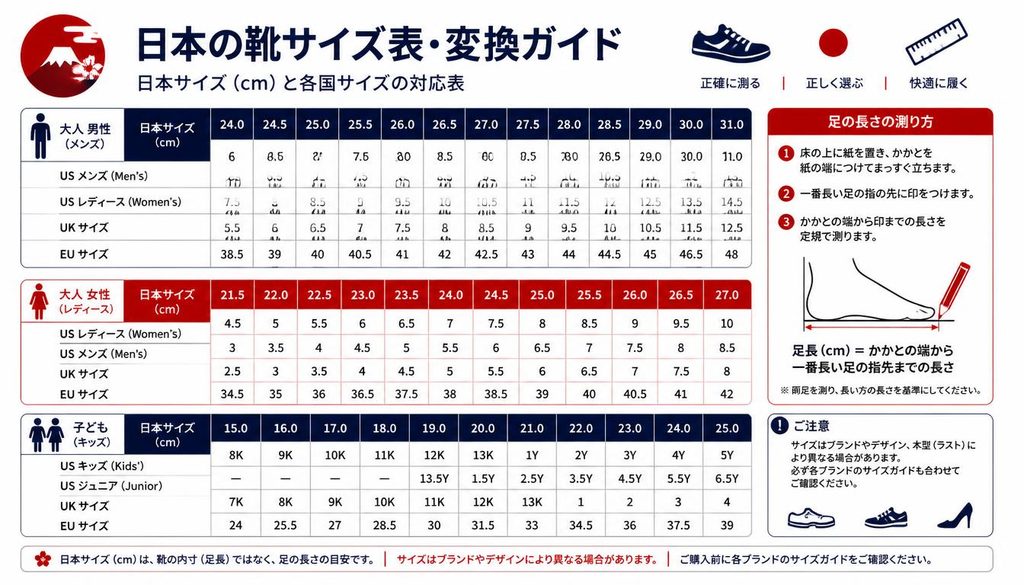
The following tables provide approximate comparisons between Japanese, US, UK, and European shoe sizes. Use them as a starting point when shopping, then confirm the conversion with the manufacturer.
Japanese Men’s Shoe Size Chart
Men’s sizes are not perfectly standardized internationally. A Japanese size of 27 cm, for instance, may correspond approximately to a US men’s size 9, a UK size 8, or a European size 42–43, depending on the brand and chart used.
| Japanese size (cm) | Approx. US men’s size | Approx. UK men’s size | Approx. EU size |
|---|---|---|---|
| 23.5 | 5.5–6 | 5–5.5 | 38–39 |
| 24 | 6–6.5 | 5.5–6 | 39 |
| 24.5 | 6.5–7 | 6–6.5 | 39–40 |
| 25 | 7–7.5 | 6–6.5 | 40 |
| 25.5 | 7.5–8 | 6.5–7 | 40–41 |
| 26 | 8–8.5 | 7–7.5 | 41 |
| 26.5 | 8.5–9 | 7.5–8 | 41–42 |
| 27 | 9–9.5 | 8–8.5 | 42–43 |
| 27.5 | 9.5–10 | 8.5–9 | 43 |
| 28 | 10–10.5 | 9–9.5 | 43–44 |
| 28.5 | 10.5–11 | 9.5–10 | 44 |
| 29 | 11–11.5 | 10–10.5 | 44–45 |
| 30 | 12–12.5 | 11–11.5 | 45–46 |
| 31 | 13–13.5 | 12–12.5 | 46–47 |
These conversions are approximate, not universal sizing standards. Some brands place the same centimeter measurement in a different US or European category, particularly at the ends of their size ranges.
Japanese Women’s Shoe Size Chart
Women’s footwear often follows a different US conversion scale from men’s shoes, even when the Japanese centimeter measurement is identical. A Japanese size of 24 cm might be around a US women’s size 7–7.5, but a particular brand may recommend a different equivalent.
| Japanese size (cm) | Approx. US women’s size | Approx. UK women’s size | Approx. EU size |
|---|---|---|---|
| 21.5 | 4.5–5 | 2–2.5 | 34–35 |
| 22 | 5–5.5 | 2.5–3 | 35 |
| 22.5 | 5.5–6 | 3–3.5 | 35–36 |
| 23 | 6–6.5 | 3.5–4 | 36–37 |
| 23.5 | 6.5–7 | 4–4.5 | 37 |
| 24 | 7–7.5 | 4.5–5 | 37–38 |
| 24.5 | 7.5–8 | 5–5.5 | 38 |
| 25 | 8–8.5 | 5.5–6 | 38–39 |
| 25.5 | 8.5–9 | 6–6.5 | 39–40 |
| 26 | 9–9.5 | 6.5–7 | 40 |
| 26.5 | 9.5–10 | 7–7.5 | 40–41 |
| 27 | 10–10.5 | 7.5–8 | 41–42 |
| 28 | 11–11.5 | 8.5–9 | 42–43 |
The chart is designed for general guidance, and individual brands may use different conversion tables. If you’re between two sizes, check the brand’s fitting notes and return policy before deciding.
Japanese Shoe Size Chart in Inches
If you’re more familiar with inches than centimeters, converting a Japanese shoe measurement is easy. One inch equals 2.54 centimeters, so you can divide the centimeter measurement by 2.54 to get its equivalent in inches.
| Japanese size (cm) | Approx. length in inches |
|---|---|
| 21.5 | 8.46 |
| 22 | 8.66 |
| 22.5 | 8.86 |
| 23 | 9.06 |
| 23.5 | 9.25 |
| 24 | 9.45 |
| 24.5 | 9.65 |
| 25 | 9.84 |
| 25.5 | 10.04 |
| 26 | 10.24 |
| 26.5 | 10.43 |
| 27 | 10.63 |
| 28 | 11.02 |
| 29 | 11.42 |
| 30 | 11.81 |
| 31 | 12.20 |
| 31.5 | 12.40 |
Remember, these figures represent the centimeter measurement converted into inches, not necessarily the shoe’s internal length. That distinction is important when comparing the label with the actual space inside a sneaker.
Japanese Shoe Size Conversion: US, UK, and European Sizes
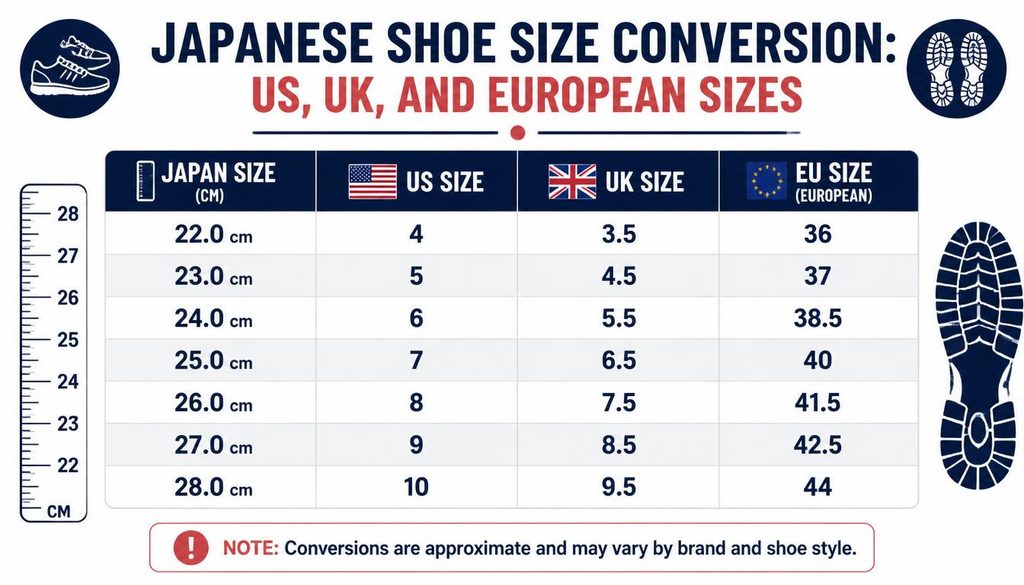
The most useful way to approach international shoe sizing is to begin with your actual foot measurement rather than relying entirely on the number printed on your current shoes.
Japanese Size to US Size
A Japanese shoe size to US conversion depends on whether you’re buying men’s, women’s, or children’s footwear. The US system assigns different numbers to these categories, so a 25 cm Japanese shoe should not automatically be matched to one universal US size.
For a quick reference:
- Japanese 24 cm: approximately US men’s 6–6.5 or US women’s 7–7.5.
- Japanese 25 cm: approximately US men’s 7–7.5 or US women’s 8–8.5.
- Japanese 26 cm: approximately US men’s 8–8.5 or US women’s 9–9.5.
- Japanese 27 cm: approximately US men’s 9–9.5 or US women’s 10–10.5.
- Japanese 28 cm: approximately US men’s 10–10.5 or US women’s 11–11.5.
- Japanese 30 cm: approximately US men’s 12–12.5.
These ranges are illustrative, and some brands may differ by half a size or more. If a manufacturer provides a dedicated US conversion chart, use that chart instead of a general estimate.
Japanese Size to UK Size
The UK sizing system uses its own numerical scale, which generally differs from the US system. UK sizes are often lower than US sizes, but the exact difference depends on the shoe category and manufacturer’s conversion method.
For example, Japanese sizes of 25 cm, 26 cm, and 27 cm may correspond approximately to UK men’s sizes 6–6.5, 7–7.5, and 8–8.5, respectively.
When using a Japanese shoe size to UK chart, check whether the retailer is displaying men’s, women’s, or unisex sizes. A small label reading “UK 6” can mean something different from a US size 6, and confusing the two is an easy mistake to make.
Japanese Size to European Size
European shoe sizes use a numerical scale that generally differs from both Japanese centimeter measurements and UK sizing. Unlike the Japanese system, European size numbers don’t directly state the foot length in centimeters.
As a rough guide:
- Japanese 23 cm: approximately EU 36–37.
- Japanese 24 cm: approximately EU 37–38.
- Japanese 25 cm: approximately EU 38–40.
- Japanese 26 cm: approximately EU 40–41.
- Japanese 27 cm: approximately EU 42–43.
- Japanese 28 cm: approximately EU 43–44.
- Japanese 29 cm: approximately EU 44–45.
- Japanese 30 cm: approximately EU 45–46.
The overlap in some ranges is intentional because conversion charts differ. When ordering from a European retailer that stocks Japanese brands, the brand’s own size table should take priority over a generic Japanese shoe size conversion chart.
How to Measure Your Feet for Japanese Shoes
A reliable measurement takes only a few minutes and can be more useful than guessing from your usual shoe size. I would always recommend measuring both feet before placing an international order, especially when returning a pair could be expensive.
What You Need
- A sheet of paper larger than your foot.
- A pencil or pen.
- A ruler or measuring tape marked in centimeters.
- The socks you expect to wear with the shoes.
Step-by-Step Foot Measurement
Place the paper on a hard, level floor. Avoid measuring on a thick carpet, since the surface can make your foot position less stable than it should be.
Stand naturally on the paper. Keep your weight distributed normally across the foot. Sitting down may produce a slightly different measurement, and that’s not ideal when you’re trying to choose a comfortable everyday fit.
Mark the heel and longest toe. Ask someone to help if you can, especially if the pencil angle makes it difficult to see where your heel ends.
Measure the distance between the marks. Record the measurement in centimeters, using the longest toe as your endpoint rather than assuming that the big toe is always the longest.
Repeat the process with your other foot. It’s fairly common for one foot to be a little longer than the other. Use the longer measurement when comparing yourself with a manufacturer’s size chart.
Measure again if the result seems unusual. A small positioning error can change the result enough to affect a half-size decision, so there is no harm in checking it twice.
For example, suppose your left foot measures 24.2 cm and your right foot measures 24.6 cm. The right foot is longer, so start by comparing 24.6 cm with the brand’s sizing recommendations. Depending on the shoe design and fit guidance, you may need to consider the next available size rather than choosing a label that is too close to your foot length.
Japanese Kids’ Shoe Size Chart
Children’s footwear deserves a little extra attention because growing feet can change size quickly. A size that fits well today may not remain suitable for very long, so measurements should be checked regularly instead of relying on a child’s age alone.
The following chart provides approximate reference points for children’s Japanese footwear.
| Japanese size (cm) | Approx. US children’s size | Approx. UK children’s size |
|---|---|---|
| 10 | Varies by brand; often pre-walker sizing | Varies |
| 11 | Varies by brand; often pre-walker sizing | Varies |
| 12 | Around US toddler 4–5 | Around UK 3–4 |
| 13 | Around US toddler 5–6 | Around UK 4–5 |
| 13.5 | Around US toddler 6–7 | Around UK 5–6 |
| 15 | Around US toddler 8–9 | Around UK 7–8 |
| 16 | Around US toddler 9–10 | Around UK 8–9 |
| 17 | Around US toddler 10–11 | Around UK 9–10 |
| 18 | Around US children’s 11–12 | Around UK 10–11 |
| 19 | Around US children’s 12–13 | Around UK 11–12 |
| 20 | Around US youth 1–2 | Around UK 13–1 |
| 21 | Around US youth 2–3 | Around UK 1–2 |
These children’s conversions are broad estimates, especially at the smaller sizes where toddler and infant categories differ significantly between brands. Always consult the retailer’s chart before buying.
Tips for Choosing Children’s Shoes
- Measure both feet while the child is standing.
- Check the fit around the toes, heel, and widest part of the foot.
- Allow the amount of extra room recommended by the manufacturer.
- Avoid buying shoes that are excessively large just because the child is growing.
- Recheck the fit regularly as the child develops.
- Choose footwear suited to the child’s activity, whether it’s school, sports, or everyday walking.
A shoe shouldn’t squeeze a child’s toes, but it also shouldn’t slip around so much that walking becomes awkward. Comfort and stability are more useful goals than buying a pair that will supposedly last forever.
Are Japanese Shoe Sizes the Same for Men and Women?
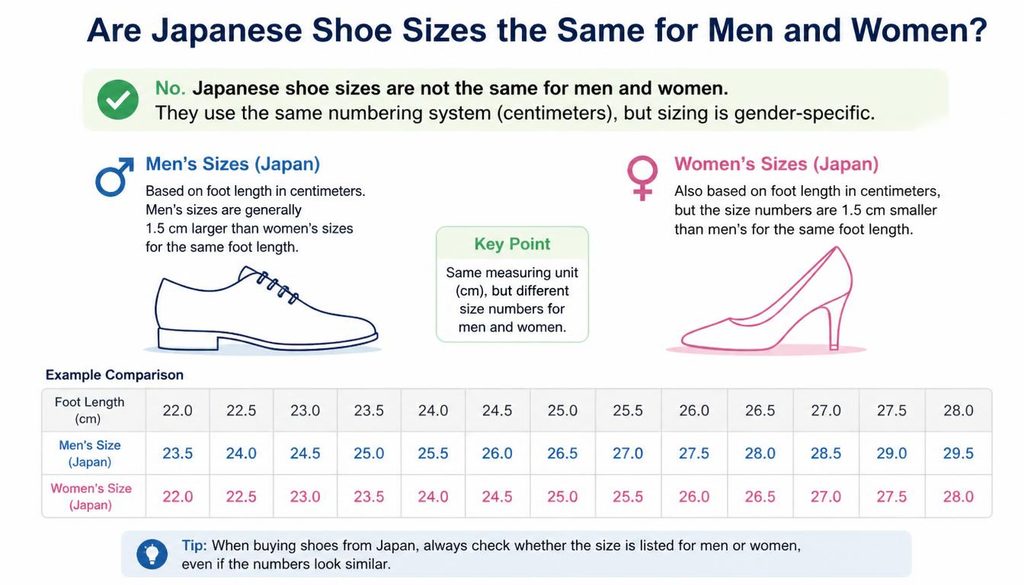
The centimeter measurement itself can be used for both men’s and women’s footwear, but the equivalent US, UK, or European size may differ. For example, a 25 cm label may translate to different US numbers depending on the shoe’s category.
There are also differences in shape and width. Some women’s shoes have narrower proportions, while certain men’s styles have a wider construction, although these are general design tendencies rather than rules that apply to every shoe.
Unisex sneakers add another layer of confusion. A unisex product might list US men’s sizes, Japanese centimeters, or both. Before ordering, confirm which sizing system the retailer uses and whether the displayed conversion is for men’s or women’s footwear.
The most sensible approach is to focus on your measured foot length, check the shoe’s width and fit notes, and then follow the brand’s official recommendations. The number alone can’t tell you everything about comfort.
Do Japanese Shoes Run Smaller Than US Shoes?
Not necessarily. Japanese shoes do not automatically run smaller than US shoes; the difference often comes from how the sizes are labeled and how individual brands construct their footwear.
A shoe marked 25 cm may be perfectly appropriate for a foot around 25 cm long, but the internal space can vary. A narrow toe box may feel tight, while a wider design with a similar label could feel much more comfortable.
Several factors affect the fit:
- Foot length: The heel-to-toe measurement is the starting point.
- Foot width: Two people with equally long feet may need different shoe shapes.
- Toe-box design: Pointed or narrow styles may provide less room for the toes.
- Material: Leather and certain flexible materials may adapt differently from rigid synthetic uppers.
- Intended use: Running shoes, dress shoes, sandals, and boots are designed for different purposes.
- Brand-specific sizing: Manufacturers can use different lasts and fitting allowances.
If you are buying shoes online, read the product reviews for comments about length, width, and toe-box comfort. Reviews can help identify patterns, but use them alongside the manufacturer’s chart rather than treating one person’s experience as a universal rule.
Popular Japanese Shoe Brands and Their Sizing
Japan has a varied footwear scene, from performance running shoes to heritage-inspired sneakers and experimental designer footwear. Knowing the brand you’re buying is helpful because a generic conversion table may not match every product line.
Onitsuka Tiger
Onitsuka Tiger is known internationally for its retro-inspired sneakers and recognizable classic designs. If you’re shopping for an Onitsuka Tiger model, look for the official model-specific size guide and check whether the product page displays centimeters alongside US or European sizes.
Searches such as Onitsuka Tiger shoe size chart and Onitsuka Tiger size conversion can help you locate relevant sizing information, but the official product listing is the best place to confirm a particular pair.
ASICS
ASICS is strongly associated with running and athletic footwear. Fit matters especially for running shoes because your feet may move differently during activity than they do while standing still.
Check the model’s length and width recommendations, and pay attention to whether the product comes in different width options. An ASICS shoe that fits comfortably in one model may not feel identical to another model.
Mizuno
Mizuno offers athletic footwear for activities including running and other sports. When comparing Mizuno sizing with another Japanese brand, avoid assuming that two shoes labeled 26.5 cm will feel exactly the same.
Look for model-specific fit information and consider the activity for which the shoe is designed.
Other Japanese Footwear Names
Other names associated with Japanese fashion and footwear include Visvim, Suicoke, Hender Scheme, Losers, Yohji Yamamoto, ISSEY MIYAKE, and Comme des Garçons Play.
These names cover different product categories and collaborations, so their sizing should not be treated as one unified system. Some products may be manufactured in different countries or developed with partner brands.
Always check the actual product’s sizing details rather than assuming that every item follows a single Japanese standard.
Traditional Japanese Footwear and Cultural Context
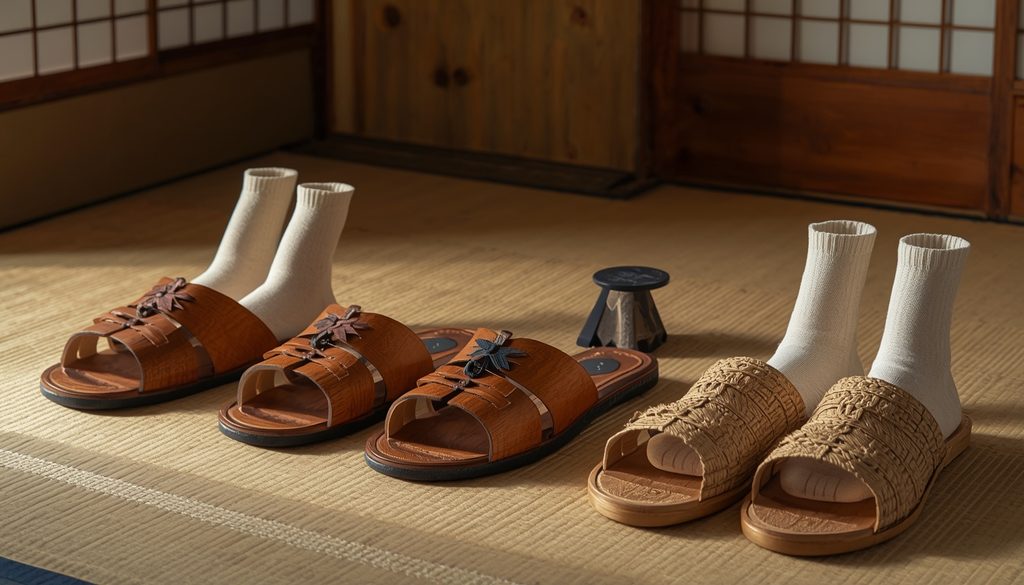
Japanese footwear is not limited to modern sneakers. Traditional styles reflect practical needs, clothing customs, materials, and regional history, offering a useful reminder that shoes have always been about more than numbers on a label.
Geta and Zori
Geta are traditional Japanese wooden sandals, often recognized by their raised wooden base and supporting straps. Zori are flat sandals that may be made from different materials and are associated with traditional clothing as well as modern variations.
Because these sandals don’t have the same enclosed structure as sneakers, their fit may be assessed differently. Strap placement, foot position, and the design of the sole can matter as much as a numerical size.
Waraji and Jika-tabi
Waraji are traditional straw or natural-fiber sandals historically associated with practical walking footwear. Jika-tabi are footwear with a separated big-toe section, designed for activities that benefit from a flexible, close-fitting construction.
These styles demonstrate why traditional footwear cannot always be compared directly with modern US or European sneaker charts. Their design and intended use are different, and sizing advice should reflect those differences.
Japanese Footwear Etiquette
In Japan, removing shoes before entering many homes is a familiar custom. Visitors may also be asked to remove their shoes in certain traditional accommodations, temples, or other designated spaces.
The custom varies by location and context, so follow the signs or the host’s instructions. It is a practical part of many everyday settings, and clean, easy-to-remove footwear can make visits more convenient.
Buying Japanese Shoes Online: A Practical Checklist
Shopping internationally opens the door to styles that might not be available locally, but a little checking before payment can prevent disappointment later.
- Confirm the unit. Make sure the label refers to centimeters, not US, UK, or European sizing.
- Find the official size chart. Give priority to the chart for the exact model you’re considering.
- Measure your feet. Use the longer foot measurement as your starting point.
- Check the width. Length alone cannot tell you whether the shoe will feel comfortable.
- Read model-specific reviews. Look for repeated comments about narrowness, roomy toes, or unusual sizing.
- Review the return policy. International shipping and return costs can be significant.
- Check shipping and import charges. The final cost may be higher than the displayed product price.
- Confirm the product category. Unisex, men’s, women’s, and children’s charts may use different conversions.
These steps are particularly helpful when buying limited-edition sneakers or ordering from a Japanese retailer that may not use the same sizing labels as your local shops.
Common Mistakes to Avoid When Converting Shoe Sizes
Even a clear chart can lead to a poor purchase if one small detail is overlooked. Here are some common errors worth avoiding.
Assuming all conversion charts agree. Different manufacturers may assign slightly different US, UK, or European equivalents to the same Japanese measurement.
Choosing by your usual number alone. Your normal size is a helpful reference, but it doesn’t replace a foot measurement or a brand’s specific instructions.
Ignoring width. A shoe can have the correct length and still feel too tight across the forefoot.
Measuring only one foot. Small differences between feet are common, so checking both helps you make a better decision.
Confusing foot length with shoe length. A Japanese label in centimeters usually relates to a sizing measurement, not necessarily the complete internal length of the footwear.
Rounding too quickly. If your measurement falls between available sizes, follow the manufacturer’s advice rather than automatically rounding up or down.
A few minutes spent checking these details can make international shoe shopping a lot less stressful.
How to Choose the Right Japanese Shoe Size for You
The most reliable way to choose Japanese footwear is to combine your measured foot length with the manufacturer’s conversion chart. Start with centimeters, check whether the shoe is designed for men’s, women’s, children’s, or unisex sizing, and pay attention to width and model-specific fit notes.
If you’re buying shoes as a gift, ask the recipient for a recent foot measurement or check the sizing information on a pair they already wear comfortably. A little preparation is more useful than guessing from age, appearance, or a conversion chart alone.
You can also make international shopping easier by saving your measurements in both centimeters and inches. Once you know your approximate foot length, comparing different Japanese brands becomes much simpler, although checking each model remains important.
Frequently Asked Questions
How do Japanese shoe sizes work?
Japanese shoe sizes are generally measured in centimeters (cm), representing foot length. For example, a Japanese size 25 usually corresponds to a foot length of about 25 cm.
How do I convert Japanese shoe sizes to US sizes?
Measure your foot length in centimeters and compare it with a Japanese shoe size chart. US size conversions vary by gender, brand, and shoe style.
What is a Japanese shoe size 24 in US sizes?
A Japanese size 24 is approximately a US men’s size 6 or women’s size 7.5. Exact conversions may vary by manufacturer.
Are Japanese shoe sizes the same as European sizes?
No, Japanese and European shoe sizes use different sizing systems. Japanese sizes are typically based on centimeters, while European sizes use a numerical scale.
How can I find my Japanese shoe size?
Measure your foot from heel to longest toe in centimeters and use a Japanese shoe size chart. Check the brand’s sizing guide for the most accurate fit.
Read This Blog:https://ravonexium.com/standard-chips-bag-size-chart/
Final Thoughts
Understanding the Japanese Shoe Size Chart And Conversion Guide doesn’t have to be complicated. Japanese sizes offer a convenient centimeter-based reference, and with a reliable chart, you can compare them with US, UK, and European systems without relying on guesswork.
Measure both feet, use the longer measurement as your starting point, and check the manufacturer’s official recommendations before ordering. Remember that the same labeled size can feel different depending on width, construction, and shoe design.
Whether you’re choosing Japanese running shoes, classic sneakers, children’s footwear, or traditional sandals, the goal is the same: a comfortable fit that suits your feet and your everyday needs.
Have you ever bought shoes from Japan? Share your experience, favorite Japanese footwear brand, or sizing tip in the comments. Your advice might help another shopper find the right pair with a little more confidence.