A 2mm measurement sounds almost laughably small. You hear “two millimeters” and the brain sort of nods politely, but it doesn’t immediately create a picture. Is it the width of a pencil?
The thickness of a coin? Smaller than a grain of rice? And, honestly, how big is 2mm when you have nothing nearby to compare it with?
The answer is: 2 millimeters is very small, but it is not invisible. It equals 0.2 cm, 0.0787 inches, or 0.002 meters. On a normal ruler, it is just two tiny spaces between centimeter markings.
That sounds simple, yet when you’re buying jewelry, checking a screw, planning tile spacing, looking at electronics, or trying to understand a technical drawing, a difference of even one millimeter can suddenly matter a lot.
This guide gives you a practical 2mm size comparison using familiar objects. Some comparisons are close approximations rather than exact 2mm objects, because nature and manufactured products don’t all come with a perfectly standardized ruler attached to them. Still, they make an excellent visual reference for understanding the scale.
So, let’s make those two tiny millimeters feel much less mysterious.
| Measurement | Equivalent |
|---|---|
| Millimeters | 2 mm |
| Centimeters | 0.2 cm |
| Inches | 0.079 inches |
| Meters | 0.002 m |
| Everyday comparison | About the thickness of a small coin’s edge |
| Size description | Very small and thin |
How Big Is 2mm in Inches, Centimeters, and Meters?
Before comparing 2mm with objects, it helps to settle the actual measurement.
A millimeter is one-thousandth of a meter. In the metric system, the relationship is straightforward:
- 2mm = 2 millimeters
- 2mm = 0.2 cm
- 2mm = 0.0787 inches
- 2mm = 0.002 meters
So when somebody asks 2mm equals how many inches, the answer is approximately 0.0787 inches.
If you’re more comfortable with centimeters, 2mm to cm is even easier: divide by 10. You get 0.2 centimeters.
For meters, divide by 1,000. That’s where the slightly strange-looking 0.002 meters comes from.
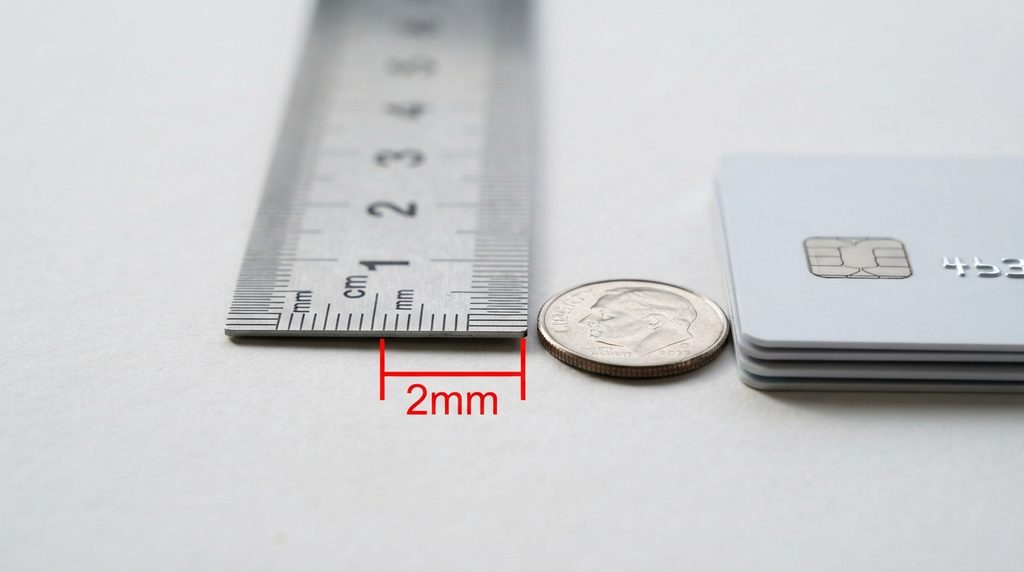
Think of a standard centimeter on a metric ruler. It is divided into ten little tick marks, each representing 1mm. Therefore, 2mm occupies just two of those tiny graduation marks.
That is why 2mm on a ruler looks surprisingly small. You aren’t looking at two centimeters. You’re looking at only one-fifth of a centimeter.
2mm Size Comparison: 14 Everyday Things That Make It Easier to See
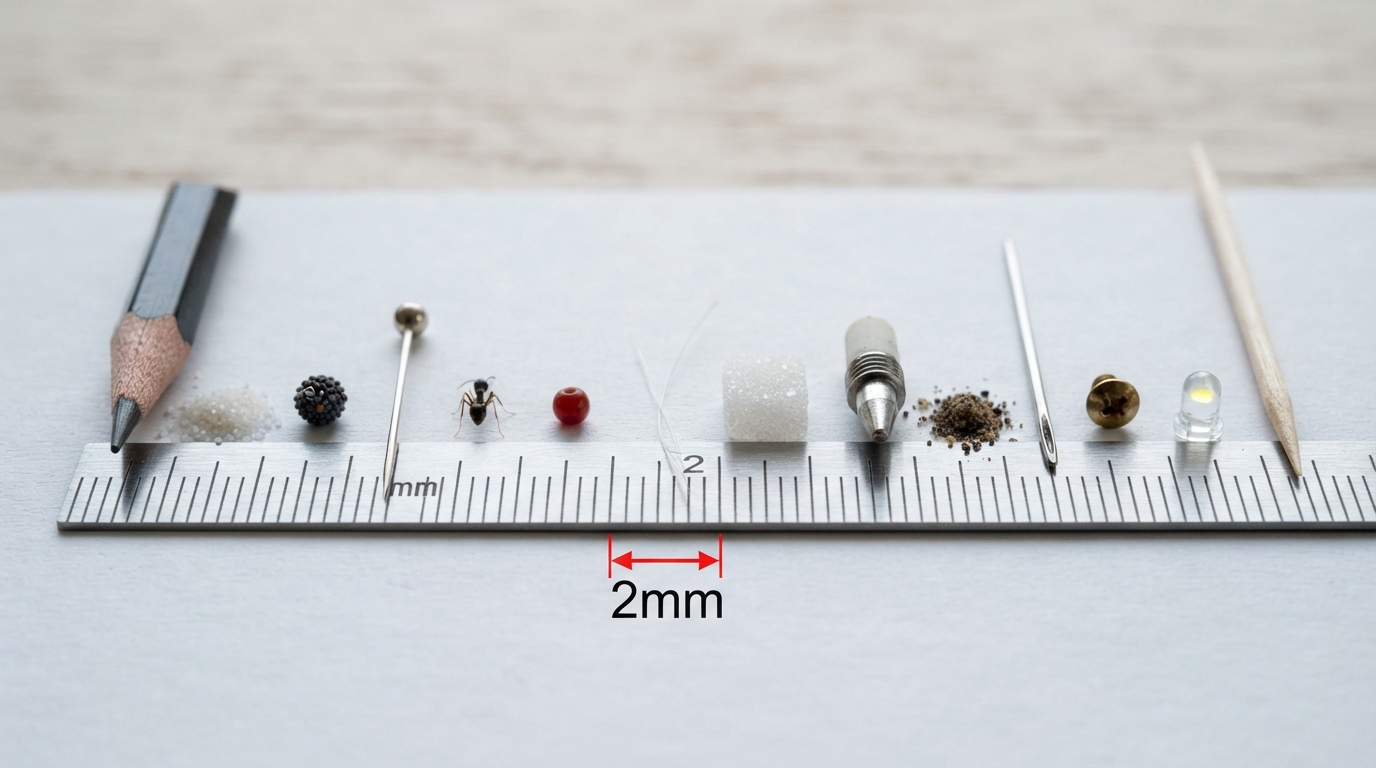
Numbers are accurate, but objects are memorable. If you want to visualize 2mm, everyday items can provide a much better mental picture.
The comparisons below aren’t claiming every object is exactly 2mm. Natural objects, manufactured parts, and different brands vary. Instead, they show things that are near this scale or can help you understand the dimension.
1. A 2mm Pencil Lead Is a Useful Reference
A pencil lead is one of the easiest ways to think about small measurements, although common mechanical pencil leads are often much thinner than 2mm.
For example, mechanical pencil lead may come in diameters such as 0.5mm, 0.7mm, 0.9mm, or 2mm depending on the pencil type. A 2mm drafting lead is therefore a particularly useful physical reference.
A 2mm lead is noticeably thicker than a standard 0.5mm writing lead. Put the two side by side and the difference suddenly becomes obvious. What seemed like a microscopic change on paper becomes a proper little cylinder sitting there, quietly showing off.
This is especially relevant in technical drawing, drafting, architecture, and engineering, where pencil lead diameter can affect line appearance and control.
A 2mm drafting lead is not huge, obviously, but it is substantial enough to hold and see without a magnifying glass.
2. A SIM Card Is Larger Overall, but Its Thickness Helps Explain Scale
A SIM card is much larger than 2mm in length and width, so it is not a direct 2mm object. But its thickness can help when thinking about small manufactured dimensions.
Different SIM formats include:
- Mini SIM
- Micro SIM
- Nano SIM
The cards became physically smaller as mobile technology evolved, but their exact dimensions are still considerably larger than 2mm.
This comparison is useful because a SIM card demonstrates how several millimeters can exist as a meaningful feature inside a very small mobile device.
When manufacturers work with electronics, a seemingly tiny component thickness can affect how parts fit together. In miniature design, 2mm isn’t “nothing.” It can be the difference between a component fitting neatly or interfering with another component.
3. Tile Spacers Can Put 2mm Into Perspective
If you’ve ever watched someone install floor tiles, you’ve probably seen those little plastic crosses sitting between the tiles.
A ceramic tile spacer or porcelain tile spacer may be available in dimensions such as 1mm, 2mm, 3mm, 4mm, or larger. A 2mm spacer creates a narrow, consistent gap between tiles.
This is one of the clearest real-world examples of 2mm thickness comparison because you can actually see what the measurement does.
A 2mm gap might look insignificant when you’re holding a single spacer in your hand. Across an entire tiled floor, though, those gaps become visible lines.
That’s the funny thing about tiny measurements: repeated thousands of times, they stop being tiny.
In tile installation, home renovation, construction, and floor work, accurate spacing helps create a clean finished appearance. A few millimeters can influence the visual rhythm of an entire wall.
4. A Mustard Seed Can Look Surprisingly Close
Nature offers some wonderfully weird measurement references.
A mustard seed can be around a couple of millimeters across depending on the species and seed. Black mustard (Brassica nigra), yellow mustard, and brown mustard seeds don’t all have identical dimensions.
A typical mustard seed is therefore a useful visual comparison when you’re trying to understand mustard seed diameter or the general scale of 2mm.
Place one beside a ruler and suddenly the number makes more sense.
Of course, don’t treat a mustard seed as a precision measuring tool. Seeds vary naturally because nature did not consult a manufacturing tolerance chart before growing them.
Still, for a quick natural size comparison, it works beautifully.
5. A Small Ant Can Be Around This Scale in One Dimension
Ants are another fascinating reference.
A very small ant may have a body part or body width approaching the 2mm scale, while the complete ant body length can be several millimeters or considerably more. Species differ enormously.
This means an ant is not an exact 2mm object, but it gives your brain a useful sense of proportion.
If you look closely at a tiny insect, you may notice how many structures fit into just a few millimeters: legs, antennae, body segments, and an exoskeleton.
Nature performs some pretty impressive miniature design without using a ruler.
In a wider ecosystem, tiny insects can be physically small while having a surprisingly large ecological role. Size doesn’t automatically determine importance.
6. A Rice Grain Shows How Narrow 2mm Can Feel
A grain of rice is longer than 2mm, but its width can be useful for comparison.
Different types such as basmati rice and jasmine rice have different shapes and dimensions. Basmati grains are typically long and slender, while jasmine rice has a somewhat different profile.
If you’re wondering about rice grain width, imagine the short dimension of a grain rather than its full length.
A single grain may help you understand that 2mm is not “short” in the way a 2mm-long line is short. It can also describe width, thickness, or diameter, depending on the object.
That distinction matters.
A 2mm line and a 2mm-thick object don’t necessarily look alike because orientation changes our perception.
7. A Matchstick Is Larger, but Its Diameter Helps
A standard matchstick is obviously much longer than 2mm, yet its thickness provides another useful everyday comparison.
Depending on the manufacturer, matchsticks can have diameters around a few millimeters. That makes them helpful when you’re trying to imagine a small cylindrical measurement.
The head of a matchstick, meanwhile, is considerably larger.
So if someone says “2mm,” don’t imagine the whole matchstick. Imagine a narrow cross-section of the stick.
This is a useful lesson in diameter comparison: when measuring round objects, diameter describes the distance straight across the circle, not the circumference around it.
8. Tiny Screws Bring 2mm Into the World of Engineering
Look closely at a watch, pair of glasses, electronics, or small mechanical device and you’ll encounter hardware that seems almost ridiculously tiny.
Tiny screws, including watch screws and eyeglass screws, can have dimensions around the millimeter scale.
A screw might be 2mm in diameter, for example, while its total length could be several millimeters or more.
This is where precision engineering becomes important.
When you’re dealing with miniature components, a difference of 0.1mm or 0.2mm may affect whether something fits correctly. Manufacturing therefore relies on controlled dimensions, tools, specifications, and tolerances.
What looks like a speck to your eye can be a properly engineered mechanical component.
9. An Earring Post Can Help You Imagine 2mm
Jewelry gives us another interesting way to understand tiny dimensions.
An earring post or stud earring component can be only a few millimeters in diameter or length depending on the design.
In fine jewelry, dimensions are carefully considered because changing the thickness of a band or post can alter its appearance, weight, comfort, and structural strength.
A 2mm jewelry component can look delicate without being impossibly fragile.
This is especially noticeable in minimalist jewelry, where the entire design depends on visual lightness. A tiny change in dimension can make a piece feel dainty, bold, heavy, or almost invisible.
10. A Thin Ring Can Be Around the 2mm Scale
Imagine a narrow jewelry band sitting on your finger. Some minimalist rings have widths around 2mm.
This is one of the better ways to understand 2mm width because you can actually see how narrow a 2mm strip looks when it becomes part of a larger object.
A 2mm ring may look simple, but its manufacturing still requires accuracy. The metal needs enough structural strength for normal wear while retaining the intended delicate appearance.
For someone shopping for a ring, “2mm band” can mean something meaningfully different from a 4mm or 6mm band.
The difference isn’t enormous mathematically. Visually, however, it can be surprisingly obvious.
11. Paper Helps You Understand Thickness, but Don’t Confuse It With 2mm
A normal sheet of printer paper is much thinner than 2mm. That’s precisely why paper becomes interesting as a comparison.
If one sheet is around a fraction of a millimeter thick, then several sheets of paper stacked together can begin approaching the millimeter scale.
The exact number varies according to paper type, but the principle is simple: stacking thin layers creates measurable thickness.
If you imagine approximately 20 sheets of ordinary paper stacked together, you’re getting into the general neighborhood of a few millimeters, depending on the paper.
This illustrates an important idea about component layers. A tiny dimension doesn’t always belong to one solid object. It can be created by multiple thin layers placed together.
12. Smartphone Screen Glass Makes Tiny Thicknesses Feel Important
A smartphone screen contains multiple layers, including display components, adhesives, protective surfaces, and tempered glass or other protective glass.
The glass itself is not necessarily 2mm thick; modern phones are designed around relatively thin layers. Still, the example shows why millimeter-level engineering matters in electronics.
A mobile device might have an overall device thickness in the general range of several millimeters, often around the 7mm–9mm smartphone thickness range depending on the model.
Inside that compact body, engineers have to arrange batteries, cameras, processors, displays, antennas, frames, and other parts.
That is precision manufacturing at a scale where every fraction of a millimeter starts looking less like a number and more like a design constraint.
13. A Gemstone Can Be Described as 2mm
Jewelry provides perhaps the most literal use of a 2mm size.
A 2mm gemstone, 2mm diamond, or 2mm sapphire describes a stone whose relevant dimension is approximately 2mm, usually referring to its diameter or width in a round stone.
In a pavé setting or micro-setting, tiny stones can be placed closely together to create sparkle across a jewelry surface.
A 2mm stone sounds almost too small to matter until you see ten, twenty, or more of them arranged together.
That’s when scale gets playful.
One tiny gemstone is subtle. A collection of tiny gemstones can create an entire visual texture.
For jewelry design, gemstone size affects brilliance, spacing, setting style, cost, and the overall character of a piece.
14. Stacked Dimes Show How Small Measurements Add Up
Coins are excellent physical references because their dimensions are manufactured and comparatively consistent.
A dime in the United States has a thickness of about 1.35mm. That makes it a useful reference when thinking about 2mm, even though it isn’t exactly 2mm.
If you place a dime next to another object or compare its edge to a ruler, you get a physical sense of what roughly one-and-a-third millimeters looks like.
Two stacked dimes would be around 2.7mm thick, which is close to the 2.7mm comparison point in your list.
That makes stacked coins useful for understanding how quickly tiny dimensions accumulate.
A single dime is roughly in the 1.35mm neighborhood. Two are around 2.7mm. Suddenly, 2mm has somewhere to live between them.
How 2mm Compares With 1mm, 1.52mm, 1.95mm, and 2.28mm
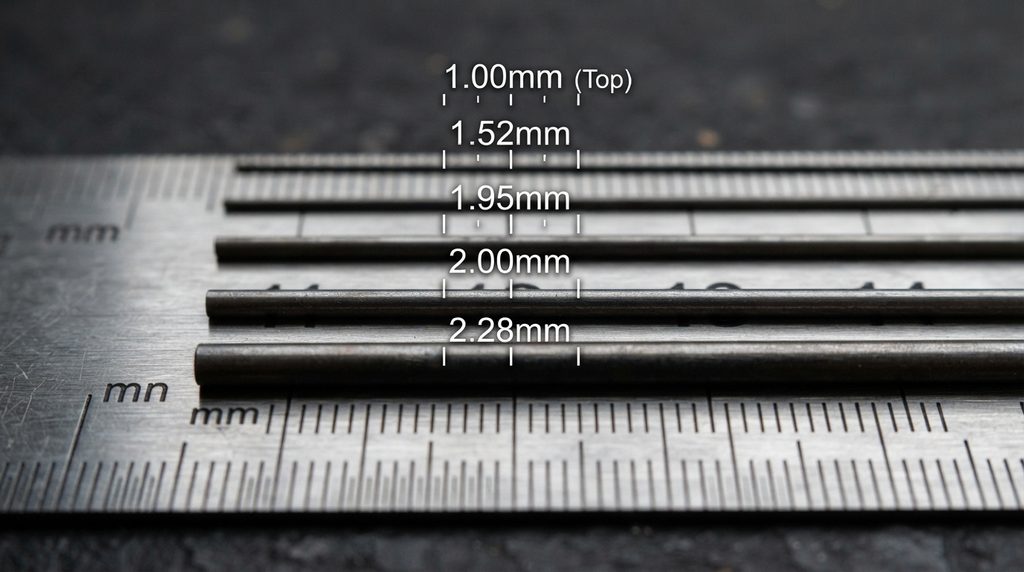
One of the best ways to understand 2mm is to compare it with measurements that sit very close to it.
Consider these values:
- 0.1mm extremely small compared with 2mm
- 0.6mm less than one-third of 2mm
- 0.76mm still significantly thinner
- 1mm exactly half of 2mm
- 1.35mm smaller than 2mm, similar to the thickness of a dime
- 1.52mm noticeably below 2mm
- 1.95mm only 0.05mm less than 2mm
- 2mm the reference point
- 2.28mm only slightly larger than 2mm
- 2.7mm 0.7mm thicker than 2mm
The jump from 1.95mm to 2mm is only 0.05mm. That’s tiny.
But in precision manufacturing, that difference can matter.
Likewise, 2.28mm may sound almost identical to 2mm in casual conversation. In engineering, however, whether that extra 0.28mm is acceptable depends entirely on the application.
This is why specifications often include tolerances rather than simply saying “about this big.”
What Does 2mm Look Like on a Ruler?
If you’re wondering what does 2mm look like, grab a metric ruler.
Find the centimeter markings. Between 0cm and 1cm, you’ll normally see ten small divisions.
Each small division represents 1mm.
Count two tick marks from the zero point.
That’s 2mm.
It isn’t halfway to the next centimeter. It is only one-fifth of the way there.
If your ruler has clear graduation marks, you should be able to identify the distance quite easily. A ruler with smaller markings can make the task even easier.
For technical work, however, don’t rely on a cheap flexible ruler when extreme accuracy is required. A suitable measuring tool, caliper, micrometer, or other precision instrument may be more appropriate.
How to Measure 2mm Without a Ruler
What if you don’t have a ruler?
You can still get a rough visual estimate, although it won’t be precise.
One method is to use a known object as a reference. For example, a small tile spacer, drafting lead, or suitable coin comparison can help establish approximate scale.
You can also use the edge of standard paper or a known object, but remember that household items vary. A comparison is not a substitute for actual precision measurement.
If you need exactly 2mm for engineering, jewelry manufacturing, construction, electronics, or a repair, use an appropriate measuring instrument.
For casual questions such as “is this gap roughly 2mm?”, visual comparison is usually enough.
For manufacturing tolerances, “looks about right” is how expensive mistakes are born.
Is 2mm Visible to the Human Eye?
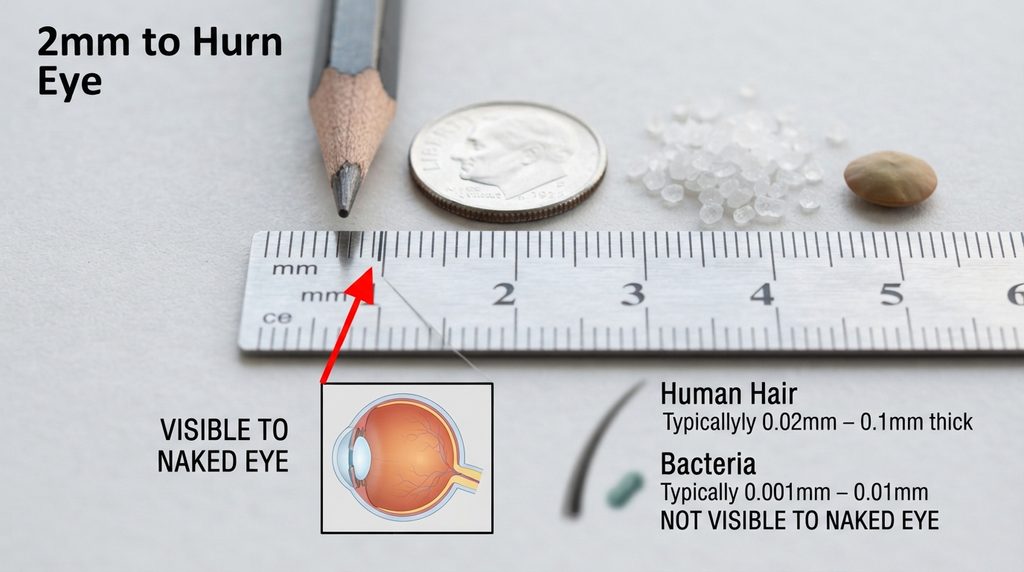
Yes, 2mm is visible.
A 2mm mark, gap, bead, line, or object can generally be seen without magnification. But visibility depends on contrast, lighting, distance, shape, and what you’re looking at.
A black 2mm line on white paper is much easier to notice than a 2mm transparent gap in clear plastic.
This is also why visual comparison can be misleading.
Two objects may have the same numerical dimension but appear completely different because of color, orientation, texture, and surrounding objects.
So when someone asks, “Can you see 2mm?” the practical answer is yes, but the ease of seeing it varies.
2mm Thickness vs. 2mm Diameter vs. 2mm Length
A major source of confusion is the word “2mm.”
It tells you the numerical dimension, but not necessarily what direction you’re measuring.
For example:
2mm length means the distance from one end to another is 2mm.
2mm width means the object spans 2mm across its width.
2mm thickness means the object is 2mm from one surface to the opposite surface.
2mm diameter means a round object measures 2mm straight across its center.
These are different concepts even though the number is identical.
A 2mm-long line might be nearly invisible at a glance. A 2mm-thick metal ring can be very noticeable because it surrounds a much larger space.
Understanding the measurement type is therefore just as important as understanding the number itself.
Why 2mm Matters in Engineering and Manufacturing
It is tempting to think that 2mm is too small to matter.
Engineering says otherwise.
In precision engineering, a few millimeters can determine whether components fit, move, seal, rotate, or withstand stress correctly.
Manufacturers use controlled dimensions for everything from machinery and electronics to eyewear and watches.
A tiny screw needs a compatible hole.
A bearing needs suitable clearance.
A tile needs consistent spacing.
An optical component needs careful alignment.
A piece of jewelry needs enough material to remain durable.
These applications demonstrate why manufacturing tolerances, structural integrity, and precision measurement are important.
A 2mm dimension isn’t automatically “small” from an engineering perspective. Its importance depends on the object around it.
Why 2mm Matters in Jewelry
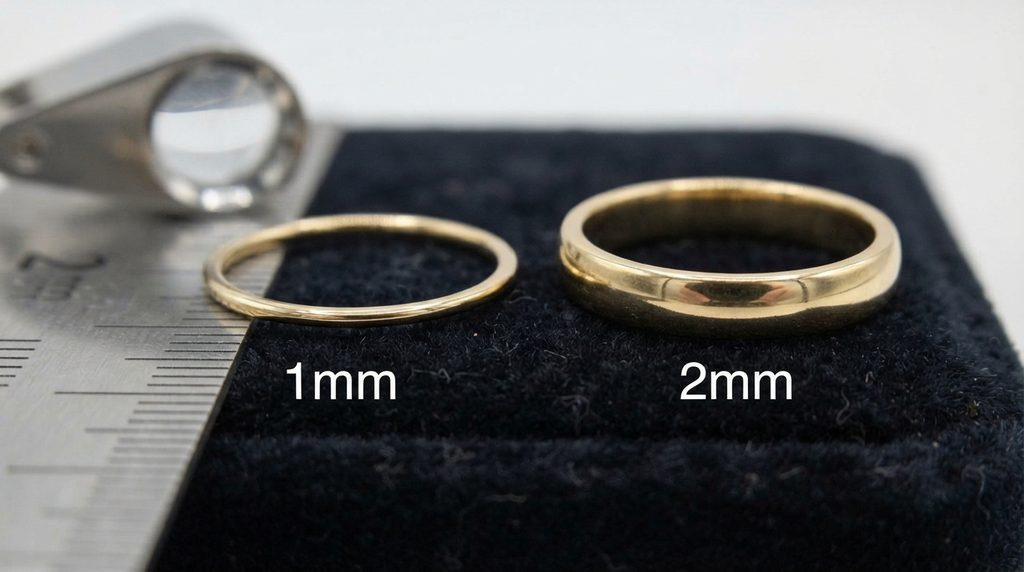
Jewelry is a particularly good example of how small measurements influence design.
A 2mm gemstone can be delicate and understated. A 2mm jewelry band can look minimalist. A 2mm earring component can be comfortable while remaining strong enough for its intended purpose.
Designers think about proportions constantly.
A tiny increase in ring thickness may improve durability. A smaller gemstone may create a subtle sparkle. A slightly wider band may make a piece look more substantial.
In fine jewelry, the difference between 1.5mm, 2mm, and 3mm isn’t merely technical language. It changes the visual personality of the piece.
That is why jewelry listings often provide millimeter measurements instead of relying on words like “small” or “medium.”
Words are fuzzy. Millimeters are not.
Why 2mm Matters in Tile Installation
Tile installation is another area where a tiny measurement becomes visually important.
A 2mm tile spacer can create a consistent gap between tiles, allowing grout joints to remain uniform.
Without consistent spacing, a tiled surface can appear uneven even if the individual tiles themselves are beautiful.
In floor work, wall tiling, bathrooms, kitchens, and other renovation projects, spacing helps control the final appearance.
The funny part is that nobody usually walks into a room and says, “Ah yes, excellent 2mm grout spacing.”
They just think the room looks neat.
That’s what good measurement often does. It quietly creates quality without asking for applause.
2mm in Technology and Miniature Design
Modern electronics are packed with tiny dimensions.
Smartphones, watches, cameras, laptops, earbuds, and other devices rely on miniature components arranged within limited spaces.
A phone’s screen may look like one simple surface, but underneath it are multiple layers and components.
Similarly, a smartwatch combines sensors, batteries, displays, processors, casing, buttons, and mechanical parts in a compact body.
The concept of lightweight design often depends on reducing unnecessary material while preserving durability and impact resistance.
At this scale, a millimeter isn’t merely a unit from a school textbook. It becomes part of the architecture of the product.
A Quick 2mm Visual Reference Table
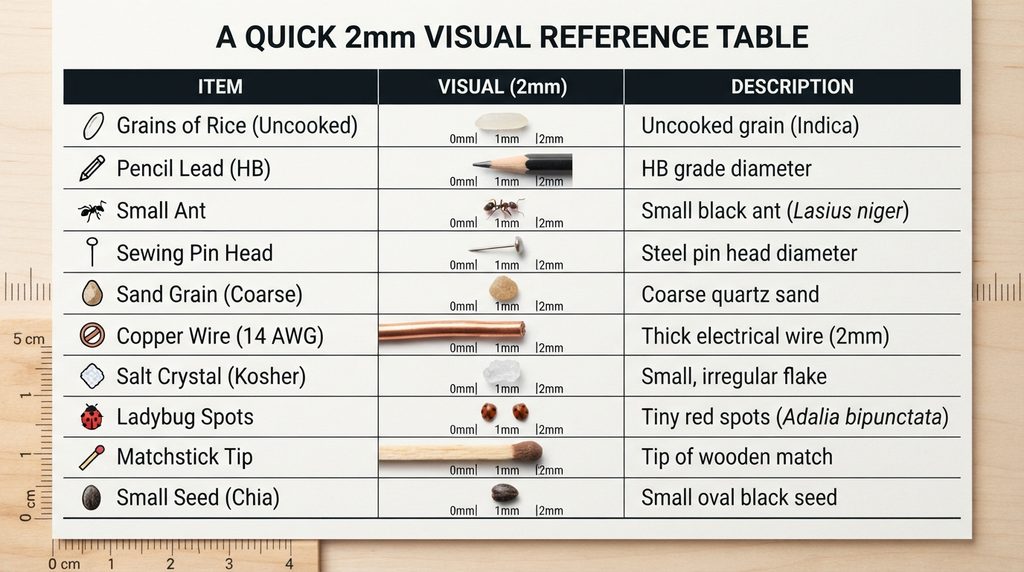
| Comparison | Approximate relationship to 2mm |
|---|---|
| 1mm | Half of 2mm |
| 1.35mm | Smaller than 2mm; close to a dime’s thickness |
| 1.52mm | Slightly less than 2mm |
| 1.95mm | Almost exactly 2mm |
| 2mm | Reference measurement |
| 2.28mm | Slightly larger than 2mm |
| 2.7mm | About 35% larger than 2mm |
| 0.2cm | Exactly 2mm |
| 0.0787 inches | Approximately 2mm |
| 0.002 meters | Exactly 2mm |
These comparisons make the 2mm measurement easier to mentally place, particularly if you’re switching between metric and imperial units.
The Easiest Way to Visualize 2mm
If you remember only one thing, remember this:
2mm is one-fifth of a centimeter.
Look at a metric ruler.
Find one centimeter.
Imagine dividing that centimeter into five equal sections.
One of those sections is 2mm.
That is probably the simplest mental picture.
For another reference, imagine the thickness of a dime at roughly 1.35mm and then imagine something a little thicker. That’s getting closer to 2mm.
Or picture two ordinary ruler tick marks right beside the zero point.
Tiny? Definitely.
Invisible? Not at all.
Frequently Asked Questions
How Big Is 2mm?
2mm is very small—equal to 0.2 centimeters or about 0.079 inches.
What Does 2mm Look Like?
2mm is roughly the thickness of two stacked sheets of paper, depending on the paper type.
How Many Inches Is 2mm?
2mm equals approximately 0.079 inches, making it less than one-tenth of an inch.
Is 2mm Considered Small?
Yes, 2mm is a very small measurement and is commonly used for thin materials, jewelry, and small parts.
How Many Centimeters Is 2mm?
2mm equals 0.2 centimeters, since 10 millimeters make 1 centimeter.
Read This Blog:https://ravonexium.com/standard-dimensions-of-the-us-flag/
Final Thoughts: Putting 2mm Into Perspective
So, how big is 2mm?
It is 2 millimeters, 0.2 centimeters, 0.0787 inches, or 0.002 meters. On a metric ruler, it occupies just two small graduation marks. In everyday life, it sits in that interesting zone where something is undeniably tiny but still large enough to see, touch, manufacture, measure, and design around.
A drafting pencil lead, tile spacer, tiny screw, mustard seed, rice grain, earring component, gemstone, coin thickness, and miniature mechanical part can all help your brain build a better 2mm size reference.
None should automatically be treated as an exact 2mm standard, because objects vary, but together they make the measurement much easier to understand.
The bigger lesson is that measurement is relative to context.
Two millimeters might seem insignificant when you’re looking at a football field. Put those same two millimeters inside a watch mechanism, a piece of jewelry, a smartphone, or a precision-engineered component, and suddenly they’re important.
That is the strange charm of small measurements. A number that looks almost harmless on paper can control the fit of a component, the spacing of a tile, the delicacy of a ring, or the appearance of a tiny gemstone.
So next time someone asks “what does 2mm look like?”, don’t just give them a decimal conversion. Show them a ruler. Show them a tiny screw. Show them a tile spacer. Point toward a little drafting lead or a small seed.
Two millimeters becomes much easier to understand once it stops being only a number and starts becoming something your eyes can recognize.
And perhaps that’s the best purpose of an everyday measurement: not merely telling us how big something is, but helping us actually see it.