There is something quietly powerful about seeing an American flag moving in the wind. It can be hanging outside a small home, standing in front of a courthouse, or appearing at a crowded public event, and somehow its familiar shape still catches the eye.
The United States flag is not simply a piece of cloth measured in feet and inches; its proportions, colors, stripes, and stars have developed alongside the history of the country.
But when someone asks, “What are the standard dimensions of the US flag?” the answer is pleasantly precise.
The official design follows a 10:19 ratio, meaning the flag is 10 units high for every 19 units of length. From a small indoor flag to a huge outdoor banner, that relationship is what keeps the familiar shape looking right.
This guide explores US flag dimensions, common sizes, proportions, flagpole considerations, history, symbolism, and practical display information. There are a few measurements worth memorizing, and thankfully, nobody needs a ruler taped to their forehead to remember them.
| Common US Flag Size | Dimensions (Feet) | Dimensions (Inches) |
|---|---|---|
| Small | 2 × 3 ft | 24 × 36 in |
| Medium | 3 × 5 ft | 36 × 60 in |
| Standard | 4 × 6 ft | 48 × 72 in |
| Large | 5 × 8 ft | 60 × 96 in |
| Extra Large | 6 × 10 ft | 72 × 120 in |
| Very Large | 8 × 12 ft | 96 × 144 in |
What Are the Standard Dimensions of the US Flag?
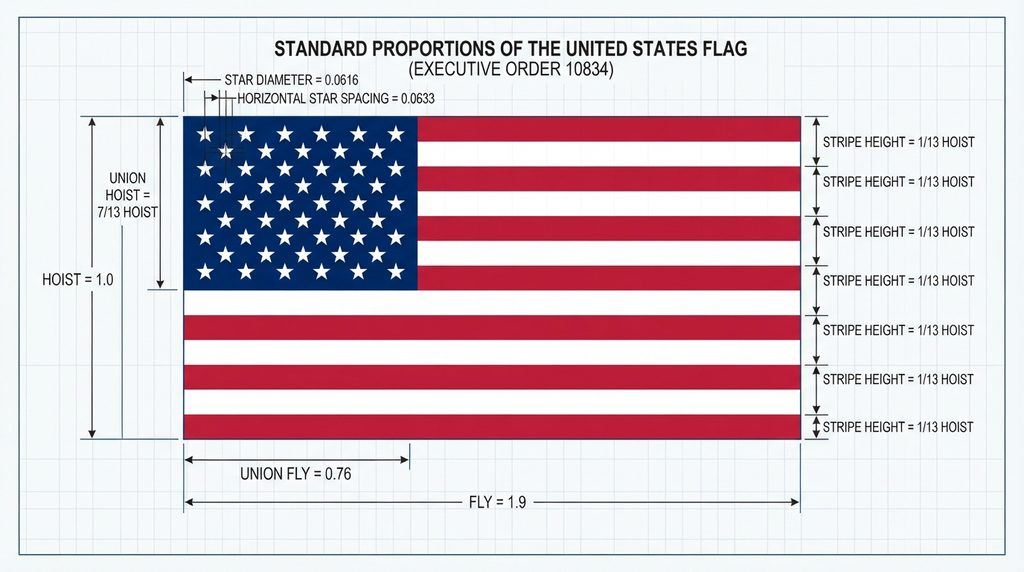
The official Flag of the United States of America has a 10:19 ratio. Its height is 10 units and its length is 19 units. This is the key measurement behind the American flag proportions.
For example, a flag measuring 10 feet high would be 19 feet long. Likewise, a 5 foot high flag would be 9.5 feet long. The ratio stays constant even when the physical flag size changes.
Common examples include:
| Flag dimensions | Approximate ratio |
|---|---|
| 3 × 5 feet | 10:16.67 |
| 4 × 6 feet | 10:15 |
| 5 × 8 feet | 10:16 |
| 6 × 10 feet | 10:16.67 |
| 20 × 38 feet | 10:19 |
One important detail here: many commercially sold flags use convenient retail dimensions such as 3 × 5 or 4 × 6 feet. These are extremely common, but they do not exactly reproduce the official 10:19 mathematical ratio.
The official US flag measurements are governed by a standardized construction specification, including the arrangement of the 13 stripes, the 50 stars, the blue field, and their relative dimensions.
Understanding the 10:19 US Flag Ratio
The US flag aspect ratio is one of those details that seems tiny until you place several flags next to each other. A flag that is too short or too tall can immediately look unusual, even when all the colors and stars are correct.
The flag length-to-height ratio is 19:10. Another way to write it is 1.9:1.
So, if you know the desired flag height, you can calculate the length:
Flag length = flag height × 1.9
If the height is 4 feet:
4 × 1.9 = 7.6 feet
For an official 6-foot-high flag:
6 × 1.9 = 11.4 feet
This is why an exact official-size flag may look slightly different from a standard retail “3 × 5” flag. The latter is based on convenience and common merchandising rather than being an exact expression of the federal proportions.
When ordering a custom American flag, it is therefore useful to ask whether the manufacturer follows the official dimensions or simply uses a conventional commercial size.
Common American Flag Sizes in Feet
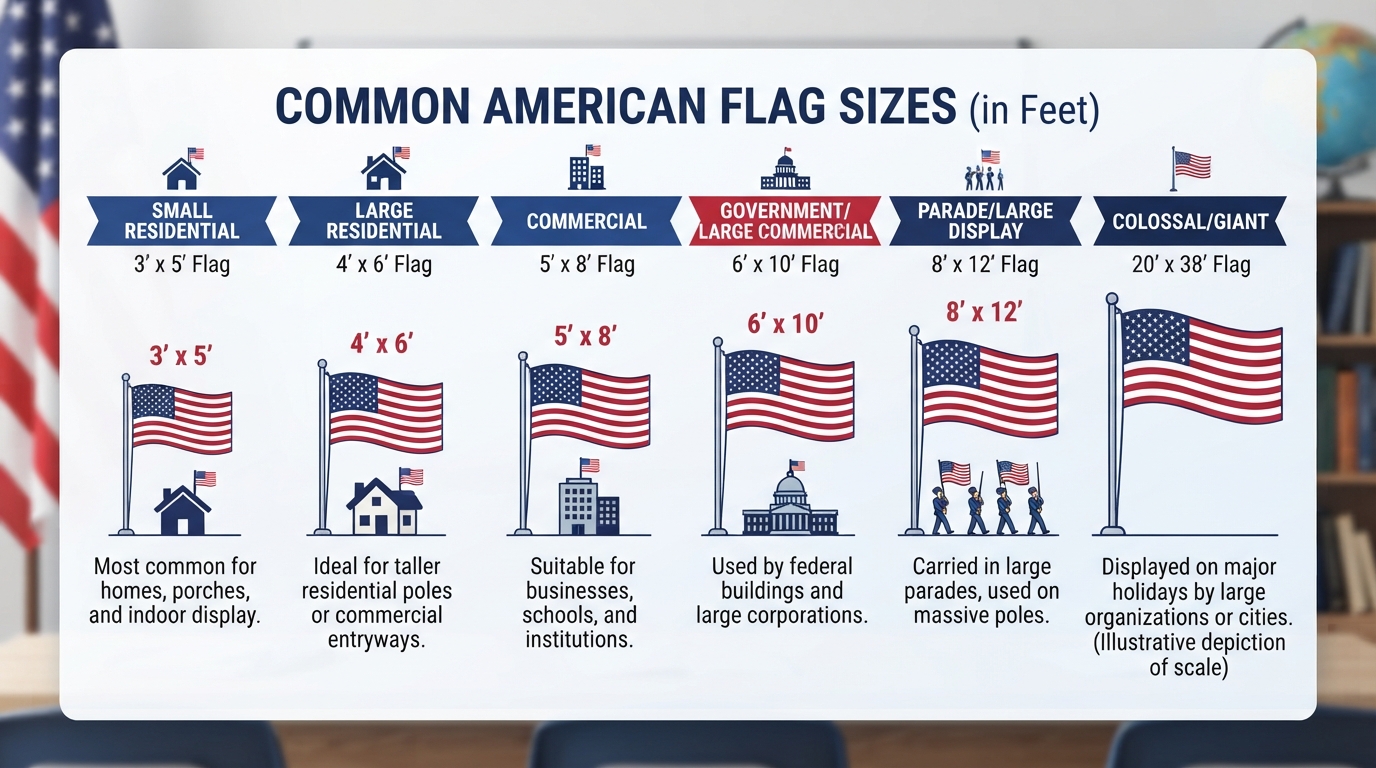
A practical US flag size chart makes choosing a flag much less mysterious. The appropriate size depends on where it will be displayed, how high it will be mounted, and whether it is intended for a home, institution, event, or very large outdoor installation.
Some commonly encountered standard American flag sizes include:
- 3 × 5 feet: Frequently used for homes, offices, classrooms, and indoor presentations.
- 4 × 6 feet: A somewhat larger option for residential or institutional use.
- 5 × 8 feet: Useful where greater visibility is desired.
- 6 × 10 feet: Suitable for larger outdoor flagpoles and public-facing locations.
- 20 × 38 feet: A very large flag intended for major outdoor displays.
These dimensions should not be confused with the exact official 10:19 flag ratio. Retail flags are often manufactured in familiar sizes because they are easier to produce, sell, and replace.
For a custom installation, proportional dimensions should be checked before fabrication. A beautiful fabric, perfect stitching, and brilliant colors cannot rescue a flag whose proportions have gone wandering off on their own little adventure.
American Flag Size for a Flagpole
Choosing the correct flag size for a flagpole is just as important as choosing the pole itself. A small flag on an enormous pole can disappear visually, while an oversized flag on a short pole may appear crowded.
There isn’t one universal flag size for every pole because the appropriate choice can depend on the type of installation, surroundings, wind exposure, and whether the pole is residential or institutional.
For example, commonly discussed outdoor installations may involve:
- A 20-foot flagpole with a moderate-sized residential or commercial flag.
- A 25-foot flagpole where a somewhat larger flag may be appropriate.
- A 30-foot flagpole for more prominent outdoor displays.
- A 35-foot flagpole for larger properties and institutional settings.
- A 100-foot flagpole where a giant flag becomes part of a major public display.
Manufacturers often provide their own flagpole height chart because pole diameter, halyard configuration, finial size, wind conditions, and mounting method can affect the recommended dimensions.
For a specific installation, the pole manufacturer’s guidance should take priority over a generic internet chart. That little bit of checking can prevent an expensive fabric-and-metal mismatch.
American Flag Size for a 20 Foot Pole
A 20-foot flagpole is common in residential and smaller commercial settings, but there is no single mandatory flag dimension simply because the pole is 20 feet tall.
A medium-sized flag such as a 3 × 5-foot or 4 × 6-foot commercial flag may be seen on installations of this general scale, while larger flags can also be used depending on the pole design and manufacturer recommendations.
Wind is another practical consideration. A flag that looks magnificent on a calm afternoon can put considerable force on its mounting hardware during strong weather.
Before selecting an American flag size for a 20 foot pole, check the manufacturer’s recommended flag dimensions and the local wind conditions. The flag should have enough room to fly naturally without overwhelming the pole.
American Flag Size for a 25, 30, or 35 Foot Pole
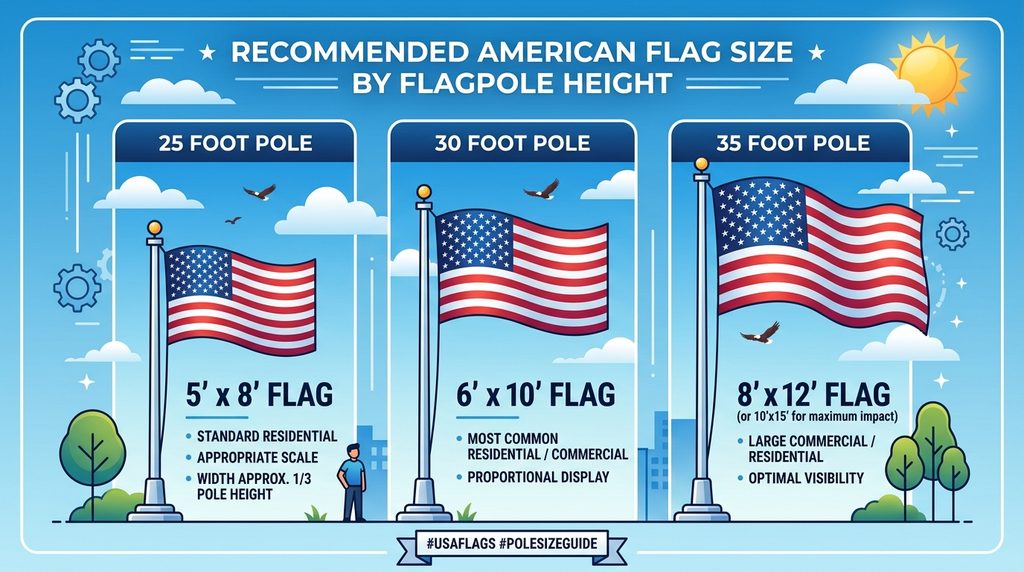
As the flagpole height increases, the flag generally needs to become larger to remain visually proportional and visible from a distance.
A 25-foot flagpole may accommodate a medium or larger outdoor flag depending on its construction. A 30-foot flagpole is commonly used for more prominent commercial or institutional displays, while a 35-foot flagpole can support a still more substantial visual presence.
There is no magic equation that says every 30-foot pole must carry exactly one particular flag. The pole manufacturer, flying conditions, hardware, and intended display all matter.
For a flag size for flagpole decision, think about three things together: pole height, flag dimensions, and available flying space. A flag needs room to breathe, basically.
What Size Is a Standard American Flag for a Home?
For many residential displays, the familiar 3 × 5-foot flag is a practical choice. It is large enough to be recognizable without becoming awkward on a typical house-mounted bracket.
A house flag can be mounted from a porch, wall, balcony, garage, or dedicated pole. The installation method matters because a flag attached to a building behaves differently from one flying freely from a ground-mounted pole.
When displaying US flag indoors, smaller flags are commonly used for offices, classrooms, ceremonies, and decorative civic displays. Indoor flags may be mounted on a flag staff with a suitable stand.
For outdoor residential use, a building mount can make the flag visible from the street while keeping the installation relatively compact.
The 13 Stripes and 50 Stars
The physical dimensions of the flag make more sense when its pattern is understood.
The modern American flag has 13 stripes: 7 red stripes and 6 white stripes. They alternate across the flag.
The stripes recall the original thirteen colonies that became the foundation of the United States.
The upper-left portion is the blue canton, which contains 50 white stars. Each star represents one state.
That means the modern flag brings together two different historical counts in one piece of fabric: 13 stripes and 50 stars. The design can look wonderfully simple from across a football field, yet there is quite a lot packed into it.
The star arrangement is standardized rather than left to the imagination of the person sewing it. The current design contains five rows of six stars alternating with four rows of five stars.
What Do the 13 Stripes Represent?
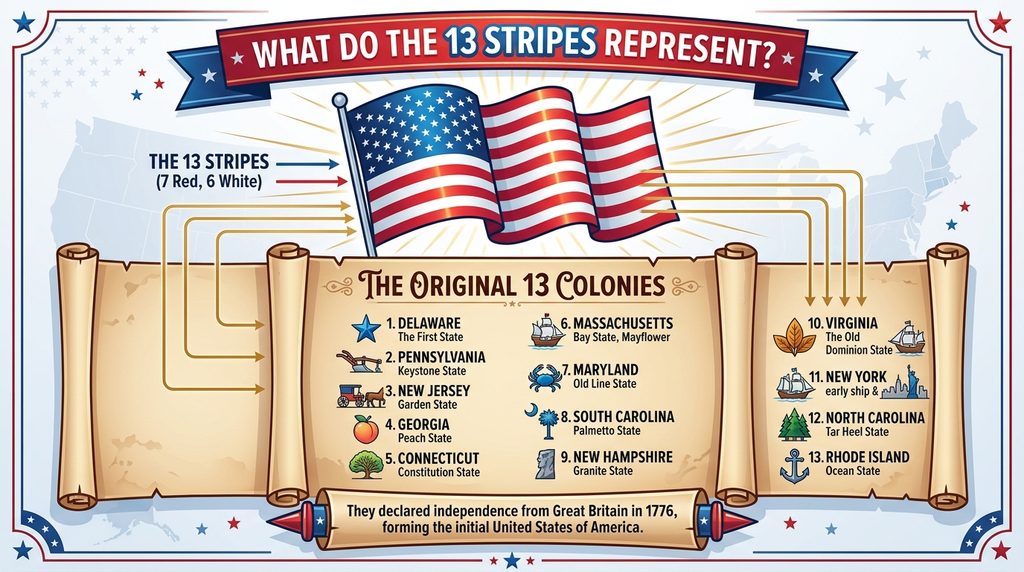
The meaning of 13 stripes reaches back to the country’s founding period. The stripes represent the thirteen colonies that declared independence from British rule and became the first states of the new nation.
The red and white alternating stripes therefore connect the modern flag to the revolutionary era.
The exact symbolic meanings popularly assigned to the colors are sometimes presented in different ways, particularly when people refer to early descriptions and later traditions.
Common interpretations associate red with valor and bravery, white with purity or innocence, and blue with vigilance, perseverance, and justice.
These ideas are widely repeated in American civic culture, although they should not be mistaken for a single simple explanation established at the moment the original flag was adopted.
What Do the 50 Stars Represent?
The meaning of 50 stars is more straightforward. Each star represents one state in the United States.
The 50-star design became official on July 4, 1960, following the admission of Hawaii as the 50th state.
Before that, the American flag changed as new states joined the Union. The current pattern therefore represents the United States as it exists today, while the stripes preserve the memory of its thirteen-colony beginning.
It is a clever bit of visual history: the stripes look backward toward the country’s founding, while the stars reflect its later expansion.
A Brief History of the American Flag
The history of US flag design is considerably more complicated than the familiar Betsy Ross stories sometimes make it sound.
During the American Revolution, several flags were used by American forces and communities. The Grand Union Flag, sometimes called the Continental Colors, combined the thirteen alternating red and white stripes with a canton containing the British Union design.
The Continental Congress adopted the first national flag commonly known as the Stars and Stripes on June 14, 1777.
The identity of the individual who physically designed or first stitched that flag remains historically debated. Francis Hopkinson, a New Jersey Congressman and signer of the Declaration of Independence, is associated with the design through a claim for compensation submitted to the Continental Congress.
The famous story that George Washington personally selected the exact design is much less firmly documented.
Earlier flags, including the Cambridge Flag and what is sometimes called the First Navy Ensign, belong to the wider story of early American flags, but they should not simply be treated as identical to the modern national flag.
The 1818 Flag Law and Changing Stars
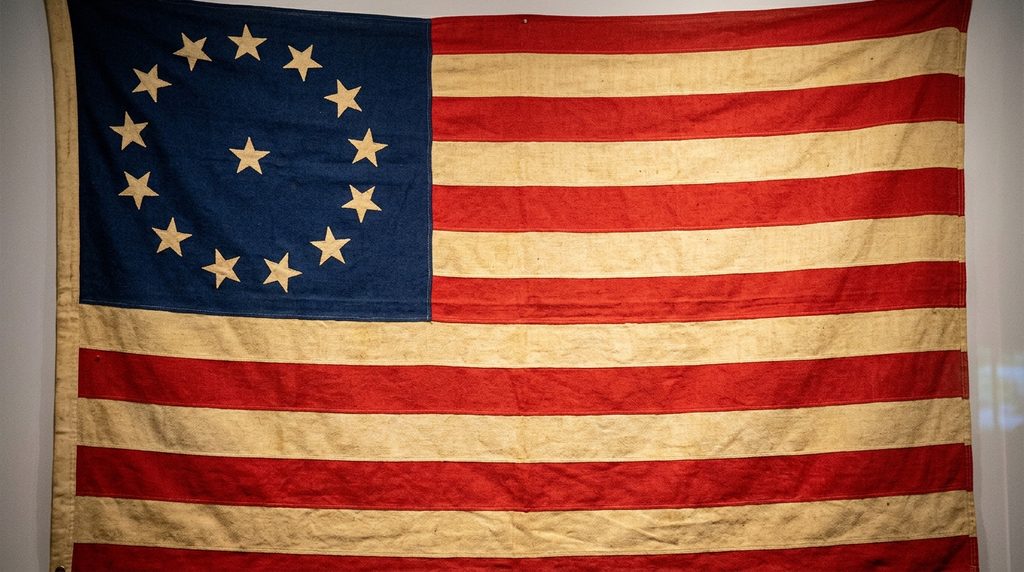
The year 1818 was particularly important in the development of the American flag.
Congress established that the flag would retain thirteen stripes while adding a star for each new state. The idea effectively separated the historical thirteen stripes from the changing number of states represented in the canton.
This became the foundation for the modern approach to flag design.
As America expanded, stars were added. The stripes stayed at thirteen.
That distinction is why today’s 50 star American flag can simultaneously represent the country’s present political geography and its historical beginning with thirteen colonies.
What Do the Red, White, and Blue Colors Mean?
The American flag colors are red, white, and blue, and each has acquired symbolic associations in American civic tradition.
Red is often associated with valor, bravery, and sacrifice.
White is commonly associated with purity, innocence, and ideals of truth.
Blue is frequently connected with vigilance, perseverance, and justice.
These interpretations are especially common in educational and ceremonial contexts. Other discussions of the flag emphasize broader ideas such as freedom, liberty, unity, solidarity, and national identity.
The symbolism can therefore operate on several levels at once. For one person, the flag may represent a family member’s military service. For another, it may represent citizenship or immigration. Someone else may see it primarily as a historical symbol.
Proper Flag Display Outdoors
Knowing the dimensions is only part of responsible flag use. Proper flag display also involves condition, position, lighting, and local or federal etiquette guidance.
When displaying US flag outdoors, people commonly use a dedicated flagpole, wall bracket, or other secure flag mount.
The flag should be kept in good condition. A visibly damaged flag with serious tears or extensive fading may no longer present the dignified appearance generally expected of a national flag.
Traditional U.S. flag etiquette also addresses circumstances such as sunrise, sunset, nighttime display, and proper illumination. When displayed after dark, adequate illumination is generally expected.
The U.S. Flag Code provides guidance on these matters, although much of the code is advisory rather than enforced as criminal law.
Displaying the American Flag Indoors
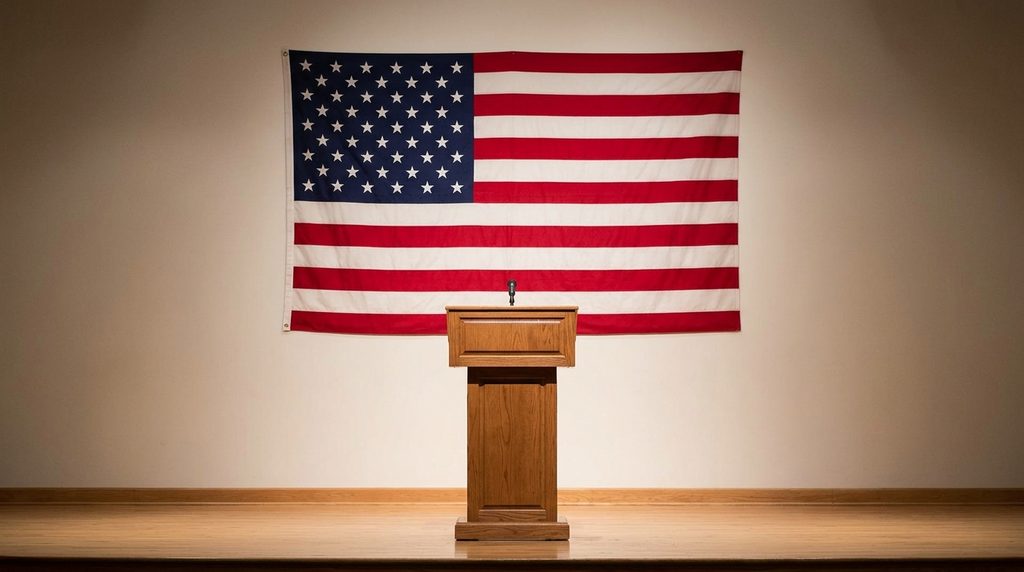
An indoor flag display has a different practical character from an outdoor installation.
In a classroom, office, auditorium, government building, or ceremony, the flag may be placed on a flag staff or stand. Its location can be particularly important when several flags are displayed together.
Traditional etiquette places the U.S. flag in the position of honor, subject to the particular arrangement and circumstances.
For formal events, organizations often follow the U.S. Flag Code as a guide while also considering venue requirements and applicable institutional protocols.
The important thing is that the flag is displayed deliberately rather than squeezed into a corner between a plant and somebody’s forgotten coat.
Flagpole Height and Flag Visibility
A taller flagpole does not automatically mean a larger flag is appropriate.
The surrounding landscape matters. Buildings, trees, streetlights, signs, and neighboring structures can affect flag visibility.
A flag flying high above an open field may need a different size from one mounted beside a two-story building. Wind exposure also increases with height, which means hardware and fabric strength deserve attention.
For a major installation, consider:
- Flagpole height
- Flag width and height
- Flying clearance
- Wind exposure
- Hardware capacity
- Mounting method
- Flag condition
- Visibility from the intended viewing area
This is where a manufacturer’s specifications become especially useful. A generic American flag size guide can provide a starting point, but it cannot inspect your particular property.
How to Choose the Correct Flag Size
If you’re buying a flag and don’t know where to start, don’t panic. The decision becomes easier when you work backward from the display location.
For a house-mounted flag, consider the wall or porch dimensions and choose a manageable commercial size.
For a ground-mounted outdoor flagpole, start with the manufacturer’s recommended flag size. Then consider wind conditions and how prominently you want the flag to appear.
For a public building, event, or large property, a larger flag may be necessary for visibility, but the pole and hardware need to be designed for it.
The basic principle is simple: flag size, pole size, mounting hardware, and environment should work as one system.
Large and Giant American Flags

A large American flag can become an architectural feature rather than merely a decorative object.
Flags measuring dozens of feet across are sometimes displayed at stadiums, government facilities, military sites, memorials, and major public events.
A 20 × 38 flag, for example, is enormous compared with a household 3 × 5 flag. At that scale, fabric weight, wind load, reinforced stitching, specialized hardware, and maintenance become serious engineering considerations.
A giant American flag also needs enough surrounding space to fly safely. Putting an enormous flag beside obstacles creates practical problems that aren’t solved by simply buying stronger fabric.
Large installations should therefore be planned with professional flagpole and rigging guidance.
Flag Condition, Weather, and Maintenance
Even the most carefully made flag eventually faces weather.
Sunlight can cause fading, while rain, snow, dust, pollution, and strong wind can wear fabric fibers. A flag used outdoors may therefore need replacement more often than an indoor flag.
Regularly inspect the flag for:
- Torn seams
- Frayed edges
- Holes
- Faded colors
- Damaged grommets
- Broken mounting hardware
- Excessive fabric wear
A clean, well-maintained flag is easier to display properly and lasts longer.
Weather conditions should also influence whether a flag remains flying. Many flag owners lower or secure flags during severe weather to protect both the fabric and the installation.
Flag Etiquette During Mourning and Special Occasions
The flag is frequently used during special occasions, ceremonies, memorial services, public events, and periods of mourning.
One familiar practice is displaying the flag at half-staff or half-mast as a sign of mourning or respect. Federal proclamations and applicable laws can specify when this should occur.
The U.S. Flag Code also contains guidance about how the flag should be handled during ceremonies and public display.
Because circumstances vary, people organizing a formal ceremony should check the current federal, state, local, or institutional guidance that applies to the event.
Why Flag Proportions Matter
Imagine taking the familiar Stars and Stripes and stretching it until it resembles a very long bedsheet. The stars are still there, the stripes are still there, and technically it may still look recognizable, but something feels off.
That is the importance of US flag proportions.
The official 10:19 ratio provides the visual foundation of the national flag. The relationship between the stripes, canton, stars, and overall dimensions creates the appearance people recognize instantly.
For manufacturers, schools, government facilities, printers, event organizers, and anyone ordering a custom flag, accurate measurements aren’t merely a cosmetic detail.
They are part of reproducing the standardized design.
American Flag Dimensions and Proportions at a Glance
Here is a compact American flag dimensions chart for quick reference:
| Feature | Standard information |
|---|---|
| Overall ratio | 10:19 height to length |
| Stripes | 13 |
| Red stripes | 7 |
| White stripes | 6 |
| Stars | 50 white stars |
| Canton | Blue field |
| Star representation | One star per state |
| Historical stripe representation | Thirteen original colonies |
| Common retail size | 3 × 5 feet |
| Other common sizes | 4 × 6, 5 × 8, 6 × 10 feet |
| Very large example | 20 × 38 feet |
The chart is useful for orientation, but exact official construction involves more detailed specifications than the table can capture.
Frequently Asked Questions
What Are the Standard Dimensions of the US Flag?
The most common US flag size is 3 × 5 feet, making it suitable for homes, offices, and outdoor displays.
What Is the Width-to-Length Ratio of the US Flag?
The official US flag has a width-to-length ratio of 1:1.9, meaning it is nearly twice as long as it is wide.
What Is a Common US Flag Size for a House?
A 3 × 5-foot or 4 × 6-foot flag is commonly used for residential flagpoles and home displays.
What Size US Flag Is Used on a Flagpole?
The appropriate flag size depends on the flagpole height, but 3 × 5 feet is a common choice for smaller residential poles.
Are US Flag Dimensions Standardized?
Yes. The US flag has standardized proportions, while its overall dimensions can vary depending on where and how it is displayed.
Read This Blog:https://ravonexium.com/what-does-50ft-look-like/
Final Thoughts on Standard Dimensions of the US Flag
The standard dimensions of the US flag tell only one part of its story.
The measurements explain how the fabric should be proportioned, but the flag itself carries layers of history that stretch from the American Revolution through the growth of the United States into the nation represented by fifty stars today.
Its 13 stripes recall the beginning. Its 50 stars reflect the present Union. Its red, white, and blue design has accumulated meanings involving courage, sacrifice, liberty, justice, perseverance, and national identity.
For practical use, remember the central figure: 10:19. Then consider where the flag will fly, how tall the flagpole is, what weather it will face, and how visible it needs to be.
A 3 × 5 flag may make perfect sense outside a home, while a huge commercial or ceremonial installation may require a much larger design and professional hardware.
And perhaps that’s the nicest thing about the flag’s dimensions: they are precise without making the object feel cold.
Behind every measurement is a piece of fabric that somebody may raise at dawn, carry into a ceremony, place outside a family home, or unfold at an important national occasion. The numbers give it structure; history gives it meaning.
Whether you’re researching American flag measurements, buying your first house flag, planning a public display, or simply wondering why the Stars and Stripes look the way they do, understanding its proportions makes that familiar symbol a little less mysterious and perhaps a little more interesting too.